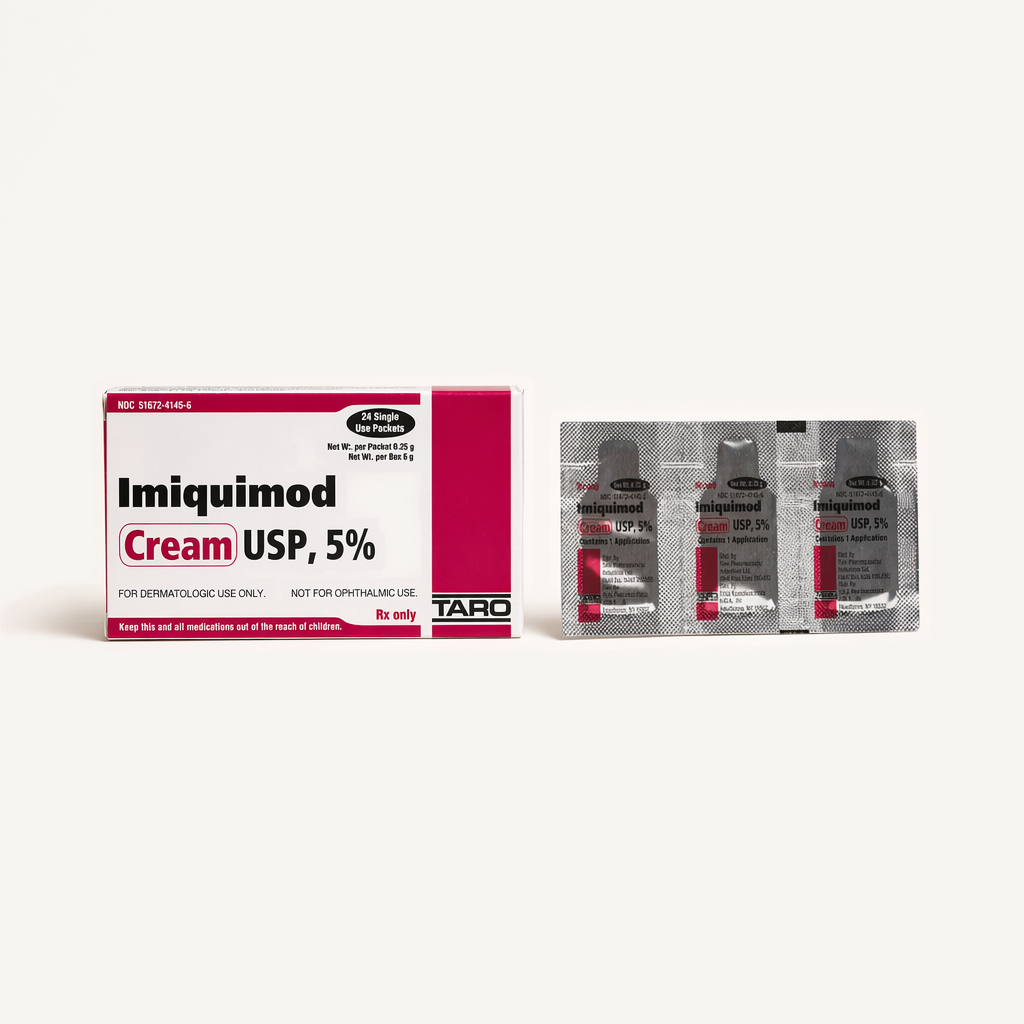
How It Works
Imiquimod is thought to work as an agonist for Toll-like receptor 7 (TLR7), a group of sensors concentrated in the immune system. Imiquimod binding to TLR7 receptors triggers the release of cytokines, messengers for the immune system that act as a signaling device for white blood cells.
After receiving the signal, white blood cells converge on the site of application and work to eradicate abnormal cells. This can cause skin around the application to become red, swollen, or crusty – these are signs the medication is working as intended.
| Quick Facts | |
|---|---|
| Common Brands | Aldara, Zyclara |
| Drug Class | Immune Response Modifier |
| Generic Status | Generic version of Zyclara |
| Availability | Prescription Only |
Dosing
Imiquimod is a topical cream applied directly to the affected skin. Dosage and application schedule depends on the condition being treated, as well as patient factors like age and severity of symptoms. The most common prescribed forms of imiquimod include 5%, 2.5% and 3.75%.
- External Genital and Perianal Warts: To treat external genital and perianal warts brought on by human papillomavirus (HPV), doctors may prescribe Aldara 5% three times per week for up to 16 weeks or whenever the warts have fully cleared. Alternatively, providers may prescribe a daily application of Zyclara 3.75% for up to eight weeks.
- Superficial Basal Cell Carcinoma (sBCC): To treat sBCC, providers frequently prescribe a six-week Aldara 5% course consisting of five applications per week.
- Actinic Keratosis (AK): This condition, characterized as rough or scaly patches of skin brought on by overexposure to the sun, is often treated with two weekly applications of Aldara 5% for a 16-week course. Zyclara 3.75% may be prescribed once daily with an intermittent “two weeks on, two weeks off” schedule to help the body rest.
Note: Dosing information is educational only. Your prescribing physician will determine your specific dose based on your individual health needs. Always follow your healthcare provider’s instructions for exact dosing.
Uses
FDA-Approved Uses
Imiquimod topical cream is FDA-approved to treat typical, nonhypertrophic actinic keratosis on the face or scalp of immunocompetent adults. It is also FDA-approved to treat external genital and perianal warts from HPV, and to treat biopsy-confirmed sBCC on the trunk, neck, and extremities for people who are not good candidates for surgical procedures.
Off-Label Uses
You may see Imiquimod prescribed for uses that are not “FDA-approved.” This is a very common and legal practice called “off-label” prescribing, where a doctor uses their clinical judgment to prescribe a drug for a different (but well-researched) purpose.
Common off-label uses for imiquimod topical cream found in clinical practice and research include:
- Molluscum Contagiosum: Providers may prescribe imiquimod for adults with this condition, which is characterized by small, viral bumps on the skin.
- Bowen’s Disease: This early-stage form of skin cancer may be treated with imiquimod if surgery is not an option.
- Common Warts: Imiquimod can treat stubborn warts on the hands and feet that have not responded to freezing or salicylic acid.
- Lentigo Maligna: Imiquimod may be used to treat lentigo maligna, an early melanoma that may occur in a location that is not convenient for surgery.
Side Effects
Local skin response side effects are common when taking imiquimod – so common, in fact, that they’ve been dubbed the “imiquimod reaction” due to their frequency. Imiquimod reaction side effects around the application site include:
Common Side Effects
- Redness and swelling
- Itching and burning
- Crusting and scabbing
Other side effects can include headache and flu-like symptoms such as fever, fatigue, and muscle aches.
Serious Side Effects
Serious side effects are rare, but it’s important to know what to look for if they do occur. Serious side effects of using imiquimod topical cream include:
- Severe Local Inflammation: Imiquimod reaction is common, but it is advised to contact a provider if you experience deep skin ulcers, significant bleeding, or severe pain around the application site.
- Difficulty Urinating: Swelling of the vulva and urinary opening can lead to pain and difficulty during urination.
- Flu Symptoms: People who use imiquimod may experience a “flu response” with high fever, chills, and body aches.
- Skin Color Changes: Imiquimod can cause permanent lightening or darkening of skin around the application site.
- Severe Allergic Reaction: As with many types of medication, imiquimod can trigger a severe allergic reaction in some people. Hives, itchy skin, and swelling of the face, lips, tongue, and throat are among the most common symptoms of this rare reaction.
Call your doctor immediately if you experience any concerning or prolonged symptoms.
Pharmacist Tips
Take Pre-Application Measures
It is recommended to only apply imiquimod to dry skin, as damp skin can cause irritation. Before applying the cream, it is advised to wash and dry both the application area and both hands.
A Little Goes a Long Way
You only need a thin layer of cream for the imiquimod to be effective. Simply rub the cream into your skin until it is no longer visible. For genital and perianal warts, providers generally recommend rubbing cream into the wart without doing so on the surrounding skin.
Avoid Bandages
It is not advised to cover the application site with a bandage, even if a local skin response occurs. Bandages can trap medication and cause severe burns. Loose gauze is generally seen as the most acceptable covering.
Stay Hygienic
Wash your hands thoroughly after each application. This helps ensure the cream never enters your eyes, nose, or mouth.
Practice Sun Protection
Since imiquimod can cause sun sensitivity, protective layers and high-SPF sunscreen on the treated area are advised when you go outside.
Discard Cream Packets
Throw away used imiquimod packets. Some cream may remain inside the packet, but it will quickly lose its preservatives and effectiveness. It is recommended to open a new packet for each application.
Drug Interactions
Barrier Contraceptives: Imiquimod can weaken the effectiveness of condoms, diaphragms, and other types of barrier contraceptives. This can increase the risk of both pregnancy and transmission of genital warts.
The body quickly absorbs imiquimod, so “pill-to-pill” interactions are not common, but local interactions may still occur.
- Immunosuppressants: Oral steroids, chemotherapy, and other immunosuppressant drugs that lower the immune system may decrease the effectiveness of imiquimod.
- Other Topicals: Medical creams and exfoliants can worsen irritation – sometimes to dangerous levels – if applied to the same spot where imiquimod has been used.
Always give your doctor and pharmacist a complete list of all your medications, vitamins, and supplements to check for potential interactions.
FAQs
Why does my skin look worse after starting imiquimod?
Imiquimod triggers an immune response that causes inflammation around the application site. This is a sign the medication is working properly, but the inflammation can cause reddening, scabbing, and crusting.
How long should I leave imiquimod on my skin before washing it off?
Standard guidelines for using imiquimod recommend leaving the cream on for about eight hours before washing it off. Many people apply the cream at bedtime and leave it on overnight. If treating genital warts, providers may recommend leaving the cream on for six to 10 hours. Leaving the cream on longer than prescribed can cause the skin to break down without treating the condition.
Can I have sex while using imiquimod?
Most providers recommend abstaining from sex while the cream is on the skin. This not only prevents the partner’s skin from becoming irritated, but also because imiquimod compromises the effectiveness of barrier contraceptives like condoms and diaphragms. It is generally advised to avoid sexual contact until the cream has been removed.
Does imiquimod kill the virus (HPV) or just the warts?
Imiquimod does not directly kill viruses. Rather, the medication signals to your body that abnormal cells are present in the skin and natural processes in the immune system are used to eradicate the abnormal cells. HPV may continue to reside in skin peripheral to the original application site, so new warts may appear during treatment.
Is it normal to have a fever while using imiquimod?
Many people experience a flu response after taking imiquimod, with a fever being one of the most common flu response symptoms. If the fever exceeds 101 degrees or is accompanied by chills, it is advised to contact your doctor immediately.
Can I use imiquimod on my face for actinic keratosis?
Yes, imiquimod is FDA-approved to treat actinic keratosis (AK) on the face and is one of the most frequently prescribed medications for doing so. Use the topical cream to treat AKs as directed by your healthcare provider.
Is imiquimod safe to use during pregnancy?
Research is limited on whether imiquimod is safe to use during pregnancy, but many providers encourage pregnant patients to explore other medication options first.
Does imiquimod weaken condoms or diaphragms?
Yes, chemicals in imiquimod topical cream can weaken and destabilize the latex used in condoms and diaphragms. This makes the barrier contraceptives prone to tearing and increases the risk of pregnancy and STD transmission.
Can I go out in the sun while using imiquimod?
Yes, you can go out in the sun while using imiquimod, but the medication causes sunlight sensitivity and extra precautions are strongly recommended. Protective clothing and high-SPF sunscreen can be effective guardrails. If you apply imiquimod to your scalp or face, a wide-brimmed hat is also advised.
Should I cover the treated area with a bandage?
No, it is not recommended to use a bandage to cover an area treated with imiquimod topical cream. Covering can increase how much of the drug is absorbed in the bloodstream and exacerbate swelling and other local skin reactions. Most doctors recommend leaving the area uncovered after applying the topical cream.
Can you put makeup over Imiquimod?
No, it is not advised to wear makeup over imiquimod that has been recently applied and is still actively “working.” Makeup can interfere with the cream’s effectiveness. It is recommended to only put on makeup after the cream has been applied, worn for about eight hours, and washed off.
Comparable Medications
Imiquimod, Podophyllotoxin, or Diclofenac?
Imiquimod topical cream is an immune response modifier that helps the body identify and eliminate abnormal skin cells. Below, we’ll look at two imiquimod alternatives:
Podophyllotoxin
Podophyllotoxin is used to treat genital warts by acting as a cytotoxic agent that kills warts directly. It acts quickly and can clear warts in a matter of weeks, but imiquimod has a lower recurrence rate because it helps the body identify abnormal skin cells.
Diclofenac Sodium Topical Solution
From $49.99
Diclofenac is a topical nonsteroidal anti-inflammatory drug (NSAID) used to treat actinic keratosis. Its side effects are mild compared to imiquimod’s and generally do not produce as much redness or crusting. However, diclofenac schedules tend to be significantly longer and the drug may not be as effective as imiquimod for treating advanced or stubborn precancerous lesions.
We Have Imiquod in Stock. Get Yours Today!
Important: Information on this page is for educational purposes only. Prescribing decisions are made by independent, licensed providers. TelyRx operates technology-enabled pharmacies and a telehealth platform that connects patients with licensed providers. Prescriptions, when provider-approved and issued, are filled and shipped by TelyRx-affiliated pharmacies. We do not employ physicians or make prescribing decisions. Learn more about our editorial standards here.