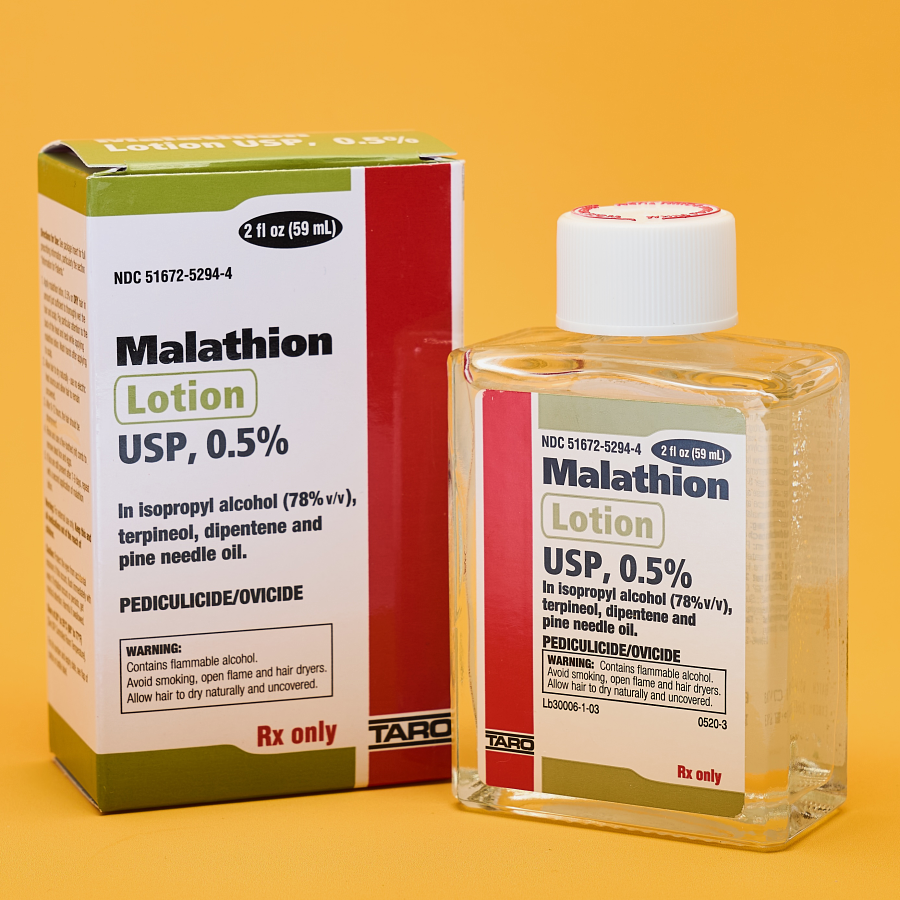
How It Works
Malathion works by disrupting the nervous system in lice. This kills the live lice and their eggs (ova) to eliminate the infestation.
| Quick Facts | |
|---|---|
| Common Brands | None |
| Drug Class | Topical pediculicide, antiparasitic agent |
| Generic Status | Generic is available |
| Availability | Prescription only |
Dosing
Malathion lotion is typically applied once. It is generally recommended to massage just enough of the medication into the dry hair to ensure that the scalp and the hair, including the back of the neck and head, become thoroughly wet.
Once applied, the lotion should be left in the hair and allowed to air dry naturally for 8 to 12 hours. After that time period, shampoo and rinse the hair thoroughly. It is recommended to follow the treatment by working through the hair with a fine-toothed comb to manually remove any remaining dead lice and eggs.
If live lice are still observed 7 to 9 days after the initial application, a healthcare provider might recommend repeating the treatment process.
Note: Dosing information below is educational only. Your prescribing physician will determine your specific dose based on your individual health needs. Always follow your healthcare provider’s instructions for exact dosing.
Uses
FDA-Approved Uses
Malathion is FDA-approved to treat infestations of head lice and their ova (eggs) in the scalp hair.
Off-Label Uses
You may see malathion prescribed for uses that are not “FDA-approved.” This is a common and legal practice called “off-label” prescribing, where a doctor uses their clinical judgment to prescribe a drug for a different (but well-researched) purpose.
There are currently no common off-label uses for malathion.
Get Savings Updates for Malathion
Join our mailing list for exclusive deals and more.
Side Effects
Like all medications, malathion can cause side effects. Some common side effects may improve over time as your body adjusts to the medication. Other side effects may be serious and require medical attention.
Common Side Effects
- Skin irritation
- Skin redness
Serious Side Effects
Serious side effects are rare, but it’s important to know what to look for if they do occur. Stop using malathion and call your doctor immediately if you experience:
- Severe allergic reactions: Symptoms include swelling of the face, lips, tongue, or throat; difficulty breathing or swallowing; racing heart; severe rash or itching; and/or fever.
- Chemical burns: While rare, topical malathion may cause chemical burns. Symptoms include stinging or irritated skin and second-degree burns. If severe irritation occurs, stop applying malathion. If the irritation clears, you can try applying the malathion. However, if the irritation returns again, stop applying, wash off any lotion you’ve applied, and contact your healthcare provider.
- Overdose: If too much malathion is applied or absorbed, overdose symptoms may occur. These can include stomach cramps, diarrhea, nausea, vomiting, unusual weakness, clumsiness, dizziness, fainting, slow heartbeat, pinpoint pupils, convulsions, or loss of bladder and bowel control. Call 911 or Poison Control at (800) 222-1222 if you or someone you know is showing signs of overdose.
Call your doctor immediately if you experience any concerning or prolonged symptoms.
Pharmacist Tips
Avoid Heat and Open Flames
Topical malathion is highly flammable, meaning it can catch fire easily. It is strongly recommended to keep your hair away from open flames, cigarettes, hair dryers, electric straighteners, and curlers before, during, and after using the medicine. Let your hair air dry.
Protect Your Eyes and Face
Keep the medication away from your eyes, eyelashes, ears, nose, mouth, lips, and vagina. You may keep your eyes closed while applying it. If malathion gets into your eyes, flush them immediately with water.
Wash Your Hands Before and After Applying
Wash your hands thoroughly after handling and applying the lotion to prevent accidentally spreading the medication to other areas of your body.
Wash All Recently Used Linens and Clothing
It’s recommended to wash any clothing, hats, accessories, towels, or bedding that you’ve used while using malathion in hot water. Dry these items on a high heat setting.
Dry Clean or Seal Non-Washable Items
Personal care items like combs or hair clips should be washed in hot water. Items that can’t be washed should either be dry-cleaned or sealed in a plastic bag for a minimum of 2 weeks to reduce the likelihood of reinfestation.
Check for New Lice Every Few Days
For the next few weeks, check your hair with a nit comb to make sure no new lice appear.
Drug Interactions
Currently, there are no known or expected interactions between topical malathion and other prescription medications, over-the-counter drugs, or dietary supplements. There are also no known interactions with foods or drinks.
Always give your doctor and pharmacist a complete list of all your medications, vitamins, and supplements to check for potential interactions.
FAQs
Why does the bottle say this lotion is flammable?
The lotion contains ingredients that are flammable, which means the product can easily ignite and catch on fire if exposed to a heat source while wet. It is strongly recommended to avoid heat or open flames during malathion application and while waiting for it to air dry on the hair.
Can I use a hair dryer or curling iron after applying malathion?
It is strongly advised to avoid using hair dryers, electric curlers, straighteners, or any direct heat sources after applying malathion because the medicine is highly flammable.
Does malathion kill the lice eggs (nits) or just the live bugs?
Malathion is capable of killing live lice and some of their eggs, which are known as nits or ova. However, it may not kill every egg present. That’s why it’s recommended to use a comb to manually remove any remaining nits 8-12 hours after you’ve applied malathion and washed your hair.
Why do I have to leave malathion on for 8 to 12 hours?
Leaving the treatment on for 8 to 12 hours gives the medication enough time to work and kill the lice and eggs.
Why does this medication smell so bad?
Malathion has a strong odor due to the chemicals it contains.
Can I use malathion for pubic lice (crabs) or scabies?
Malathion is only FDA-approved for head lice, not pubic lice or scabies. Your healthcare provider can prescribe the appropriate treatment for these other conditions.
Do I still need to comb out the nits if malathion kills them?
Yes, manual removal is typically recommended. Because the medication may not kill all the eggs, providers may suggest using a fine-toothed nit comb to remove both dead lice and remaining nits.
Is it safe to use malathion if I am pregnant or breastfeeding?
Malathion has not been studied in human pregnancies. It is unknown if it can cause harm to an unborn baby or if the medication passes into breast milk, so risk cannot be ruled out. Ask your healthcare provider if this treatment is an appropriate option for you while pregnant or breastfeeding.
Why is malathion considered an “organophosphate,” and is that dangerous?
Malathion is classified as an organophosphate insecticide and can be toxic in high doses or when applied improperly.
Can I use conditioner or styling products before applying malathion?
It’s recommended to avoid washing your hair with conditioner, or using a combination shampoo-conditioner product, immediately before applying malathion.
What should I do if the lotion gets in my eyes?
If malathion lotion accidentally gets into your eyes, immediately and gently flush your eyes with water to prevent burning, stinging, or irritation.
How long should I wait before applying a second treatment?
If live lice are still observed in the hair, a second application may be recommended 7 to 9 days after the initial treatment. Consult your healthcare provider if you still see live lice.
Does this medication work on “super lice” that are resistant to other treatments?
Yes, malathion is designed to work on “super lice.”
Can I cover my head with a shower cap while the medicine is working?
In general, it’s recommended to leave your hair uncovered so it can air dry naturally while the medication is working.
Why is this medication prescription-only in the U.S.?
Malathion is a prescription medication in the U.S. because it requires medical supervision to use safely and to monitor for potentially serious side effects, such as chemical burns or severe allergic reactions.
Does malathion expire or lose effectiveness if the bottle is old?
Yes, malathion can expire and lose effectiveness. Check the expiration date on your bottle.
Can I go to sleep with the lotion on my hair?
Yes, you may sleep with it on your hair. It’s important to remember to keep the hair away from any open flames or heat sources while it dries.
Comparable Medications
Malathion, permethrin 1% (Nix), spinosad (Natroba), or ivermectin?
There are several medications that your doctor can prescribe in place of malathion. Here are a few possible alternatives below.
Permethrin
From $34.99
A topical antiparasitic medication used to treat head lice and scabies.
Spinosad
From $359.99
A topical antiparasitic medication used to treat head lice.
Ivermectin – Lice
From $79.99
An oral medication that may be used off-label to treat head lice.
We Have Malathion in Stock. Get Yours Today!
Important: Information on this page is for educational purposes only. Prescribing decisions are made by independent, licensed providers. TelyRx operates technology-enabled pharmacies and a telehealth platform that connects patients with board-certified licensed providers. Prescriptions, when provider-approved and issued, are filled and shipped by TelyRx-affiliated pharmacies. We do not employ physicians or make prescribing decisions. Learn more about our editorial standards here.