Waking up with itchy skin or red bumps may understandably make you feel nervous and eager to identify the cause of your symptoms. Scabies, bed bugs, chiggers, eczema, and other skin conditions can look similar, especially if you aren’t familiar with them.
While receiving one of these diagnoses may feel alarming, they are all treatable and more common than you may think. Studies show that over one million people in the U.S. experience scabies every year. Keep reading to learn what scabies is, the symptoms it causes, and how to differentiate between scabies and other causes of bumps, rashes, and itchy skin.
What Is Scabies?
Scabies is the name of the condition that happens when a microscopic mite called Sarcoptes scabiei, or the human itch mite, burrows into human skin. When people get scabies, their skin generally itches and develops a rash with bumps that look similar to pimples. Scabies is a common condition around the world, and is usually transmitted through physical contact with someone who has it.
Although learning you have scabies may feel upsetting, it is a normal condition that can be easily treated with a prescription cream. Scabies takes 4 to 8 weeks to develop, so it’s important that anyone you live with or have been in close physical contact with also gets treated. Scabies is usually identified by the appearance of its rash, which often occurs between fingers, in skin folds, or on genitals, the waist, or buttocks.
How To Identify Scabies: Scabies vs. Common Rashes
Although scabies can be easily confused with rashes and skin infections, there are ways to tell the difference among these similar-looking skin disorders.
| Contagion | Visual Cues | Typical Locations | |
| Scabies | Microscopic mites (Sarcoptes scabiei) | Rash made up of small, red, itchy bumps and thread-like tracks | Skin folds, including between fingers, under breasts, genitals, elbows, or knees |
| Bed bugs | Tiny insects (Cimex lectularius) | Small, raised, red, itchy bumps with dark red centers that may be in a line or zig-zag formation | Anywhere skin was touching the bed, such as arms, legs, face, and back |
| Chiggers | Microscopic mite larvae (Trombiculidae) | A line of small, itchy, red bumps, often found along or beneath a clothing seam | Ankles, legs, behind the knees, beneath a waistband or another area where clothing fits tightly |
| Contact dermatitis | Allergens, which can include plants, metals, makeup, perfume, and more | A red, itchy rash, patches of darkly pigmented skin, cracked or scaly skin, or blisters that may leak fluid or crust over | Anywhere the skin came into contact with an allergen, which can be different for every individual |
| Eczema | A combination of genetics and triggers in the environment | A dry, scaly, flaky rash that looks pink or red on light skin and brown, purple, or gray on dark skin | On the hands, face, eyelids, neck, and behind the knees |
| Hives | Often unknown, but can be triggered by allergies, stress, exercise, hot or cold temperatures, or an infection | Raised bumps or welts on the skin that itch, feel warm, and are red or skin-colored | The back, chest, abdomen, buttocks, upper legs, and upper arms |
| Ringworm | Fungi, such as Trichophyton, Microsporum, and Epidermophyton | Itchy, ring-shaped scales that may look pink and remain flat, except for a raised edge | The feet (athlete’s foot), the groin (jock itch), the scalp, fingernails and toenails |
| Shingles | Varicella-zoster virus | A stripe of itchy and painful red blisters that may break open and crust over | The right or left side of the torso |
This table is a general guide outlining how these skin disorders most commonly appear, and why they happen. Your unique situation may be different. Speak with a doctor if you have a rash or skin irritation that you cannot identify.
Scabies vs. Other Common Bug Bites

Although scabies is caused by microscopic mites burrowing into the skin, many people believe its appearance resembles small bug bites. For this reason, scabies is commonly mistaken for bed bug bites and chigger bites, and vice-versa. Figuring out which mite or insect caused your rash is important, because the underlying cause determines what treatment you need.
Scabies vs. Bed Bugs
Likely bed bug scenario: You recently stayed in a hotel, hostel, dorm, or other accommodation
Unlike scabies, which are mites, bed bugs are insects that feed on human blood and live on furniture or mattresses. People often get bed bugs while traveling. The presence of bed bugs doesn’t necessarily reflect the quality of a place because even five-star hotels can have bed bugs.
If you have a rash and are trying to decide between bed bugs vs. scabies, there are some ways to tell. Bed bug bites usually first appear in the morning after you wake up, especially while traveling. Bed bugs bite a few times in a row, so they may leave a line, zig-zag, or cluster of individual, raised red bumps. On the other hand, mites that cause scabies burrow beneath the skin, which can cause raised lines, bumps that look like pimples, and scaly skin that spreads out into a rash.
Once bed bugs are finished biting, they don’t stay on a person. You could get more bites another night if bed bugs are still in the bed you’re sleeping in, but otherwise, the red bumps won’t continue to spread. That’s a difference when comparing bed bug bites vs. scabies, because scabies continue to spread over the skin until it is treated. Both scabies and bed bug bites itch, but scabies tends to produce more intense itching, and the itching might get worse at night.
Bed bug bites generally heal on their own, but a topical cream can reduce itching, redness, and inflammation. If you have bed bug bites, it’s important to take action so you don’t get bitten again. Wash bedding in hot water and dry on the highest heat setting to kill bed bugs. Examine the mattress, furniture, and nearby carpeting and curtains to look for bed bugs hiding along seams or in crevices. Vacuum the area, and call in pest control if you find a severe infestation.
Scabies vs. Chiggers
Likely chiggers scenario: You were recently near or in tall grass or wooded areas, especially near a body of water or in warm weather
Chiggers are the larvae of a mite called Trombiculidae. Unlike the mite that causes scabies, chiggers do not burrow into the skin, nor do they spread from person to person. Instead, chiggers live in grasses and woods, often near water, and tend to bite humans who spend time outdoors in these areas during warmer weather.
Skin appearance helps clarify the difference between chiggers vs. scabies. Chigger bites cause individual blisters that look quite different from a spread-out scabies rash. The blisters itch immensely. Using an anti-itching cream may be helpful, especially since scratching the blisters too much can cause them to break open and create an infection risk.
A treatment beyond anti-itching cream usually isn’t necessary for chiggers, unless an infection develops. Using bug spray that contains DEET and wearing protective clothing when outdoors, such as tall socks with long pants, can help prevent future chigger bites.
Scabies vs. Allergic Skin Reactions

People commonly mistake scabies for an allergic skin reaction, specifically contact dermatitis or a reaction to poison ivy or poison oak. It’s important to know whether scabies is present or if an allergy is causing the rash because the treatments are different.
Scabies vs. Contact Dermatitis
Likely contact dermatitis scenario: You touched something you’re allergic to, or wore jewelry, makeup, or a fragrance that you’re allergic to
Contact dermatitis is a rash that develops after you touch something you have an allergy or sensitivity to. People are commonly allergic to metals like nickel, specific plants, latex, or ingredients in makeup or fragrances. People may be sensitive to hair dye, cement, shampoo, or pesticides. A person can experience contact dermatitis after touching something that didn’t bother them in the past, and the reaction may appear a day or two later.
When comparing contact dermatitis vs. scabies, it’s important to know that both can produce an itchy rash. With contact dermatitis, the intensity of itchiness tends to stay the same over time, while scabies tends to become itchier at night. Contact dermatitis develops where the body touched the allergen or irritant and stays in that place, whereas scabies often forms in skin folds and spreads over time. Contact dermatitis often causes pinkness or redness over an entire area, and may cause blisters within that, while scabies causes scattered red bumps and short lines or waves.
The treatment for contact dermatitis depends on how severe it is. Often, washing and moisturizing the area is a first step. Topical corticosteroid medication, anti-itch cream, or both may also be recommended.
Scabies vs. Poison Ivy Or Poison Oak
Likely poison ivy or oak scenario: You touched either plant while spending time outdoors
About 85% of people are allergic to poison ivy and poison oak plants. For these people, touching either plant prompts a rash that is considered a specific type of contact dermatitis, but is more severe than many other forms of contact dermatitis due to a plant oil called urushiol.
While both scabies and poison ivy and oak reactions cause an itchy rash, there are differences. In addition to itching, poison ivy and poison oak rashes often burn, sting, and cause more pain than scabies. Also, the itchiness stays fairly consistent, while scabies tend to itch more at night.
The rash location can also be different with poison ivy vs. scabies. A poison ivy or oak rash usually only develops on skin that was exposed while a person was outdoors, like the legs or arms. Scabies can develop anywhere, even beneath clothing, and tends to begin in the body’s skin folds, such as between fingers or in the armpits.
Treatment of poison ivy and poison oak begins with removing and washing all clothes that might’ve touched the plant and cleaning the skin with dish soap and cool water. Sometimes an over-the-counter topical cream is enough to manage the rash, but in other cases, antihistamines or corticosteroids may be recommended.
Scabies vs. Other Common Rashes
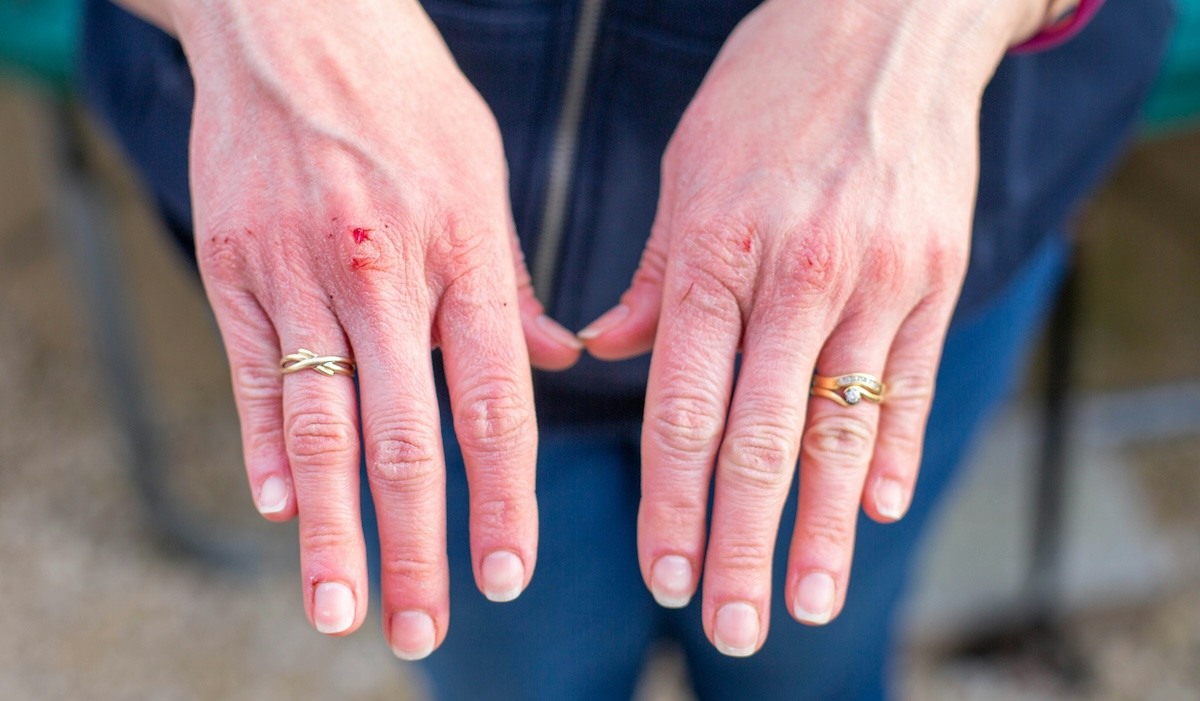
Scabies may be difficult to differentiate from multiple other skin conditions, including eczema, shingles, ringworm, and hives. As with bug bites and allergic reactions, identifying the underlying cause is important because treatments differ.
Scabies vs. Eczema
Likely eczema scenario: You’ve recently been under more stress or come into contact with an environmental trigger for you, like smoke, pollution, dry air, wool, or harsh personal care products
Eczema is a skin condition that can result from a combination of genetics and environmental triggers. Eczema can cause itchiness, redness, and swelling, which is why some people confuse it with scabies.
When trying to determine eczema vs. scabies, the appearance of the rash can help. Scabies usually causes noticeable red bumps, as well as small red lines or waves. In contrast, eczema tends to look dry and scaly. The location of the rash may also differ. Scabies tends to form between the fingers, in the armpits, and in skin folds around the waist. Eczema is most common in the elbows, behind the knees, and on the face, neck, and hands.
Itchiness can also differ between a scabies rash vs. eczema. Eczema may itch on and off all day and night, while scabies becomes less itchy during the daytime and more itchy at night. Eczema may be treated with creams, medication, light therapy, skincare, and the avoidance of known triggers, like certain foods, soaps, and fabrics. Reducing stress may also help with eczema.
Scabies vs. Shingles
Likely shingles scenario: You had chickenpox earlier in life and the virus was reactivated due to stress, a weakened immune system, or unknown causes
While some people mistake shingles for scabies or vice-versa, these rashes have very different causes. The varicella-zoster virus, which is also the cause of chickenpox, leads to shingles. Most people get this virus in childhood when they get chickenpox, then it remains dormant for decades. Shingles occurs when the virus is reactivated. Older age, stress, and a compromised immune system all may make shingles more likely to develop.
When comparing shingles vs. scabies, there are multiple factors that make shingles distinguishable. While a scabies rash tends to form in skin folds, a shingles rash is often on one side of the torso or, less commonly, on the face. A shingles rash contains blisters that often scab over and may be accompanied by other symptoms, like a headache, fever, chills, and stomachache.
Shingles is generally treated with antiviral medication. This medication can’t cure the virus, but it can shorten the length of a shingles attack. There is also a shingles vaccine, called Shingrix, which can help prevent shingles.
Scabies vs. Ringworm
Likely ringworm scenario: You have recently walked barefoot in a communal shower or locker room, participated in contact sports like wrestling, or been in close contact with a person or animal with ringworm
Despite its name, ringworm is a fungal infection, not a worm. For this reason, ringworm is treated with an antifungal medication. In mild cases, an over-the-counter cream is sufficient, but in moderate to severe cases, a topical or oral prescription-strength medication is needed. Like scabies, ringworm is contagious.
A ringworm rash is often ring-shaped, which makes it stand out from a scabies rash. A scabies rash usually doesn’t take a circular shape. Also, scabies often causes pimple-like bumps in the rash, while a ringworm rash is mostly flat with a raised outer edge.
Ringworm can occur on the torso, neck, arms, or legs. When ringworm develops on the feet, it’s called athlete’s foot. When ringworm develops on the groin, it’s called jock itch. Ringworm can also infect toenails or fingernails.
Scabies vs. Hives
Likely hives scenario: You have recently been under more stress, are facing an infection, or have come into contact with a trigger for you, like exercise, an allergen, or extreme temperatures
Hives are non-contagious welts on the skin. These welts are usually large, raised spots that may be pink, red, or skin-colored. Usually, hives can be distinguished from a scabies rash, which includes smaller, red bumps that look like pimples. Scabies also has characteristic small lines or waves within its rash, which hives do not have. With hives, individual welts tend to raise and fade over the course of hours or a day, whereas scabies bumps stick around until treated.
Hives are prompted by an immune system reaction. While they can be part of an allergic reaction, they can also occur in response to stress, extreme temperatures, exercise, infections, or an underlying condition. In many cases, a person may not know what caused their hives.
Hives are often not serious and can be treated with over-the-counter antihistamines. But in some cases, hives are part of a severe allergic reaction called anaphylaxis. If, in addition to hives, you experience swelling in the lips or tongue, shortness of breath, wheezing, coughing, dizziness, nausea, diarrhea, or a sense of doom, seek immediate emergency medical care.
How To Treat Scabies
Scabies typically requires prescription treatment to eliminate the mites. Without treatment, the infestation often persists and may continue to spread to others . The following treatments are most commonly prescribed for scabies:
- Permethrin cream: This cream contains 5% medication and is meant to be applied all over the body, from the neck down. One application may be enough to resolve scabies, but often two or more are recommended.
- Oral Ivermectin: Although creams are more commonly prescribed for scabies, ivermectin provides an oral option. People generally need to take two doses of the drug, a week or two apart.
Other creams are sometimes also prescribed for scabies, depending on a person’s unique situation, including spinosad and malathion.
FAQs About Scabies
Do chiggers actually burrow under the skin like scabies mites?
Despite what people often say, chiggers do not burrow under the skin like the mites that cause scabies. Chiggers are also a mite, but their larvae bite human skin with their sharp mouths. They then inject a digestive enzyme into the skin. This enzyme kills skin tissues, making it possible for the chigger larvae to drink in skin cells.
Do bed bug bites or chiggers spread from person to person like scabies?
Unlike the mites that cause scabies, chiggers do not spread from one person to another, and the rash they cause is not contagious. Bed bugs also do not spread directly from person to person, but they can spread by traveling on people’s belongings. For example, a bed bug could be on someone’s clothing, in their luggage, or on their furniture, and then spread to another person who comes into contact with that infested object.
Can scratching an eczema patch look like scabies burrows?
Scratching an eczema patch with fingernails could create small lines that resemble the lines caused by burrowing mites in scabies. Fingernail scratches are more likely to be longer and straight, whereas scabies burrows are very short and may look wavy or like they zig-zag. Also, fingernail scratch marks would only appear where a person had scratched their skin, but scabies lines can develop anywhere.
How does the treatment for a fungal ringworm infection differ from treating scabies?
Because ringworm is caused by a fungus, it must be treated with a topical antifungal cream applied to the rash and just outside of its edges. This cream kills the fungus and allows the skin to recover. In contrast, scabies is caused by a mite and must be treated with a topical scabicide cream, which is an antiparasitic cream that must be applied to the entire body. Sometimes, an oral antiparasitic medication is also recommended for scabies.
If my partner or family members aren’t itching, does that automatically rule out scabies?
No, if one person is diagnosed with scabies, everyone they have been in close contact with may also need to be treated. This includes household members and sexual partners. Scabies can take weeks to develop after being exposed, and if only one person is treated, the infestation could keep moving from person to person.
Can you have a scabies infestation without any visible skin burrows?
In rare cases, a person may have scabies without the clear, visible signs. This is called scabies incognito, and it’s more common among people who are on a corticosteroid or have a compromised immune system. People with scabies incognito are still highly contagious and require treatment.
Can using steroid creams mask scabies symptoms and make the mites harder to detect?
Yes, regularly using a topical steroid cream can mask the symptoms of scabies, leading to scabies incognito. The steroid cream may reduce or eliminate the visible symptoms of scabies, but it doesn’t address the mites causing scabies. That means the underlying problem is still present and it can become more severe than visible scabies, because the mites continue to reproduce.
What is scabies commonly mistaken for?
Scabies is commonly mistaken for bug bites, like bed bug bites and chigger bites. Scabies is also commonly mistaken for allergic skin reactions, poison ivy and poison oak, eczema, shingles, ringworm, and hives.
Your Next Steps
If you are dealing with an itchy, red rash, your ideal next steps are to identify the cause of the rash and receive the appropriate treatment. Some people are able to figure out the cause of a rash on their own, but seeing a doctor may be necessary if you cannot identify the rash. In cases where it’s difficult to determine the cause of a rash, a doctor can scrape the skin and view it under a microscope to check if there are mites or fungi present.
If you do have scabies, treating the parasite is necessary because scabies cannot resolve without treatment. An online pharmacy platform can be a convenient way to receive your prescription scabies treatment. Be sure that your platform of choice is certified and safe. For instance, TelyRx is LegitScript-certified, HIPAA compliant, and works with U.S.-licensed pharmacies and licensed physicians to bring scabies medicine safely to your doorstep.
Our experts

Written by
Jay Vera Summer, NBC-HWC
Jay Vera Summer is a health writer specializing in sleep, nutrition, fitness, mental health, and women's health. As a wellness coach, she holds certifications from Mayo Clinic and the National Board of Health and Wellness Coaches. She's also earned a Bachelor's of Science in psychology and Master's degrees in writing and public policy.

Reviewed by
Ashley Robinson, PharmD
Ashley Robinson oversees daily operations at TelyRx's Clearwater pharmacy location, optimizes workflow efficiency, and ensures compliance with regulatory standards while maintaining a strong focus on patient safety and quality of care. She collaborates closely with clinical and operations teams to evaluate new medications, support formulary development, and implement process improvements that enhance both patient outcomes and team performance.
This blog post is for informational purposes only and does not constitute medical advice, diagnosis, or treatment. The content provided here is not a substitute for professional medical advice, consultation, or care from a qualified healthcare provider. Always seek the guidance of your physician or another licensed health professional with any questions you may have regarding a medical condition or treatment. Do not disregard or delay seeking professional medical advice based on information read on this site. Learn more about our editorial standards.