

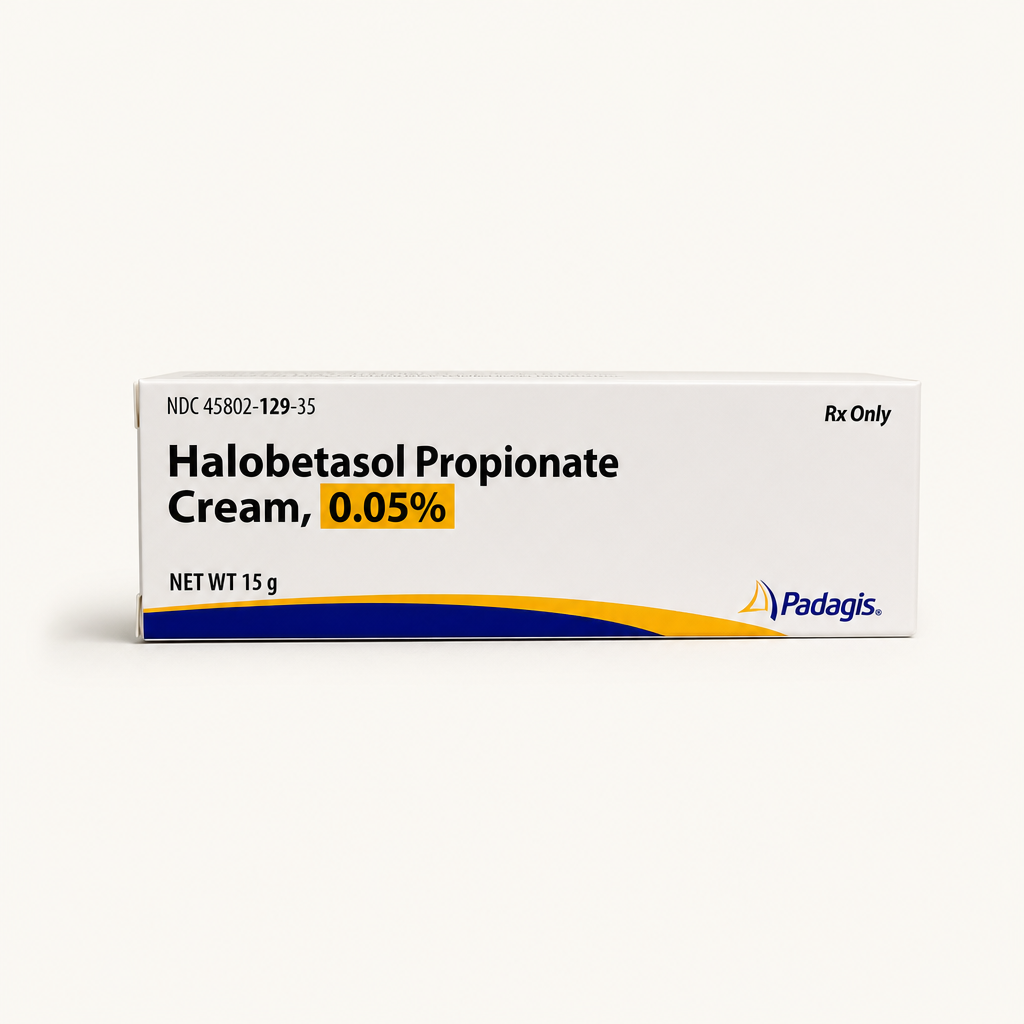
How It Works
Halobetasol cream works by penetrating the epidermis to alter how your body manages inflammation. When applied to psoriasis patches or eczema lesions, halobetasol enters skin cells and binds to specific receptors. This binding process helps decrease the number of white blood cells in the affected area, reducing swelling and redness.
Halobetasol also blocks the production of cytokines, chemical messengers that signal the immune system to produce inflammation when the body is threatened. Vasoconstriction is another key mechanism of this drug. When blood vessels in the dermis narrow, less blood flows to the area, reducing symptoms like redness and heat.
Halobetasol also helps normalize the rate of skin cell division in people with conditions like psoriasis. Stabilizing the cell turnover rate helps the body shed dead skin cells and regenerate at a normal pace.
| Quick Facts | |
|---|---|
| Common Brands | Protavate (cream), Bryhali (lotion), Lexette (foam) |
| Drug Class | Topical corticosteroid (very high potency/Class 1) |
| Generic Status | Generic version available |
| Availability | Prescription only |
Dosing
When applying a high-strength steroid like halobetasol, application technique is crucial to successful treatment and minimizing side effects.
- Application amount: Standard guidelines suggest using the “Fingertip Unit” as a measurement when dispensing halobetasol cream. This unit refers to the distance between the tip and the top joint of your index finger.
- Frequency: Providers typically recommend applying halobetasol cream in a thin film to the affected area once or twice daily. Using more cream may not increase the medication’s efficacy, but can increase the risk of systemic absorption and side effects.
- Duration: Patients are generally advised not to use halobetasol cream or foam for more than 2 consecutive weeks. For certain lotions, such as Bryhali, your provider may extend the treatment course to up to 8 weeks.
- Maximum dose: To prevent serious side effects, patients are usually advised not to exceed 50 grams per week when using a 0.05% concentration of halobetasol topical medication.
Note: Dosing information below is educational only. Your prescribing physician will determine your specific dose based on your individual health needs. Always follow your healthcare provider’s instructions for exact dosing.
Uses
FDA-Approved Uses
Halobetasol cream is FDA-approved to manage the inflammatory, itchy patches of moderate-to-severe plaque psoriasis. The drug is also FDA-approved to treat corticosteroid-responsive dermatoses, including severe eczema, lichen planus, and discoid lupus erythematosus.
Off-Label Uses
You may see halobetasol cream prescribed for uses that are not “FDA-approved.” This is a very common and legal practice called “off-label” prescribing, where a doctor uses their clinical judgment to prescribe a drug for a different (but well-researched) purpose.
Common off-label uses for halobetasol cream currently found in clinical practice and research include:
- Severe poison ivy and poison oak: While providers normally treat poison ivy and poison oak with mid-potency steroids, severe cases with blistering may warrant the extra strength of halobetasol.
- Vitiligo: Halobetasol cream may be used to slow the progression of vitiligo, a condition that causes loss of skin pigment in patches and can spread across the entire body if left untreated. Using halobetasol for vitiligo typically requires close medical supervision.
- Alopecia areata: Doctors may recommend halobetasol to patients for application on the scalp to treat localized patches of hair loss triggered by autoimmune response.
Side Effects
Due to its high potency, halobetasol carries a higher profile for side effects than many over-the-counter or lower-strength prescription topical creams.
Common Side Effects
Common side effects from using halobetasol cream include:
- Temporary burning, stinging, or itching at the application site
- Skin thinning (atrophy)
- Stretch marks (striae)
- Spider veins on the skin surface (telangiectasia)
- Inflammation or pus bumps around hair follicles (folliculitis)
Serious Side Effects
Serious side effects are rare, but it’s important to know what to look for if they do occur. Serious side effects from using halobetasol cream can include:
- HPA axis suppression: This condition occurs when the body absorbs enough steroidal medication through the skin to interfere with cortisol production in the adrenal glands. Symptoms include extreme fatigue, low blood pressure, and dizziness.
- Cushing’s syndrome: Halobetasol can lead to Cushing’s syndrome, a condition that can cause facial puffiness and a shiny, “moon-like” appearance.
- Visual impairment: If halobetasol accidentally comes into contact with the eyes, it can cause visual impairment and increase the patient’s risk of conditions like glaucoma or cataracts.
- Infection masking: Since halobetasol suppresses the immune system, it can hide the signs of a fungal or bacterial infection. The skin may appear less red and inflamed, but the infection can still progress if not treated separately.
Call your doctor immediately if you experience any concerning or prolonged symptoms.
Pharmacist Tips
Thoroughly Wash Your Hands
Per standard guidelines, patients are advised to wash their hands twice with each application. Washing before application helps ensure your hands are clean, while washing after prevents the lotion from accidentally transferring the powerful steroid to your eyes, mouth, and other sensitive areas.
Do Not Cover
Occlusion, or covering the affected area with bandages or tight dressing, is not advised when using halobetasol cream. Covering the cream can significantly increase its absorption into the bloodstream, drastically elevating the risk of toxicity.
Watch “Thin” Areas
Areas where skin is naturally thin are more susceptible to atrophy, or severe thinning, after halobetasol is applied. Standard guidelines advise patients to never use the cream on the face, armpits, or groin.
Moisturizer Timing Is Key
Guidelines advise patients to wait at least 15 to 30 minutes after applying halobetasol cream before using daily moisturizer. This ensures ample time for the steroid to be absorbed properly, as a moisturizer can dilute the medication.
Tapering Is Recommended
Patients who use the cream regularly for two or more weeks are advised to taper off the medication rather than abruptly ending usage. Gradually lowering the dosage can reduce the risk of rebound flare-ups.
Drug Interactions
Drug interactions are not common for most topical creams, but halobetasol’s high potency makes it more likely to interact with oral medications, especially if it is absorbed systemically. Known interactions with halobetasol cream include:
- Oral corticosteroids: Taking oral steroids like prednisone or dexamethasone alongside halobetasol can compound the risk of conditions that occur due to steroid overload, such as HPA axis suppression and Cushing’s syndrome.
- Other topical steroids: Using halobetasol cream at the same time as other topical steroids can cause an overdose in the skin, leading to symptoms like rapid thinning.
Always give your doctor and pharmacist a complete list of all your medications, vitamins, and supplements to check for potential interactions.
FAQs
Why should you never put this cream on your face or genitals?
The skin on your face and genitals is much thinner than the skin on other parts of your body. Using a potent steroid like halobetasol can cause permanent skin atrophy (thinning) and visible blood vessels.
Is halobetasol considered a strong or weak steroid compared to other creams?
Halobetasol is considered a strong steroid compared to other creams. The medication is categorized as a very high potency or Class 1 steroid, which is the most potent designation available.
Why can’t I use this for more than two weeks in a row?
Using halobetasol for more than two weeks in a row can suppress the adrenal glands and lead to the condition known as HPA axis suppression. The two-week course is a standard safety buffer to help prevent the medication from interfering with your body’s natural hormone production.
What is the difference between the halobetasol cream, ointment, and lotion?
Halobetasol topicals vary by consistency. The ointment is greasy and offers the best absorption, often making it ideal for dry, scaly patches of psoriasis. The cream is less messy and better at treating moist skin. The lotion and foam may be easier to apply to hairy areas of the body or to large skin surfaces.
Can I wrap my psoriasis patches in bandages or plastic wrap after applying this?
No, it is not recommended to cover psoriasis patches in bandages or plastic wrap after applying halobetasol cream. This can significantly increase the cream’s rate of absorption and elevate your risk of systemic side effects.
Should I put my daily moisturizer on before or after I apply the halobetasol?
Per standard guidelines, patients are advised to put on daily moisturizer about 15 to 30 minutes after applying halobetasol cream. This allows enough time for the medication to absorb properly without interference from the moisturizer, which can dilute the halobetasol.
Can I use halobetasol to get rid of stubborn cystic acne?
No, halobetasol is not formulated to eliminate stubborn cystic acne, which typically results from bacterial infection. In fact, the steroidal component of halobetasol can worsen cystic acne. Talk to your doctor about more effective treatments for cystic acne.
Is it normal for the cream to sting and burn when I put it on cracked skin?
Yes, mild stinging and burning is a common temporary side effect when you apply halobetasol to cracked skin. If the burning is intense or is accompanied by a spreading rash, it may indicate an allergic reaction with one or more of the cream’s ingredients.
Why did my psoriasis flare up the day I stopped using this?
A psoriasis flare-up on the day you stop using halobetasol cream may be a rebound effect from abruptly quitting the high-potency steroid. A gradual tapering is recommended once the treatment course is complete to help your body adjust.
Can I use halobetasol to treat poison ivy or a severe sunburn?
Halobetasol can treat severe poison ivy, and is commonly prescribed off-label for this purpose. Per guidelines, halobetasol should never be used to treat severe sunburn. Damaged skin absorbs the cream too quickly, and the cream can trap heat, worsening the burn.
Is it safe to use this medication if I am currently pregnant or breastfeeding?
Providers typically advise that patients who are pregnant should take caution when using high-potency steroids like halobetasol and only do so under close medical supervision. For patients who are breastfeeding, standard guidelines advise avoiding applying cream anywhere on the chest where their infant may accidentally touch or ingest the medication. Patients should check with their healthcare provider prior to using the medication.
How exactly do I measure a “fingertip unit” so I don’t accidentally use too much?
One fingertip unit (FTU) equates to the amount of cream that fits on your index finger from the tip to the first joint (crease). This is usually enough cream to cover an area of skin equivalent to two adult-sized palms.
Does halobetasol absorb into my bloodstream like oral steroids do?
A small amount of halobetasol can be absorbed into your bloodstream, especially if you use the cream over a large surface area or for a longer duration. This is the reason behind the standard recommendation that patients apply no more than 50 grams of cream per week.
Can I safely put halobetasol on my scalp?
Yes, you can safely apply halobetasol to your scalp. It is commonly prescribed off-label to treat patches of hair loss from alopecia areata. However, providers typically prefer the foam or lotion because the cream and ointment can be difficult to wash out of hair.
What happens if I accidentally put this on a fungal infection like ringworm by mistake?
If you accidentally apply halobetasol cream to a fungal infection like ringworm, the medication can suppress the immune system and worsen the infection. You may notice the redness fading, but the fungus can spread rapidly if the immune system’s defenses are low.
Does halobetasol actually treat psoriasis, or just subside it while using the medication?
Halobetasol can help clear psoriasis patches of skin by suppressing inflammation, but psoriasis does not have a cure. Symptoms may return if you stop using halobetasol cream.
Do I need to wash my hands immediately after applying this to my skin?
Yes, thoroughly washing your hands before and after applying halobetasol cream is recommended as part of the drug’s standard guidelines. Washing your hands after application helps ensure the high-potency steroidal medication won’t transfer to the eyes, mouth, and other sensitive areas of the body.
Comparable Medications
Halobetasol Cream, Clobetasol, Triamcinolone, Mometasone, Hydrocortisone/Desonide, or Tazarotene?
Halobetasol is a very high-potency topical corticosteroid that can treat stubborn psoriasis, eczema, and other inflammatory skin conditions. Due to the medication’s strength, your doctor may recommend a less potent steroid to address the severity of symptoms. Alternatives to halobetasol cream include:
Clobetasol Cream
From $23.99
Halobetasol and clobetasol are both Class 1 steroids. If a patient does not respond to halobetasol, their doctor may recommend clobetasol (or vice versa) but these drugs are often used interchangeably to treat conditions like psoriasis.
Triamcinolone
From $24.99
Sold under the brand name Kenalog, triamcinolone is a steroid with mid-to-high-potency (Class 3-4). It may be prescribed for general rashes or mild eczema, but doctors typically prefer the more potent halobetasol for severe, thickened psoriasis plaques and other stubborn cases that don't respond to weaker medications.
Mometasone Cream
From $34.99
Mometasone, sold under the brand name Elocon, is a Class 4, medium-potency steroid considered "face-safe" for short periods under a doctor's supervision. It is a maintenance-level topical that a provider may recommend for treating facial skin issues, whereas halobetasol is typically recommended for short-term use.
Hydrocortisone
From $24.99
Both hydrocortisone and desonide are low-potency steroids (Class 6-7). They are considered among the safest medications for long-term use and for thin-skinned areas.
Tazarotene Cream
From $139.99
Sold under the brand name Tazorac, tazarotene is a topical retinoid that treats psoriasis by normalizing skin growth without relieving redness or itching. Providers may prescribe halobetasol and tazarotene together for rapid, dual-action relief from inflammatory skin conditions.
We Have Halobetasol Cream in Stock. Get Yours Today!
Important: Information on this page is for educational purposes only. Prescribing decisions are made by independent, licensed providers. TelyRx operates technology-enabled pharmacies and a telehealth platform that connects patients with licensed providers. Prescriptions, when provider-approved and issued, are filled and shipped by TelyRx-affiliated pharmacies. We do not employ physicians or make prescribing decisions. Learn more about our editorial standards here.