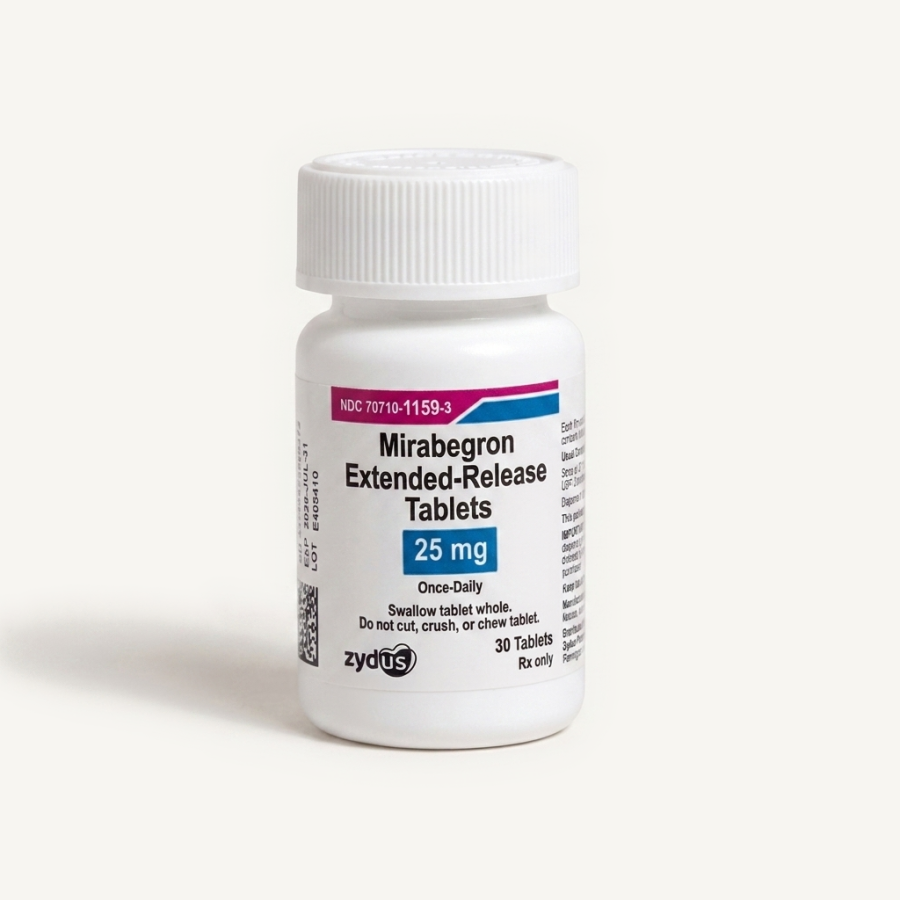
How It Works
Mirabegron works by:
- Targeting receptors: The medication attaches to beta-3 adrenergic receptors located in the bladder muscle.
- Promoting relaxation: By stimulating these receptors, mirabegron signals the bladder muscle to relax while it is filling with urine.
- Increasing capacity: As the muscle relaxes, the bladder can physically hold more urine.
- Reducing urgency: By allowing the bladder to expand more comfortably, the sudden, intense signals of urgency are reduced.
This mechanism is different from older medications like oxybutynin (Ditropan). It targets the filling phase rather than the emptying phase, avoiding the common side effects associated with older OAB treatments.
| Quick Facts | |
|---|---|
| Common Brands | Myrbetriq, Myrbetriq Granules |
| Drug Class | Beta-3 adrenergic agonist / Urinary antispasmodic |
| Generic Status | Generic versions available |
| Availability | Prescription only |
Dosing
The timing and method of taking mirabegron ER are crucial for the medication’s effectiveness.
- Typical starting dose: Most people begin with 25 mg taken once daily.
- Dose adjustment: If symptoms do not improve after four to eight weeks, a doctor may increase the dose to 50 mg once daily.
- Administration: Providers recommend swallowing the tablet whole with water. It is generally accepted that you can take mirabegron with or without food.
- The “no crush” rule: Standard guidelines advise against crushing, chewing, or splitting extended-release tablets. Doing so destroys the special coating that controls how the medicine enters your body.
- Missed doses: If you miss a dose, providers recommend taking it as soon as you remember. However, if it has been more than 12 hours since your scheduled time, it’s generally accepted that you should skip the missed dose and return to your regular schedule the next day.
Note: Dosing information below is educational only. Your prescribing physician will determine your specific dose based on your individual health needs. Always follow your healthcare provider’s instructions for exact dosing.
Uses
FDA-Approved Uses
The FDA approves mirabegron for the following conditions:
- Overactive bladder (OAB): For people experiencing symptoms of urge urinary incontinence, urgency, and urinary frequency
- Neurogenic detrusor overactivity (NDO): A specific type of bladder overactivity caused by brain or nerve problems
Off-Label Uses
You may see mirabegron prescribed for uses that are not “FDA-approved.” This is a common and legal practice called “off-label” prescribing, where a doctor uses their clinical judgment to prescribe a drug for a different (but well-researched) purpose.
Mirabegron may be prescribed for the following conditions:
- Benign prostatic hyperplasia (BPH) symptoms: In men with an enlarged prostate, mirabegron may be added to other medications to help manage the “irritative” bladder symptoms that persist after the prostate issue is addressed.
- Combination therapy: Some doctors prescribe mirabegron alongside an anticholinergic medication (like solifenacin) to provide a “dual-action” approach for severe OAB that doesn’t respond to a single drug.
Side Effects
Most people tolerate mirabegron, but like all medications, it can cause side effects. Because it does not work the same way as older bladder drugs, it is less likely to cause issues like brain fog or extreme dry mouth.
Common Side Effects
- Increased blood pressure: This is the most significant side effect to monitor
- Headache: Often mild and temporary
- Cold symptoms: Such as a runny or stuffy nose and sore throat
- Urinary tract infection (UTI): Reported in some clinical trials
- Constipation: Though less common than with older medications, it can still occur
Serious Side Effects
Serious side effects are rare, but it’s important to know what to look for if they do occur.
It’s generally accepted that you should stop taking the medication and immediately call the doctor if you experience any of the following:
- Severe hypertension: Blood pressure above 180/120 mmHg may cause severe headache, chest pain, or blurred vision.
- Angioedema: A rare but serious allergic reaction involving swelling of the face, lips, tongue, or throat. This requires immediate medical attention as it can interfere with breathing.
- Urinary retention: Inability to empty the bladder. Standard guidelines recommend contacting your doctor immediately if you feel a strong urge to go but cannot pass any urine.
- Irregular heartbeat: Feeling like your heart is racing or skipping beats.
Call your doctor immediately if you experience any concerning or prolonged symptoms.
Pharmacist Tips
Check Your Blood Pressure
Because mirabegron can raise blood pressure, it is generally recommended to monitor your readings at home when you first start the medication.
Be Consistent
It’s generally accepted that you take your tablet at the same time every day. This helps keep the level of medicine in your system steady.
Do Not Split the Pill
The extended-release mechanism depends on the tablet remaining intact. If you have trouble swallowing large pills, providers recommend talking to your pharmacist about alternative strategies.
Stay Hydrated
Even though you are treating frequent urination, providers advise not being too restrictive on your water intake. Proper hydration is necessary for kidney health and can help prevent constipation.
Watch for UTIs
If you notice burning during urination or cloudy urine, standard guidelines recommend contacting your doctor. Some people find that their symptoms change rather than disappear if an infection develops.
Inform Your Eye Doctor
While mirabegron is usually safer for the eyes than older bladder drugs, it’s generally accepted that you should still let your eye doctor know you are taking it, especially if you have a history of glaucoma.
Drug Interactions
Mirabegron can interact with other medications, potentially changing how they work or increasing the risk of side effects.
Below are known drug interactions with mirabegron:
- Heart and blood pressure medications: Mirabegron can increase the levels of medications like metoprolol and digoxin in your bloodstream.
- Antidepressants: It may interact with certain drugs like desipramine.
- Blood thinners: It may affect how warfarin works, requiring more frequent monitoring of your blood tests.
- Rhythm medications: Drugs used to treat abnormal heart rhythms, such as flecainide or propafenone, may require dose adjustments.
Always give your doctor and pharmacist a complete list of all your medications, vitamins, and supplements to check for potential interactions.
FAQs
How is mirabegron different from drugs like oxybutynin?
Oxybutynin is an anticholinergic. It works by blocking emptying signals. Mirabegron is a beta-3 agonist that promotes relaxation. Because it works differently, it does not cause the same degree of dry mouth, constipation, or confusion.
Can I crush or chew the tablet if I have trouble swallowing?
No. Standard guidelines state that crushing or chewing extended-release tablets can cause the entire 24-hour dose to be released at once. This can be dangerous and increases the risk of high blood pressure or heart palpitations.
Does mirabegron cause “brain fog”?
Unlike older OAB medications, mirabegron is not an anticholinergic. This means it is generally accepted as being safer for cognitive function and is less likely to cause confusion or memory issues, especially in older adults.
How long does it take for mirabegron to stop my frequent urination?
You may notice some improvement within one to two weeks, but providers typically recommend waiting four to eight weeks to see the full therapeutic effect.
Can I take this medication in the morning?
Yes. It’s generally accepted that you can take it at any time that is convenient for you, provided you take it at that same time every day.
Is it safe to take mirabegron if I have severe kidney disease?
Providers typically recommend caution. If your kidney or liver function is significantly impaired, your doctor may need to prescribe a lower dose (usually 25 mg maximum) or suggest a different treatment.
Can I take mirabegron with metoprolol or digoxin?
Generally yes, but it requires careful monitoring. Mirabegron can raise the levels of these drugs in your blood. Your doctor may need to adjust your heart medication doses.
Why did I get a urinary tract infection (UTI) after starting this?
While the exact reason isn’t always clear, changes in how the bladder muscle behaves can affect how well the bladder flushes bacteria. UTIs were reported as a possible side effect in clinical studies.
What is the difference between the 25 mg and 50 mg dose?
The 25 mg dose is the standard starting point to ensure you tolerate the medication well. The 50 mg dose provides a stronger effect on the bladder muscle and is used if the lower dose doesn’t provide enough relief.
Can men use mirabegron, or is it only for women?
Both men and women can use mirabegron. It is effective for OAB symptoms regardless of gender.
Is it safe to use this medication during pregnancy?
Standard guidelines indicate limited data on the use of mirabegron in pregnant individuals, so risk cannot be ruled out. Consult with a healthcare provider if you are pregnant or planning to become pregnant.
Can I take mirabegron if I have glaucoma?
Mirabegron is generally considered safer for people with glaucoma than older anticholinergic drugs. However, providers advise consulting your ophthalmologist before starting any new bladder medication.
Does mirabegron help with bedwetting?
While it helps with nighttime frequency, it is not primarily used for treating bedwetting (enuresis) unless it is part of a larger diagnosis of neurogenic bladder.
Can I drink alcohol while taking mirabegron?
There is no direct interaction, but alcohol can irritate the bladder and act as a diuretic, which may make OAB symptoms worse. Alcohol can also increase the risk of dizziness.
Does mirabegron cause water retention?
No. Mirabegron is not a steroid or a drug that typically causes the body to hold onto fluid. If you notice new swelling in your legs, it’s generally recommended that you contact your doctor.
Comparable Medications
Mirabegron, Vibegron, Oxybutynin, or Solifenacin?
If your doctor deems mirabegron unsuitable due to potential side effects or drug interactions, they may recommend one of the following alternatives:
Vibegron
This is another beta-3 agonist that’s similar to mirabegron. The main difference is that vibegron does not usually have the same drug interaction concerns with medications like metoprolol and does not require a slow dose-increase period.
Oxybutynin
An older medication that commonly has side effects of significant dry mouth, constipation, and blurred vision. It is also associated with a higher risk of confusion in elderly patients.
Solifenacin
From $29.99
An anticholinergic that is more selective for the bladder than oxybutynin. It has fewer side effects than oxybutynin but is still more likely to cause dry mouth and constipation compared to mirabegron.
We Have Mirabegron ER Tablets in Stock. Get Yours Today!
Important: Information on this page is for educational purposes only. Prescribing decisions are made by independent, licensed providers. TelyRx operates technology-enabled pharmacies and a telehealth platform that connects patients with licensed providers. Prescriptions, when provider-approved and issued, are filled and shipped by TelyRx-affiliated pharmacies. We do not employ physicians or make prescribing decisions. Learn more about our editorial standards here.