

Plenty of people put off doctor’s visits because of scheduling or cost. For many Americans, though, another holdup is stigma, or worry about how others might react to a health condition. Stigma can keep people from seeking care even when it’s close by and affordable.
TelyRx surveyed 1,049 U.S. adults and found that nearly a third (31%) have delayed or avoided medical treatment because of the stigma around a health condition. While cost is often seen as the biggest barrier to care, it isn’t the only one: 1 in 5 U.S. adults would hesitate or avoid seeking treatment for stigmatized conditions even if the care cost them nothing.
The problem is that many of the conditions people hesitate over, like sexually transmitted infections (STIs) or mental health conditions, can worsen without treatment. Here’s what the survey found about how long people wait, and what could help.
Key Takeaways
- Of the U.S. adults who have delayed or avoided medical treatment because of stigma, 53% have put off care for 6 months or longer, and 35% have waited a year or longer.
- Among people who put off care, 1 in 5 asked an AI chatbot for advice, and 15% ordered medicine from a website they weren’t familiar with.
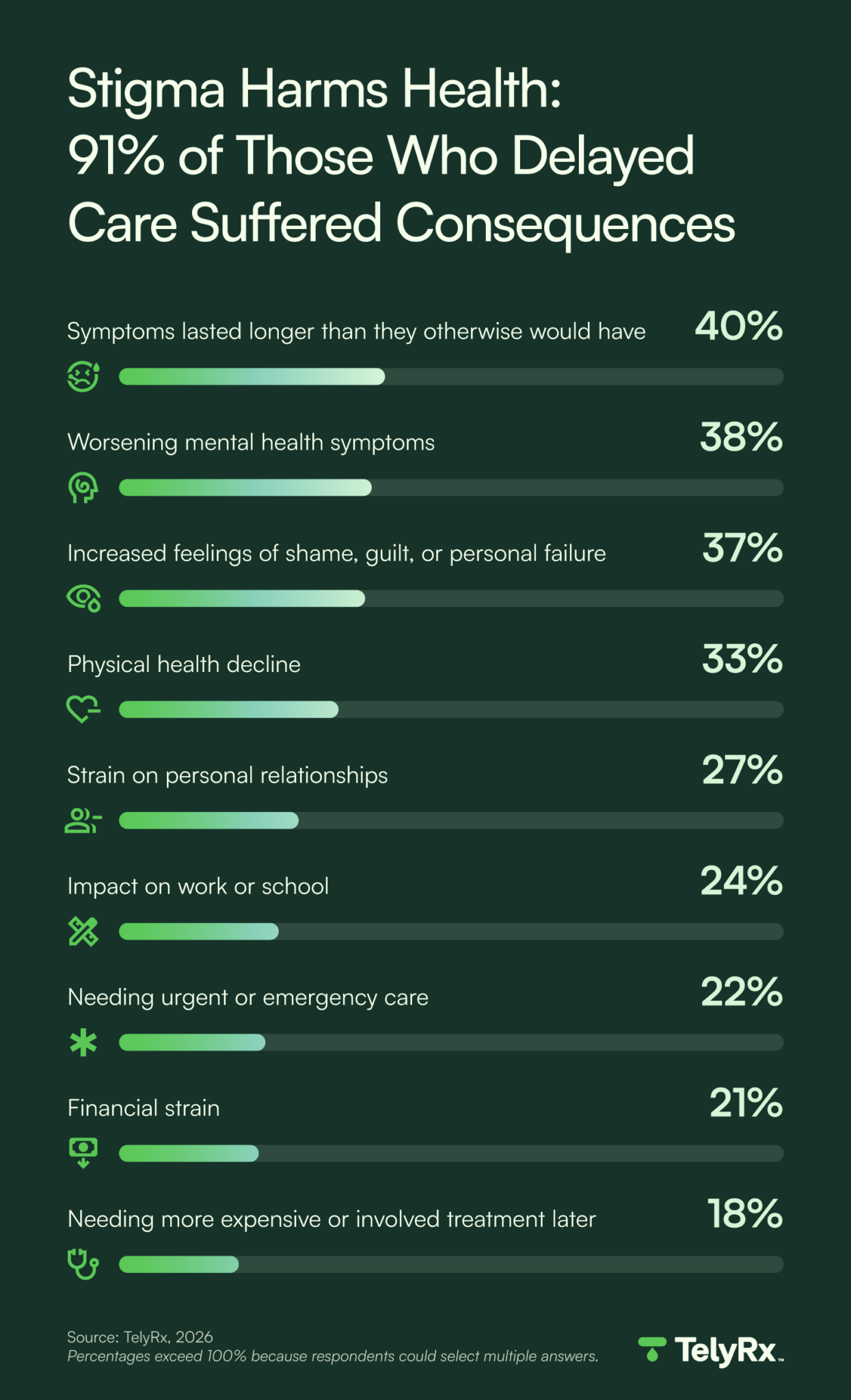
- 91% of people who put off care because of stigma say it had consequences, including 22% who needed urgent or emergency care.
- 28% of U.S. adults have hesitated to pick up a prescription for fear of being seen, overheard, or recognized, including 47% of Gen Z respondents.
- Men were more likely to delay care because of stigma (36% vs. 27%), but women who delayed were more likely to say their longest delay lasted a year or more (42% vs. 29%).
- 1 in 5 U.S. adults say they would still hesitate or avoid care even if it were free, and 77% of people who delayed care say a private, at-home option would make them more likely to seek treatment.
91% Who Put Off Treatment Say It Had Consequences
Nearly 3 in 5 U.S. adults (59%) say they’d feel uncomfortable getting in-person treatment for at least one health condition. The most common conditions driving that discomfort are STIs (22%), followed by mental health conditions like depression or anxiety (20%), and erectile dysfunction or vaginal atrophy (19%).
Every one of those is common and treatable. For example, STIs like chlamydia, gonorrhea, and syphilis can typically be treated with antibiotics. But putting off treatment gives the infection more time to spread and increases the risk of complications.
Nearly everyone who delayed care because of stigma (91%) says it led to at least one consequence, the most common of which were symptoms sticking around longer than if they’d received treatment immediately (40%). Worsening mental health symptoms (38%) and stronger feelings of shame, guilt, or personal failure (37%) were also common.
This introduces a challenging situation for patients with highly stigmatized conditions: People skip care to avoid feeling judged, yet many end up feeling worse about themselves anyway.
A third of those who delayed care also reported a decline in physical health. More than 1 in 5 (22%) also eventually needed urgent or emergency care.
“Delay changes clinical outcomes, not just comfort,” says Ashley Robinson, PharmD, pharmacy manager at TelyRx. “Weeks of avoidance can let infection progress to something that is much harder to treat than if it had been addressed earlier.”
From Home Remedies to AI Chatbots: How People Are Treating Health Issues on Their Own
Most people who put off care tried to handle their health issues themselves first. More than half (56%) searched their symptoms online or on social media. Others reached for an over-the-counter medicine (44%) or tried at-home or nontraditional remedies (40%). Just over a quarter (26%) asked a friend or family member what to do, and 1 in 5 turned to an AI chatbot for advice.
It makes sense that many people would look something up or grab an over-the-counter option as a starting point, but the risk grows when the do-it-yourself approach replaces a licensed professional altogether. Nearly 20% took medicine that was leftover or meant for someone else, and 15% ordered medicine from a website they weren’t familiar with.
While many digital pharmacy platforms are legitimate and safe, there are bad actors, too. This is why it’s important to research a site before ordering from it. A pill from an unknown seller may not contain what it says it does, just one of several unsafe assumptions about buying medicine online that can backfire.
Most of these workarounds have one thing in common: no one else has to know. Robinson says that privacy is the appeal, but it comes with a catch. “Using alternative methods instead of professional treatment can feel more private and doesn’t require an uncomfortable conversation,” she says. “But most alternative remedies aren’t held to the same evidence standards as medical treatment, meaning you could be masking symptoms without addressing the underlying condition, which often keeps progressing in the background.”
She adds that people don’t have to choose between privacy and real care: “If stigma is the barrier, telehealth and at-home testing kits now offer private, low-exposure ways to get the same effective treatment without the in-person conversation you’re dreading.”
53% of Those Who Delayed Care Have Put It Off 6 Months or Longer
For plenty of people, “I’ll deal with it later” turns into months or even years of delaying care. Among U.S. adults who have put off care because of stigma, more than half (53%) have waited six months or longer at some point, and about a third (35%) have waited a year or longer.
What’s more, among people who’ve delayed care, 39% still haven’t been treated for at least one condition they put off, including 13% who haven’t received care for any of them.
That’s a particular concern for anyone managing a chronic condition, such as diabetes or high blood pressure. Those conditions usually need regular check-ins and refills, so a long delay lets problems build up unnoticed.
The pharmacy counter can be its own hurdle, too. More than 1 in 4 U.S. adults surveyed (28%) say they’ve hesitated to pick up a prescription because they worried about being seen, overheard, or recognized by someone else. About 1 in 9 (11%) changed how they ordered, such as switching to delivery or going at a quieter time of day.
For people struggling with stigma, refilling a prescription online is one way to skip the counter altogether.
Gen Z Is Most Likely To Avoid The Pharmacy, And Women Wait Longest If They Delay Care
Older generations are less likely to avoid the pharmacy out of worry about being seen, overheard, or recognized. Nearly half of Gen Z (47%) say they’ve hesitated to pick up a prescription for that reason, dropping to 38% of Millennials, 25% of Gen X, and just 11% of Baby Boomers.
Gender splits the numbers, too, and it cuts two ways. Men were more likely than women to have delayed care because of stigma (36% vs. 27%), and they were nearly twice as likely to hesitate at the pharmacy (36% vs. 20%).
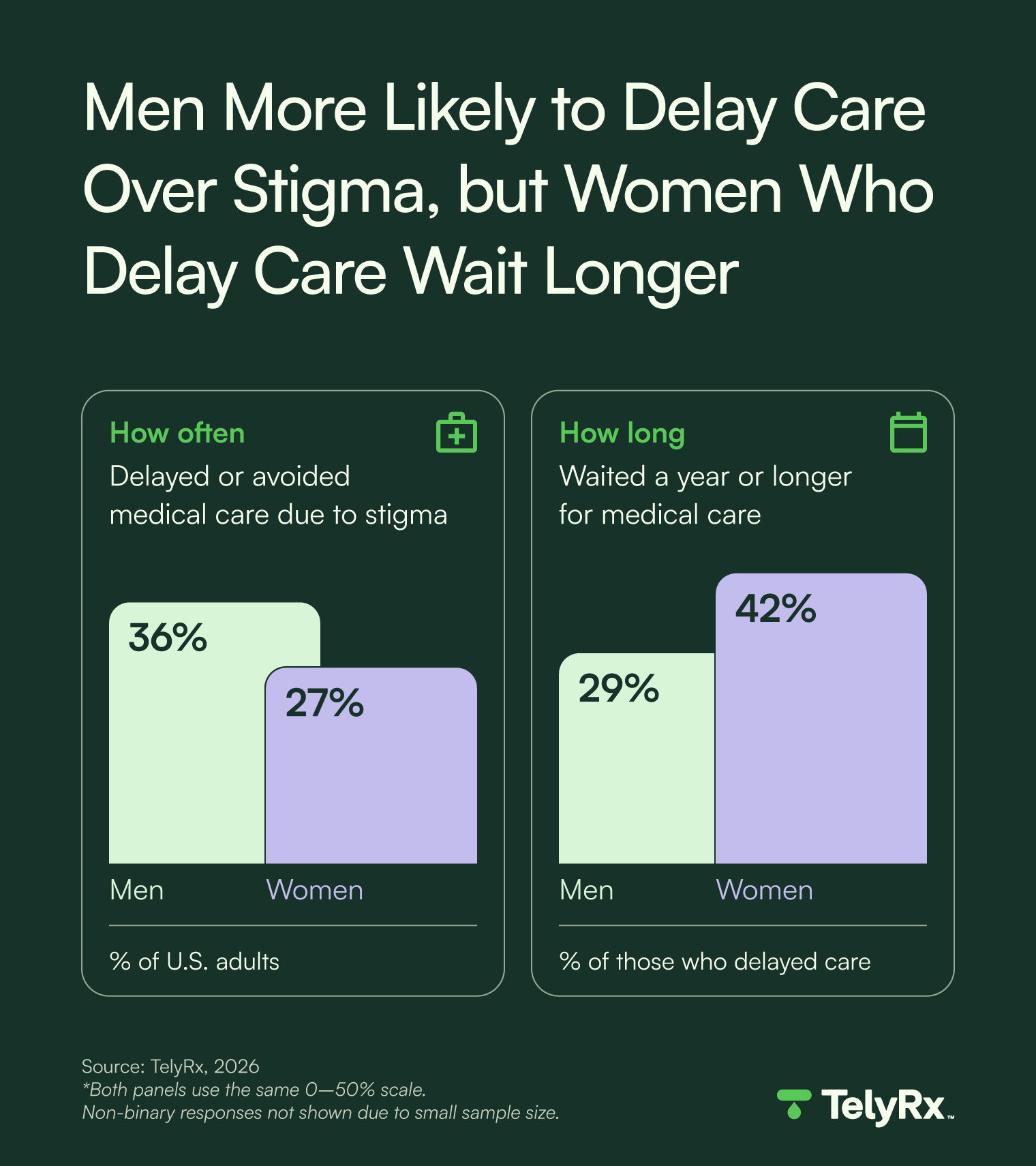
However, among people who put off care, 42% of women say the longest they’ve gone without it was a year or more, compared with just 29% of men. A year is a long time to leave a condition untreated. It also doesn’t help that STI symptoms in women often get missed or misdiagnosed, which can stretch that timeline even further.
Even If Treatment Were Free, 1 in 5 Say They’d Still Hesitate to Seek Care
People usually blame cost when they skip medical care, and for good reason. U.S. healthcare spending is expected to surpass $6 trillion in 2026, a 6% increase from last year.1 Those increases impact patients through higher premiums and out-of-pocket bills, which makes skipping an appointment or a prescription feel like the only option for many. But money isn’t the only obstacle standing between patients and treatment.
Even if care were completely free, 1 in 5 U.S. adults say they would still hesitate to get help due to judgment, embarrassment, or fear for their reputation. For people who have already delayed care in the past, that number spikes to 45%. Price matters, but social stigma creates an invisible wall that zero-dollar care can’t break down on its own.
However, many patients affected by this barrier are clear about what would help them move forward: 77% of adults who have delayed care due to stigma say a private, at-home option (like an online evaluation with a licensed provider and discreet delivery) would make them more likely to seek treatment.
When the hardest part of getting care is talking about your symptoms out loud or standing at a public pharmacy counter, eliminating those awkward touchpoints removes a key barrier.
For anyone still hesitating to seek care, Robinson has a simple message. “Providers have heard it all before,” she says. “There’s very little that surprises a doctor or pharmacist, and our job is to help, not judge … The discomfort of one conversation is almost always smaller and shorter-lived than the consequences of an untreated condition.”
If the discomfort of one conversation is the hurdle, it may feel smaller from your own home, with more distance between you and the provider. Virtual care platforms and discreet home delivery can let people have that conversation and get treatment without the waiting room or the pharmacy counter. As these options grow, they may help more people get care before a short delay turns into a long one.
Methodology
The survey was conducted by Centiment on behalf of TelyRx. It was fielded between September 16, 2026, and September 18, 2026. The results are based on 1,049 completed surveys of U.S. adults aged 18+, balanced to U.S. Census benchmarks for age, gender, and region. The margin of error is approximately ±3% for the overall sample at a 95% confidence level. Data on people who delayed or avoided treatment because of stigma is based on 328 completed responses, with a margin of error of approximately ±5% at a 95% confidence level. Generational figures for Gen Z are based on 137 responses, with a margin of error of approximately ±8% at a 95% confidence level.
External Sources
AHIP (2026, September). Experts Agree: High and Rising Medical Costs Causing Affordability Crisis for Consumers. https://www.ahip.org/news/articles/experts-agree-high-and-rising-medical-costs-causing-affordability-crisis-for-consumers