

Refilling a prescription used to mean a drive across town and a wait at the pharmacy counter. For a growing number of Americans, that same errand now starts with a few taps on a phone.
Much of this shift comes down to cost and convenience. Prescription and care costs keep climbing, and patients want faster, more private ways to get treated that fit around their work and family schedules and needs.
To get a clearer picture of where digital health is heading, TelyRx surveyed more than 4,000 U.S. adults across four separate studies in 2026. Those results, alongside recent findings from federal agencies such as the Centers for Medicare & Medicaid Services and independent research groups such as the Pew Research Center and KFF, help map out seven digital health trends shaping how people access care in 2027.
What Is Digital Health?
Digital health refers to technology that helps people get and manage healthcare outside a traditional office visit. That might be a video appointment with your provider or a prescription refill you order online and have shipped to your door.
Early healthcare technology, like electronic records, mostly helped doctors and hospitals run more smoothly. The digital health trends we’ll discuss in this article focus on how healthcare technology impacts patients, drawing on recent survey data about how they’re getting care and medication now.
Key Digital Health and Telehealth Statistics
- 35% of online pharmacy users trust these platforms more than they did in 2023, and another 27% trust certain ones more.¹
- About 23% of people with Original Medicare had a telehealth visit in 2025.⁶
- 58% of U.S. adults managing an ongoing prescription ran out of or rationed doses in the past year.²
- 69% of adults with chronic conditions face barriers to managing their medication.³
- 31% of U.S. adults have delayed or avoided care because of stigma, and 77% of them say a private, at-home option would make them more likely to get treated.⁴
- 34% of U.S. adults have used an AI chatbot for at least one health reason.⁵
1. Telehealth Trends Show Virtual Visits Are Here to Stay
Telehealth had its breakout moment in 2020, when many clinics paused non-emergency in-person visits and patients started attending routine appointments virtually from home during the COVID pandemic. Virtual appointments are not as widely used now that social distancing measures have eased, but plenty of people still rely on them to access healthcare.
Among people with Original Medicare, about 23% had a telehealth visit in 2025, according to early figures from the Centers for Medicare & Medicaid Services. That’s down from 48% at the 2020 peak, but it still adds up to millions of Medicare beneficiaries choosing virtual care.⁶ On the provider side, 80% of office-based physicians used telemedicine in 2024, down slightly from 86.5% in 2021.⁷
Prior to the pandemic, Medicare generally covered virtual visits only for patients in rural areas, and most had to travel to a clinic or other approved site for the call instead of joining from home.
These limits were set to return on Jan. 30, 2026, but the Consolidated Appropriations Act, 2026, extended many Medicare telehealth flexibilities through Dec. 31, 2027.⁸
Outside of Medicare, many private health plans, including those sold through the Affordable Care Act (ACA) marketplace, also cover virtual visits, though copays and covered services vary from plan to plan.
What Congress does before then will shape the future of telehealth for people covered by Medicare. For now, patients and providers have at least another year to treat video visits as a normal part of care.
Between steady patient use and a longer runway for Medicare coverage, telehealth now has a more practical role in everyday care, especially for check-ins that don’t require a physical exam. Patients managing stable, ongoing conditions seem ready for that.
In TelyRx’s chronic conditions survey, 19% of respondents said in-person appointments that feel unnecessary get in the way of managing their medication.³ For someone renewing a standard prescription they have been taking for years, a waiting room adds time without adding much care.
Heading into 2027, the trend to watch is whether Congress makes these Medicare telehealth rules permanent before the Dec. 31, 2027, deadline.
2. Prescriptions Are Moving Online and to the Doorstep
Most people don’t think twice about the pharmacy run until a refill lands in the middle of a hectic week. TelyRx’s research shows that more patients are rethinking that errand altogether. Among people who’ve used an online pharmacy platform, 35% trust these platforms more than they did in 2023, and another 27% trust certain pharmacies more.¹
Their trust makes sense given how often the usual pharmacy routine falls short. For example, survey results show:
- 30% of adults who ran out of or skipped a medication were too busy or otherwise unable to pick up their refill.²
- 66% of adults with chronic conditions who live within five miles of their usual pharmacy face barriers to managing prescriptions, rising to 76% for those six or more miles away.³
- 24% of adults who missed a dose switched to a more convenient pharmacy afterward.²
- Mail-order pharmacy satisfaction rose to 699 out of 1,000 in 2026, while satisfaction with brick-and-mortar pharmacies fell 7 points to 669.10
Living close to a pharmacy doesn’t seem to solve the problem. Two out of three patients living near their pharmacy still face barriers to managing their prescriptions.
If mail-order satisfaction keeps climbing while in-store scores slip, 2027 could be the year more patients on maintenance medications make home delivery their default.
3. Wearables Bring More Routine Care Into the Home
Smartwatches, fitness rings, and connected blood pressure cuffs are turning everyday health data into something patients can share with their care team. Rock Health found that 46% of U.S. adults now own a wearable, and nearly 60% of those owners have discussed their device data with a provider.⁹
That kind of sharing gives clinicians more to work with between visits, which can make a quick virtual follow-up more useful. Talking through the numbers at an appointment is common, but passing the data itself to a care team is still the exception.
A June 2026 study in the Journal of the American Medical Association, based on federal survey data, found that wearable use among U.S. adults climbed from 30% in 2020 to 41% in 2024. Sharing has grown more slowly, with the share of wearable users who sent their data to a clinician rising from 14% to 19% over the same period.17
Medicare also covers remote patient monitoring, which uses connected devices like blood pressure cuffs or glucose meters to send a patient’s readings to their care team between visits. Nearly 1 million Medicare beneficiaries received remote monitoring in 2024, and Medicare spent $536 million on these services that year, up 31% from 2023.18
For patients managing a chronic condition, home data paired with virtual check-ins can mean fewer trips to the office for routine care. In 2027, the opportunity lies in making it easier for patients to send their readings directly to a care team, so the data does more than just sit in an app.
4. Cost and Refill Delays Push Patients to Rethink How They Fill Prescriptions
Getting a refill on time is still a struggle for many patients. In TelyRx’s survey of adults managing an ongoing prescription:
- 58% ran out of doses or rationed them to make their supply last longer in the past year.²
- Of that group, 79% had it happen more than once, including 23% who did so four or more times.²
Cost is a big part of that problem. Nationally, KFF reports that 43% of adults didn’t take a medication as prescribed in the past year because of cost.¹¹ Patients also paid a record $110 billion out of pocket for prescription drugs in 2025, according to the IQVIA Institute.¹²
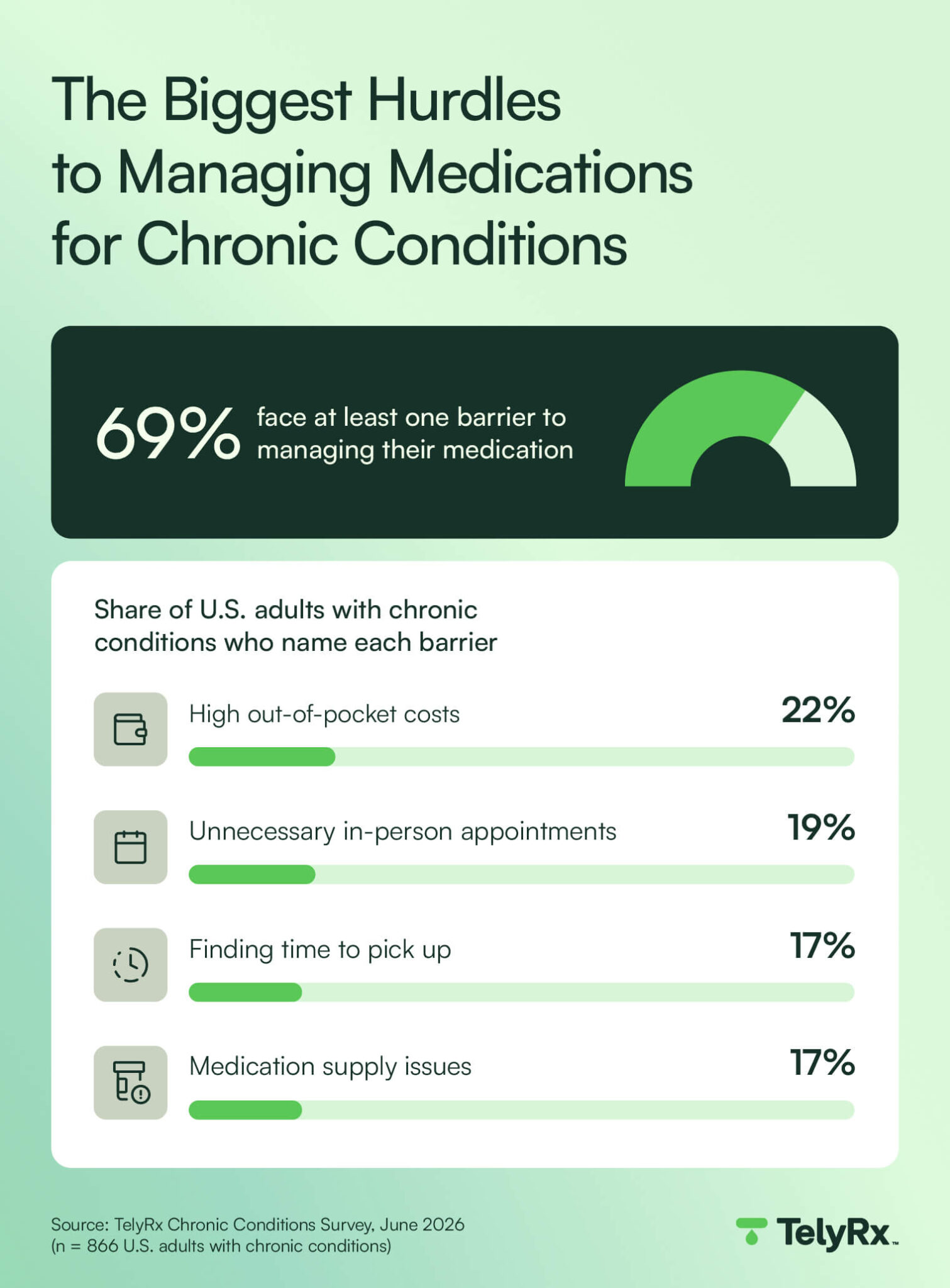
When TelyRx polled adults with chronic conditions, high out-of-pocket costs were the most common barrier to managing their medication. On top of that, 40% have skipped groceries, delayed a utility bill, or cut back on another essential expense to afford their medication, including 15% who do so frequently.³
Ashley Robinson, PharmD, pharmacy manager at TelyRx, says rising prices hit some patients harder than others:
“For individuals taking multiple medications, even a modest price increase, when spread across several prescriptions, can quickly add up to a significant monthly expense.”
Supply problems and paperwork add to the strain. Drug shortages have eased since early 2024, but 225 drugs were still in short supply at the end of Q3 2026.¹³
TelyRx data shows where refills break down and what happens when they do:
- Among adults who ran out or skipped a dose of their medication, 36% said it was out of stock or delayed, and 31% hit an insurance delay.²
- 35% of adults with chronic conditions went without their medication entirely while waiting on a refill.³
- 47% of adults with chronic conditions say waiting for their medication has hurt their health, including 25% who had noticeable symptoms or a setback.³
- For 19% of those who ran out or skipped, going without their medication could put them at risk of hospitalization or death.²
Insurance hiccups are especially tricky because patients can do everything right and still get stuck waiting on an approval.
“People don’t always realize that insurance coverage changes can happen in the middle of the year,” says Robinson. “Medications covered by insurance might change costs, preferred pharmacies shift, and prior authorizations expire, forcing patients to restart the approval process even when nothing else about their health has changed.”
That pressure is changing how patients shop for medication. More are comparing cash prices from digital pharmacy platforms like TelyRx with copays, looking for pharmacies that post prices upfront. Online platforms make it easier to do this from home.
In 2027, more patients who rely on maintenance medications could lean on 90-day supplies, price comparisons, and home delivery to stay ahead of the next shortage or paperwork hold-up.
5. Privacy Is Now a Reason People Choose Digital Care
Cost and convenience typically get most of the attention in conversations about healthcare access. Embarrassment rarely does, even though it keeps a surprising number of people away from treatment. Nearly a third of U.S. adults (31%) have delayed or avoided medical care because of the stigma around a health condition, according to TelyRx’s stigma survey.⁴
When asked which conditions they’d feel uncomfortable getting treated for in person, respondents most often named sexually transmitted infections (22%), mental health conditions like anxiety or depression (20%), and erectile dysfunction or vaginal atrophy (19%).
And once people start putting off care, the delays stretch out. Over half (53%) of those who delayed waited six months or longer, and 35% waited a year or more. Almost all of them (91%) say the delay had consequences, including 22% who eventually needed urgent or emergency care.⁴
Even picking up a prescription makes some people nervous, with more than 1 in 4 U.S. adults (28%) saying they’ve hesitated at the pharmacy counter because they worried about being seen, overheard, or recognized. Younger adults feel that worry most.
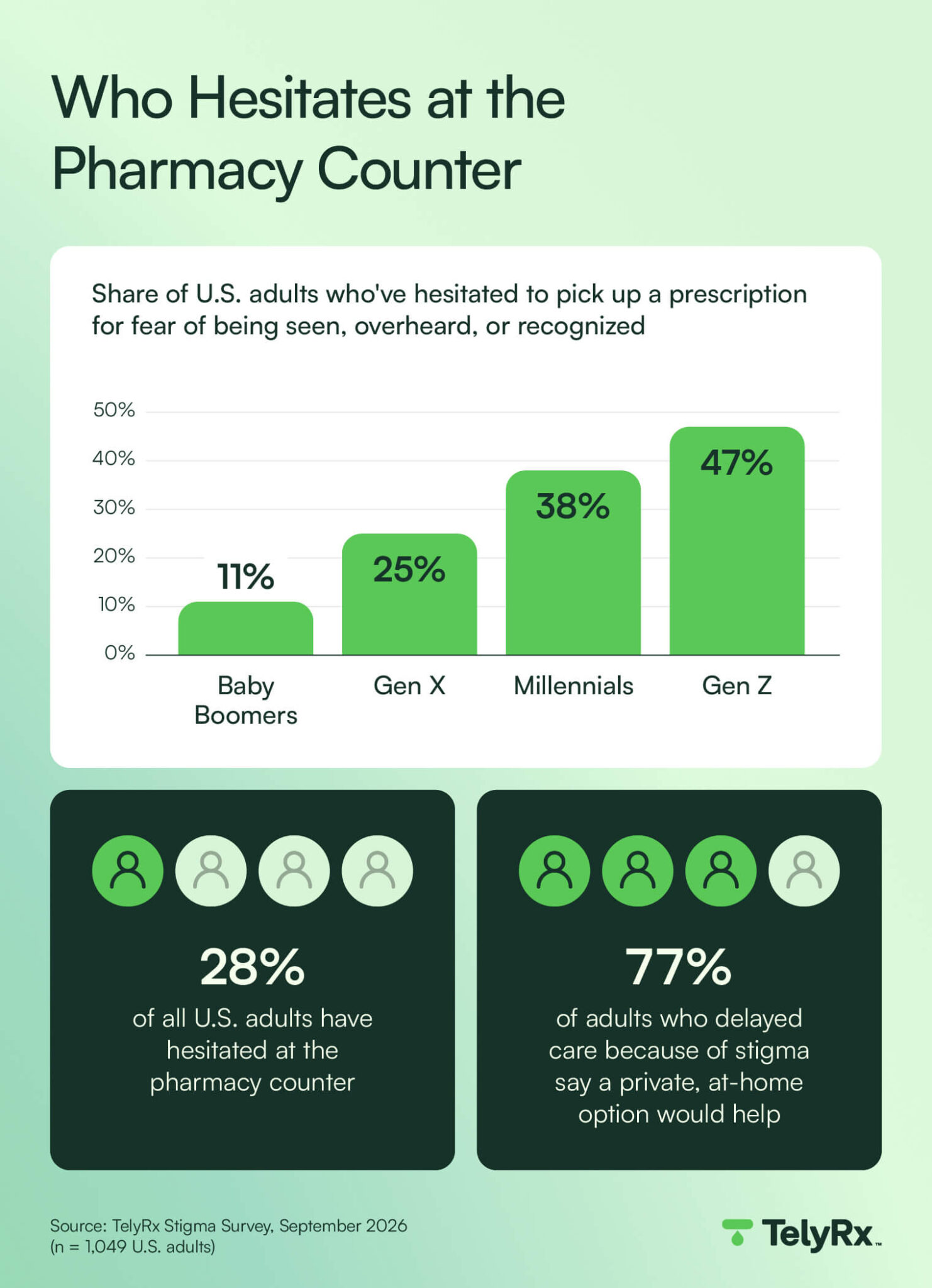
If cost were removed entirely, 1 in 5 U.S. adults say they’d still hesitate to seek care, and that share jumps to 45% among people who’ve already put off care because of stigma. 77% of people who delayed care say a private, at-home option, such as an online review with a licensed provider and discreet delivery, would make them more likely to seek treatment.⁴
Robinson sees telehealth as a practical middle ground for patients who feel stuck:
“If stigma is the barrier, telehealth and at-home testing kits now offer private, low-exposure ways to get the same effective treatment without the in-person conversation you’re dreading.”
For years, patients have weighed price and distance when deciding where to get care. The data suggests privacy now belongs on that list too. A digital option can make that first step feel less exposed, which may help people get care sooner instead of putting it off. New or changing symptoms still call for an evaluation and diagnosis from a licensed provider, whether that happens by video or in an exam room.
Privacy will likely play a bigger role in where patients choose to receive care in 2027, especially for younger adults, who already feel most uneasy at the pharmacy counter.
6. AI Chatbots Are Becoming a First Stop for Health Questions
More people are bringing their health questions to AI chatbots, from making sense of a new symptom to reading up on a treatment. About a third of U.S. adults (34%) have used an AI chatbot for at least one health reason, according to Pew Research Center. The most common reasons were getting health information quickly (28% of all adults) and figuring out what’s causing symptoms (25%).⁵
KFF polling points to cost and access as part of the draw. Among adults who used AI for health information, 19% said not being able to afford a provider was a major reason. Many are also sharing sensitive details along the way, with 41% of AI health users saying they’ve uploaded personal medical information to an AI tool.14
For people who put off care because of stigma, AI is one of several do-it-yourself workarounds. More than half (56%) searched their symptoms online or on social media, and 1 in 5 asked an AI chatbot for advice.⁴ Those shortcuts may feel more private than an appointment, but they can push back the diagnosis a patient needs.
In a separate national poll, the American Psychiatric Association found that 17% of U.S. adults overall have used an AI chatbot to talk about their mental health,15 a sign that people are bringing more personal topics to these tools.
But while AI tools can help people put words to a symptom or prepare questions for an appointment, they cannot responsibly examine a patient, order a test, or make a diagnosis. The best use of a chatbot is as a starting point for a conversation with a licensed provider.
With a third of adults already using chatbots for health, the bigger question for 2027 is how well these tools point people toward licensed care when they need it.
7. Trust and Safety Are Becoming the Next Test for Digital Pharmacy Platforms
Legitimate digital pharmacy platforms require a licensed provider to review each prescription request and a licensed pharmacist to fill it, and as online care grows more familiar, most users take those safeguards for granted.
In TelyRx’s Unsafe Assumptions survey, 76% of users of online pharmacy platforms said they believe a licensed professional signs off on their care.¹ Confusion about AI also extends to the digital pharmacy platforms people order from, with 10% of online pharmacy platform users in TelyRx’s survey believing an AI algorithm handles prescription review entirely.¹
However, not every digital pharmacy platform is legitimate or safe. Rogue sites may skip those steps entirely, and widespread confusion about Food and Drug Administration (FDA) approval makes them even harder to spot.
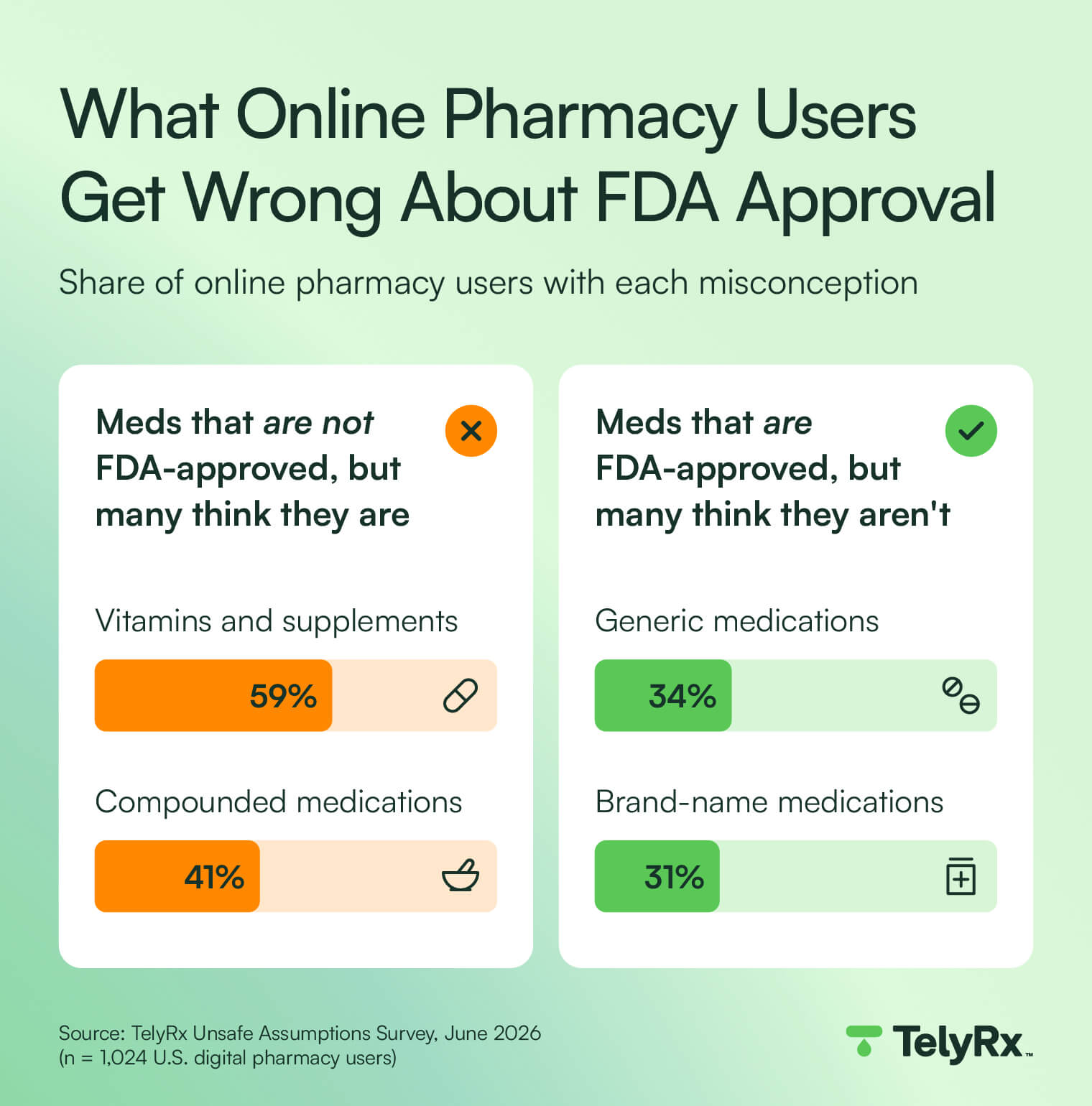
59% of users think vitamins and supplements are FDA-approved, and 41% think compounded medications are, even though neither goes through that approval process.¹ The FDA does regulate supplements, but under rules closer to those for food than for medication. Manufacturers don’t need FDA approval before selling a supplement, and the agency mainly steps in after a product is already on shelves.¹
Among the 27% of users who have questioned a medication they received, the most common red flags were a price that seemed too low (42%) and a package shipped from outside the U.S. (28%). Still, nearly two-thirds of users (64%) say they’ve never doubted the safety or authenticity of medication they bought online.¹ A national survey from the Alliance for Safe Online Pharmacies (ASOP) Foundation points to the same overconfidence, with 65% of consumers wrongly believing online pharmacy sites are reviewed or approved by regulators.16
Gen Z respondents were nearly four times as likely as Baby Boomers to check FDA or government resources before ordering (30% vs. 8%), and just 3% of Gen Z said they weren’t concerned about whether a site was trustworthy, compared with 18% of Boomers.¹
As more prescriptions move online in 2027, the patients who benefit most will be the ones who can spot online pharmacy scams before they place an order.
What These Digital Health Trends Mean for Patients in 2027
Across each of these digital health trends, patients are looking for care that fits their budgets and their daily lives. More of that care now happens online, so it pays to know which platforms to trust.
A new symptom or condition still requires a diagnosis from a licensed provider, in person or via telehealth. But once you know what you need, a few steps can make the rest easier:
- Ask about 90-day fills and home delivery for maintenance medications.
- Compare cash prices from reputable digital pharmacy platforms with your insurance costs, like copays and applicable deductibles, especially for generics.
- Make sure any online pharmacy requires a valid prescription and ships from inside the U.S.
- Look for National Association of Boards of Pharmacy (NABP) or LegitScript certification before you order.
TelyRx helps you fill and refill the prescriptions you already know you need, with transparent pricing and delivery to your door.
Methodology
The four TelyRx surveys were conducted by Centiment for TelyRx. The surveys were fielded between June and September 2026. The results are based on 4,195 completed surveys from U.S. adults aged 18 and older, with each survey screening for a specific group.
- Unsafe Assumptions: U.S. adults who have used an online pharmacy platform, n=1,024
- Managing Chronic Conditions: U.S. adults managing a chronic condition with prescription medication, n=866
- Skipped and Rationed Medications: U.S. adults taking prescription medication for an ongoing condition, n=1,256
- Health Stigma Survey: U.S. adults, balanced to Census benchmarks for age, gender, and region, n=1,049
Data for the first three surveys are unweighted. The margin of error is approximately ±3% for each survey’s overall sample at a 95% confidence level. Subgroups have a larger margin of error.
Sources
- TelyRx (July 2026). Survey of 1,000+ Users Reveals Widespread Misconceptions About Online Pharmacy Safety. Retrieved from https://telyrx.com/blog/news-research/unsafe-assumptions-report/
- TelyRx (September 2026). 58% Have Skipped, Rationed Meds in the Past Year. Retrieved from https://telyrx.com/blog/news-research/skipped-rationed-meds-in-the-past-year/
- TelyRx (August 2026). 69% of U.S. Adults With Chronic Conditions Struggle to Consistently Get Their Meds. Retrieved from https://telyrx.com/blog/news-research/managing-chronic-conditions/
- TelyRx (October 2026). Nearly a Third of U.S. Adults Avoid Medical Care Due to Stigma, 91% Say It’s Cost Them. Retrieved from https://telyrx.com/blog/news-research/health-stigma-survey/
- Pew Research Center (August 2026). From Diagnoses to Treatments, Why Americans Use AI Chatbots for Health. Retrieved from https://www.pewresearch.org/science/2026/08/25/from-diagnoses-to-treatments-why-americans-use-ai-chatbots-for-health/
- CMS (September 2026). Medicare Telehealth Trends Snapshot. Retrieved from https://data.cms.gov/sites/default/files/2026-09/Medicare%20Telehealth%20Trends%20Snapshot%2020260914_508.pdf
- CDC, National Center for Health Statistics (June 2026). Telemedicine Use Among Office-based Physicians in 2021 and 2024. Retrieved from https://cdc.gov/nchs/data/hestat/hestat120.htm
- HHS (February 2026). Telehealth Policy Updates. Retrieved from https://telehealth.hhs.gov/providers/telehealth-policy/telehealth-policy-updates
- Rock Health (June 2026). What’s Your Score? Insights on Wearables and Connected Devices From Rock Health’s 2025 Consumer Adoption Survey. Retrieved from https://rockhealth.com/insights/whats-your-score-insights-on-wearables-and-connected-devices-from-rock-healths-2025-consumer-adoption-survey/
- J.D. Power via Business Wire (July 2026). Care & Convenience: The New Rx for Pharmacy Satisfaction. Retrieved from https://www.businesswire.com/news/home/20260728365236/en/Care-Convenience-The-New-Rx-for-Pharmacy-Satisfaction
- KFF (October 2026). Americans’ Challenges With Health Care Costs. Retrieved from https://www.kff.org/health-costs/issue-brief/americans-challenges-with-health-care-costs/
- IQVIA Institute (June 2026). U.S. Medicine Use Trends 2026. Retrieved from https://www.iqvia.com/insights/the-iqvia-institute/reports/us-medicine-use-trends-2026
- ASHP (October 2026). National Drug Shortages, January 2001 to September 2026. Retrieved from https://www.ashp.org/-/media/assets/drug-shortages/docs/Drug-Shortages-Report.pdf
- KFF (March 2026). KFF Tracking Poll on Health Information and Trust, Use of AI for Health Information and Advice. Retrieved from https://www.kff.org/health-information-and-trust/poll-finding/kff-tracking-poll-on-health-information-and-trust-use-of-ai-for-health-information-and-advice/
- American Psychiatric Association (May 2026). 2026 Annual Mental Health Poll. Retrieved from https://www.psychiatry.org/News-room/News-Releases/2026-Annual-Mental-Health-Poll
- ASOP Foundation (2025). 2025 Consumer Behavior Survey. Retrieved from https://asopfoundation.pharmacy/wp-content/uploads/2025/11/ASOP-Foundation-2025-Consumer-Behavior-Survey.pdf
- JAMA Network Open (June 2026). Wearable Devices and Data Sharing in the US. Retrieved from https://jamanetwork.com/journals/jamanetworkopen/fullarticle/2850135
- USHHS Office of Inspector General (August 2025). Billing for Remote Patient Monitoring in Medicare. Retrieved from https://oig.hhs.gov/reports/all/2025/billing-for-remote-patient-monitoring/