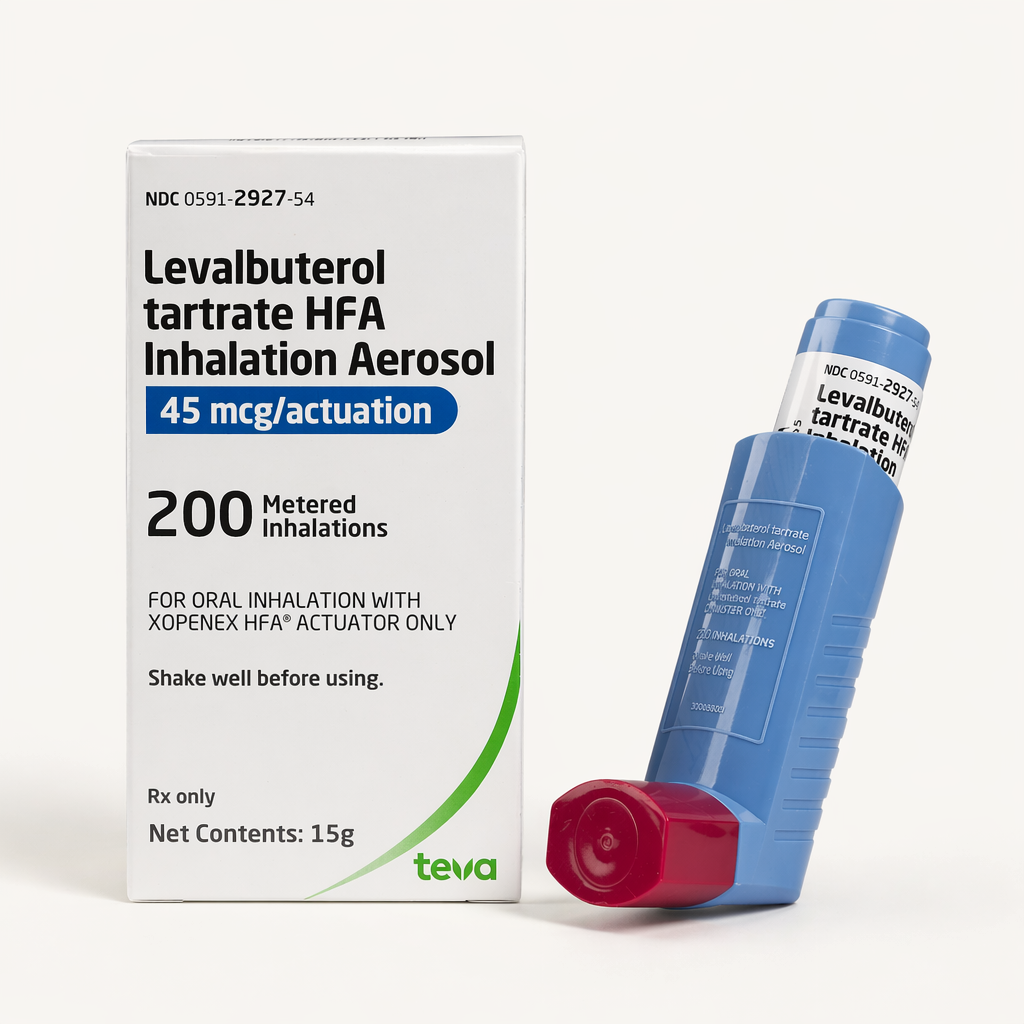
How It Works
Levalbuterol HFA works by targeting beta-2 adrenergic receptors that signal smooth muscle relaxation in the bronchial tubes. When you draw from the levalbuterol HFA inhaler, the mist enters your lungs, and the medication binds to these receptors, relaxing them. This process, known as bronchodilatation, improves the uptake of oxygen into the lungs.
| Quick Facts | |
|---|---|
| Common Brands | Xopenex HFA |
| Drug Class | Short-acting beta-agonist (SABA); bronchodilator |
| Generic Status | Generic version available |
| Availability | Prescription only |
Dosing
Since levalbuterol HFA is administered via a metered-dose inhaler, each draw delivers roughly 45 micrograms (mcg) of medication. Standard guidelines emphasize slow, deep breaths to help the medication reach peripheral airways.
- Standard adult dose: For the treatment of acute bronchospasm, doctors generally recommend 1 to 2 inhalations every 4 to 6 hours as needed.
- Preventive dosing: Per clinical guidelines, people with exercise-related bronchospasm can receive two inhalations approximately 15 to 30 minutes before engaging in physical activity.
- Maximum usage: Levalbuterol is generally safe to use as directed, but needing a rescue inhaler more than two days a week may indicate the patient’s underlying asthma is not effectively managed.
Note: Dosing information below is educational only. Your doctor will determine your specific dose based on your individual health needs. Dosing may vary. Always follow your healthcare provider’s instructions for exact dosing.
Uses
FDA-Approved Uses
Levalbuterol HFA is FDA-approved to treat acute bronchospasm, or sudden shortness of breath and wheezing in adults with reversible obstructive airway disease.
Off-Label Uses
You may see the levalbuterol HFA inhaler prescribed for uses that are not FDA-approved. This is a common practice called “off-label” prescribing, where a healthcare provider uses clinical judgment to prescribe a medication for a different, well-researched purpose.
Common off-label uses for levalbuterol HFA supported by clinical research and practice include:
- COPD flare-ups: While levalbuterol is generally used for asthma, some providers prescribe it to provide rapid relief for individuals with chronic obstructive pulmonary disease (COPD).
- Stable COPD management: For people with COPD who cannot tolerate long-acting medications, levalbuterol HFA may be prescribed as a scheduled bronchodilator.
Side Effects
Common Side Effects
While levalbuterol HFA is designed to target the lungs, some individuals may experience side effects. These are often temporary but should be monitored.
Common side effects associated with levalbuterol HFA include:
- Nervousness, tremors, and shaky hands
- Increase in heart rate or heart palpitations (tachycardia)
- Mild, transient headache
- Sore throat, runny nose, or mild cough following inhalation
- Dizziness immediately after use
- Nausea and vomiting
Serious Side Effects
While serious side effects are rare, it is important to recognize them and understand when to seek medical attention.
Potential serious side effects include:
- Paradoxical bronchospasm: In rare instances, this medication may cause an unexpected narrowing of the airways (bronchospasm) immediately after use. This is a medical emergency. If your breathing worsens after using the inhaler, seek emergency care right away.
- Cardiovascular stress: Some individuals, particularly those with pre-existing heart conditions, may experience increased blood pressure or irregular heart rhythms while using levalbuterol HFA.
- Hypokalemia (low potassium): Levalbuterol and similar medications can cause potassium levels to drop. People with hypokalemia may experience muscle cramps or heart rhythm changes.
- Severe allergic reaction: Like many medications, levalbuterol HFA can trigger a severe allergic reaction (anaphylaxis) in people who are allergic to any of its ingredients.
Call your doctor immediately if you experience any concerning or prolonged symptoms.
Pharmacist Tips
Shake Before Using
Shake the inhaler for at least five seconds before each use. This ensures the medication and propellant are properly mixed for an accurate dose.
Prime the Device
If the inhaler is new or has not been used in four days or more, it must be primed. To prime, spray four or five test puffs into the air, away from your face.
Wait Between Puffs
If your healthcare provider recommends two puffs for relief, wait approximately 60 seconds between them. This interval allows the first puff to begin opening the airways, making the second puff more effective for individuals experiencing bronchospasm.
Keep the Inhaler Clean
Regular cleaning prevents the plastic mouthpiece from becoming clogged with medication. To clean, remove the metal canister and rinse the plastic mouthpiece under warm water for 30 seconds. Allow the mouthpiece to air-dry completely before reassembling, ideally overnight.
Consider a Spacer
If coordinating your breath with the inhaler is difficult, ask your healthcare provider about a spacer. also known as a valved holding chamber. This device holds the medication mist in a chamber, allowing people to breathe in the dose more naturally and effectively.
Drug Interactions
Levalbuterol HFA may interact with other medications, particularly those affecting the heart or the sympathetic nervous system. It is essential for individuals to provide their healthcare provider and pharmacist with a complete list of all current medications, vitamins, and supplements.
Known interactions include:
- Beta-blockers: Medications such as atenolol and metoprolol, often used to manage blood pressure, can affect the effectiveness of levalbuterol. In some people with respiratory conditions, these drugs may trigger asthma symptoms.
- Diuretics (water pills): Taking non-potassium-sparing diuretics while using levalbuterol HFA can increase the risk of hypokalemia (low potassium levels).
- Digoxin: Levalbuterol may increase the concentration of digoxin in the bloodstream. Digoxin is commonly prescribed for individuals with heart failure or atrial fibrillation.
- MAOIs and tricyclic antidepressants (TCAs): Using monoamine oxidase inhibitors or tricyclic antidepressants within two weeks of levalbuterol can intensify cardiovascular side effects, such as increased heart rate or blood pressure.
Always disclose a complete list of your medications, vitamins, and supplements to your healthcare provider to check for potential interactions.
FAQs
Why did a healthcare provider prescribe levalbuterol instead of albuterol?
Providers may prescribe levalbuterol because it is less likely to produce side effects than standard albuterol. Levalbuterol has a simpler molecular makeup and does not contain the isomers that contribute to the older drug’s side effects.
Is levalbuterol a daily preventative inhaler or an emergency “rescue” inhaler?
Levalbuterol HFA is a rescue inhaler intended for rapid relief of sudden symptoms. Per standard guidelines, the drug does not treat the underlying inflammation that causes asthma and is not meant to replace a daily controller inhaler.
Why is Xopenex HFA more expensive than a standard Ventolin or ProAir inhaler?
Xopenex HFA and generic levalbuterol HFA are more expensive to manufacture than standard albuterol formulations, such as Ventolin and ProAir inhalers. This is due to the purification process required to isolate the isomers of albuterol, which help open the airways.
Do I need to shake and “prime” this inhaler before using it for the first time?
Yes, standard guidelines recommend priming the inhaler for the first use or if it has not been used for at least four days. To prime the inhaler, point it away from the face and release four puffs into the air. Shake the inhaler for five seconds before each use.
How do I clean the plastic mouthpiece?
Standard guidelines suggest removing the metal canister and rinsing the plastic actuator under warm water for about 30 seconds once per week. It is not advised to place the metal canister in water.
Can a spacer or holding chamber be used with this specific inhaler?
Yes, a spacer or holding chamber can be used with this specific inhaler. Many healthcare providers recommend a spacer to ensure the medication reaches the lungs rather than sitting in the back of the throat.
Does levalbuterol contain steroids?
No, levalbuterol does not contain steroids. This medication is a bronchodilator and muscle relaxant and is not a corticosteroid.
Can levalbuterol be used before exercising to prevent an asthma attack?
Yes, standard guidelines state that levalbuterol can be used before exercising to prevent an asthma attack. Healthcare providers generally recommend two puffs about 15 to 30 minutes prior to physical activity to prevent exercise-induced bronchospasm.
How is the dose counter read, and how is it known when the inhaler is empty?
Levalbuterol HFA inhalers usually feature a numerical display that counts down each puff. When the number turns red, this indicates the inhaler has approximately 20 puffs left.
Is it safe to use this inhaler if I am pregnant or breastfeeding?
Pregnant patients should discuss the use of levalbuterol HFA with their OB/GYN
What should I do if my breathing actually gets worse right after taking a puff?
If your breathing gets worse after taking a puff from your levalbuterol HFA inhaler, this may indicate paradoxical bronchospasm, a serious medical condition. If this occurs, patients should stop using their inhaler and contact their provider immediately.
Does levalbuterol interact with blood pressure medications?
Yes, levalbuterol interacts with some blood pressure medications. Beta-blocker drugs in particular can interfere with how levalbuterol works. Speak to your provider about interactions if you require blood pressure medication.
How many times a day is it safe to use this rescue inhaler?
Standard dosing calls for one or two puffs every 4 to 6 hours. If you need to use the inhaler more frequently, this may indicate your underlying asthma is not being effectively managed.
Does levalbuterol expire?
Yes, levalbuterol expires. The expiration date is printed on the canister. Expired inhalers may not deliver enough medication into the lungs.
Comparable Medications
Levalbuterol HFA Inhaler, Albuterol, Budesonide/Formoterol, Albuterol/Budesonide, Fluticasone/Budesonide, Levalbuterol Inhalation Solution?
Levalbuterol HFA is a mist inhaler used to treat acute bronchospasm in people with conditions such as asthma or COPD. The levalbuterol HFA inhaler is a widely prescribed form of the drug. This is not the only medication of its kind available, and your doctor may recommend an alternative to the levalbuterol HFA inhaler instead. Levalbuterol HFA inhaler alternatives include:
Albuterol HFA
From $39.99
Sold under brand names like ProAir and Ventolin, albuterol is considered the standard rescue inhaler. Its racemic composition allows for R-isomers to assist with airway dilation during bronchospasm. It may also include inert isomers that cause side effects. Because Levalbuterol HFA contains select R-isomers, it may be the better option for patients who cannot tolerate albuterol's side effects.
Brodesonide/formoterol
Sold under the brand name Symbicort, this combination medication contains a steroid and a long-acting bronchodilator.
Albuterol/brodesonide
This combination medication is sold under the brand name Airsupra. Its dual-action mechanism opens the airways and delivers a steroid to reduce inflammation.
Fluticasone and budesonide
Fluticasone (Flovent) and budesonide (Pulmicort) are steroid-based maintenance inhalers intended for long-term prevention of respiratory symptoms. Unlike levalbuterol, these medications do not provide quick relief during sudden bronchospasm episodes.
Levalbuterol Inhalation Solution
From $79.99
Levalbuterol is also available as an inhalation solution delivered through a nebulizer, which converts the liquid into a mist over five to 10 minutes. Nebulizers are typically reserved for individuals prone to severe asthma attacks who may struggle to use an inhaler. The levalbuterol HFA inhaler is a more cost-effective alternative for people who require quick relief from bronchospasm and can operate an inhaler.
We Have the Levalbuterol HFA Inhaler in Stock. Get Yours Today!
Important: Information on this page is for educational purposes only. Prescribing decisions are made by independent, licensed providers. TelyRx operates technology-enabled pharmacies and a telehealth platform that connects patients with licensed providers. Prescriptions, when provider-approved and issued, are filled and shipped by TelyRx-affiliated pharmacies. We do not employ physicians or make prescribing decisions. Learn more about our editorial standards here.