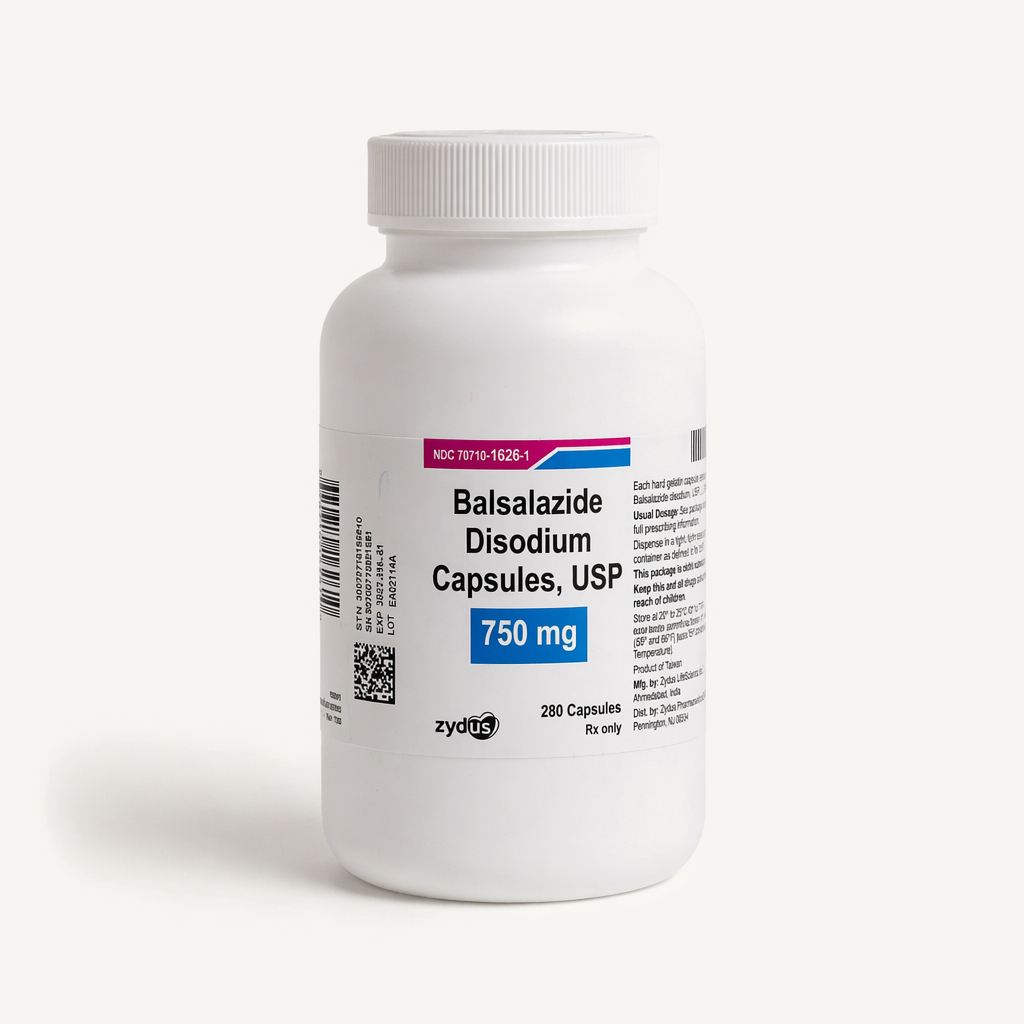
How It Works
Balsalazide capsules work by blocking the production of proteins and chemicals that trigger inflammation. By converting to mesalamine (5-aminosalicylic acid) within the colon mucosa, the medication inhibits the enzymatic pathways that lead to swelling and tissue damage.
This process helps the colon heal after a UC flare-up and can induce clinical remission, improving quality of life. Balsalazide does not generally carry systemic side effects.
| Quick Facts | |
|---|---|
| Common Brands | Colazal |
| Drug Class | Aminosalicylate (5-ASA) |
| Generic Status | Generic version available |
| Availability | Prescription only |
Dosing
Balsalazide capsules are generally administered at high doses to ensure sufficient active medication reaches the lower intestine.
- Standard dosage: Per clinical guidelines, the standard balsalazide capsule dosage for adults is 2.25 grams taken three times daily. Treatment typically runs for 8-12 weeks to achieve full therapeutic effect.
- Administration: Patients should never crush or chew the capsules. People who struggle to swallow larger pills can open the capsule and sprinkle the contents onto a small amount of applesauce, provided they swallow the mixture immediately without chewing the granules.
Note: Dosing information below is educational only. Your prescribing physician will determine your specific dose based on your individual health needs. Always follow your healthcare provider’s instructions for exact dosing.
Uses
FDA-Approved Uses
Balsalazide capsules are FDA-approved for the treatment of active, mild-to-moderate ulcerative colitis. The drug is specifically indicated for the induction of remission, or the period during which active symptoms are under control.
Off-Label Uses
You may see balsalazide capsules prescribed for uses that are not “FDA-approved.” This is a very common and legal practice called “off-label” prescribing, where a doctor uses their clinical judgment to prescribe a drug for a different (but well-researched) purpose.
Common off-label uses for balsalazide capsules currently found in clinical research and practice include:
- Maintenance of ulcerative colitis remission: While researchers have primarily studied balsalazide’s role in treating active ulcerative colitis (UC) flares, some providers also recommend the drug for long-term maintenance to prevent future UC symptoms.
- Crohn’s disease: Some doctors prescribe the drug off-label to patients with Crohn’s disease that primarily affects their large intestine.
Side Effects
Patients usually tolerate balsalazide capsules well because the medication acts in the gut rather than throughout the body. However, side effects can still occur.
Common Side Effects
Common side effects of taking balsalazide capsules include:
- Headache
- Abdominal pain or cramping
- Nausea or vomiting
- Diarrhea
- Joint pain
- Sore throat, runny nose, cough, and other respiratory symptoms
- Fatigue or insomnia
Serious Side Effects
Serious side effects are rare, but it’s important to know what to look for if they do occur. Serious side effects from taking balsalazide capsules can include:
- Renal impairment: Balsalazide capsules carry a risk of leading to kidney damage and the formation of kidney stones. Signs include decreased urination, blood in the urine, and severe pain on the side or back.
- Acute intolerance syndrome: Some people who take balsalazide capsules experience a reaction that mimics the symptoms of worsening ulcerative colitis. This can include severe cramps, bloody diarrhea, fever, and a rash.
- Hepatotoxicity: While rare, some people have reported liver issues after taking balsalazide. Symptoms can include jaundice (yellowing) of the skin and eyes, and dark-colored urine.
- Severe skin reaction: Balsalazide capsules can lead to severe skin reactions like Stevens-Johnson syndrome or drug reaction to eosinophilia and systemic symptoms (DRESS) syndrome. Both are considered medical emergencies, with symptoms including peeling skin, blisters, and a widespread red rash.
Call your doctor immediately if you experience any concerning or prolonged symptoms.
Pharmacist Tips
Practice Proper Hydration
Drink plenty of fluids throughout the day while taking balsalazide capsules. Proper hydration helps your kidneys process the medication and reduce your risk of developing kidney stones.
Watch For The Bleaching Effect
One noticeable side effect of balsalazide is that your urine may turn reddish-brown if it comes into contact with bleach after taking the medication. This is considered a normal chemical reaction. However, standard guidelines recommend contacting a doctor if urine is reddish-brown in color before coming into contact with bleach.
Practice Sun Safety
Balsalazide can increase your skin’s sensitivity to sunlight. Per standard guidelines, wear protective clothing and SPF 30+ sunscreen to protect your skin when you are outside.
Try Taking The Capsule With Food
Standard guidelines state patients can take the capsule with or without food. However, a light meal or snack at the time of dosing can reduce your risk of an upset stomach after taking the capsule.
Drug Interactions
While formulated to work within the gut and not systemically, balsalazide can still interact with other medications and substances. Known interactions with balsalazide include:
- Nonsteroidal anti-inflammatory drugs (NSAIDs): Taking NSAIDs like ibuprofen or naproxen alongside balsalazide can strain the kidneys and increase your risk of kidney damage.
- Immune modifiers: Immune modifier medications such as azathioprine and 6-mercaptopurine can interact with balsalazide. This interaction potentially increases the risk of developing a blood disorder.
- Antibiotics: Balsalazide relies on gut bacteria to work. Certain antibiotics can interfere with these mechanisms.
Always give your doctor and pharmacist a complete list of all your medications, vitamins, and supplements to check for potential interactions.
FAQs
Why do I have to swallow 9 capsules every single day for this medication to work?
Balsalazide requires a high dose to ensure that sufficient medication reaches the colon after gut bacteria convert it to mesalamine. Nine capsules roughly equate to the standard recommended daily dosage for adults.
Can I open the capsules and sprinkle the powder on food if I can’t swallow them?
Yes, standard guidelines state you can open the balsalazide capsules and sprinkle the powder on food if you are unable to swallow them. Applesauce is recommended, and patients are advised not to chew the granules as they swallow the mixture.
What is the difference between taking balsalazide and standard mesalamine?
Both balsalazide and standard mesalamine deliver the same active ingredient into your gut, but they have different release mechanisms. Balsalazide is activated in the colon by bacteria, which convert it to mesalamide, while mesalamide is released at different points along its journey through the digestive tract.
Why did my ulcerative colitis symptoms seem to get worse after starting this drug?
In rare cases, patients can develop a condition called acute intolerance syndrome that mimics an ulcerative colitis flare-up. If you notice increased cramping or bloody stool, standard guidelines advise contacting your provider immediately.
Is it safe to take this medication if I have an allergy to sulfa antibiotics?
Balsalazide does not contain sulfa, so it is generally considered safe for people with sulfa allergies. However, clinical guidelines state that people who are allergic to salicylates, such as aspirin, should not take balsalazide.
Should I take balsalazide capsules with a big meal?
Per the standard guidelines for balsalazide, you may take your capsules with or without food. However, a meal timed with your dosage can reduce your risk of an upset stomach.
Will taking this medication cure my ulcerative colitis?
No, balsalazide will not cure ulcerative colitis, a chronic medical condition with no known cure. Balsalazide can induce and maintain remission to help patients remain free of symptoms.
Does this drug suppress my immune system?
Balsalazide is an anti-inflammatory medication that works locally in the gut. Unlike other inflammatory bowel disease treatments, such as biologics and steroids, balsalazide is not considered a systemic immunosuppressant.
Can I safely take NSAIDs while taking this?
Taking NSAIDs like ibuprofen and naproxen alongside balsalazide can increase your risk of kidney damage. Talk to your provider about whether you should take both types of medication and, if so, how much of each to take.
Will taking this cause weight gain or give me a “moon face” like other steroids?
No, balsalazide is not a steroid and should not cause the same side effects as steroidal medications.
Is it safe to use this medication if I am currently pregnant or breastfeeding?
Doctors may prescribe balsalazide for pregnant or breastfeeding patients if the benefits of taking the drug outweigh risks to maternal and fetal health. The medication can pass into breast milk, so standard guidelines advise breastfeeding patients to monitor their infants for diarrhea. As with any drug during or immediately after pregnancy, patients should consult their provider or OB/GYN before taking balsalazide.
Can I safely drink alcohol while taking balsalazide?
There are no known direct interactions between balsalazide and alcohol, but doctors generally advise their patients to reduce alcohol intake. Alcohol can worsen gastrointestinal symptoms like diarrhea, irritate the gut, and increase the risk of ulcerative colitis relapse.
Does balsalazide work for Crohn’s disease, or is it just for ulcerative colitis?
Balsalazide is FDA-approved to manage ulcerative colitis, but doctors may prescribe the drug off-label to manage symptoms of Crohn’s disease that affect the colon.
What should I do if I completely forget one of the doses?
If you forget a balsalazide dose, standard guidelines recommend taking it as soon as you remember. If it’s almost time for your next dose, guidelines recommend skipping the missed dose entirely, rather than taking two full doses close to one another.
Comparable Medications
Balsalazide Capsules, Sulfasalazine, Lialda, Prednisone, or Adalimumab?
Balsalazide is a prodrug that is converted to mesalamine in the gut and formulated to manage symptoms of ulcerative colitis. Your provider may recommend this medication or an alternative to balsalazide capsules, depending on your medical history and the severity of your symptoms. Balsalazide capsule alternatives include:
Sulfasalazine
Sold under the brand name Azulfidine, sulfasalazine is an older aminosalicylate medication that contains mesalamine and a sulfa component. It is effective, but patients with sulfa allergies may need an alternative.
Lialda
Lialda is a brand-name version of mesalamine that slowly releases medication throughout the colon. Doctors typically prescribe Lialda as a once-daily dose, so it does not need to be taken as frequently as balsalazide capsules.
Prednisone Tablets
From $35.99
This is a systemic corticosteroid that provides rapid relief of inflammation. It works quickly but also carries a higher risk of side effects such as weight gain, mood changes, and bone density loss. Prednisone is mostly used for induction in patients who fail previous therapy or who present with moderate to severe disease, and it is usually not appropriate for maintenance. Balsalazide is generally preferred for mild-to-moderate ulcerative colitis that does not require immediate relief of inflammation.
Adalimumab
Sold under the brand name Humira, adalimumab is an injectable biologic medication primarily used to manage moderate-to-severe ulcerative colitis that does not respond to aminosalicylates like mesalamine. Balsalazide is often prescribed as first-line treatment for UC, while adalimumab may be reserved for more advanced cases.
We Have Balsalazide Capsules in Stock. Get Yours Today!
Important: Information on this page is for educational purposes only. Prescribing decisions are made by independent, licensed providers. TelyRx operates technology-enabled pharmacies and a telehealth platform that connects patients with licensed providers. Prescriptions, when provider-approved and issued, are filled and shipped by TelyRx-affiliated pharmacies. We do not employ physicians or make prescribing decisions. Learn more about our editorial standards here.