

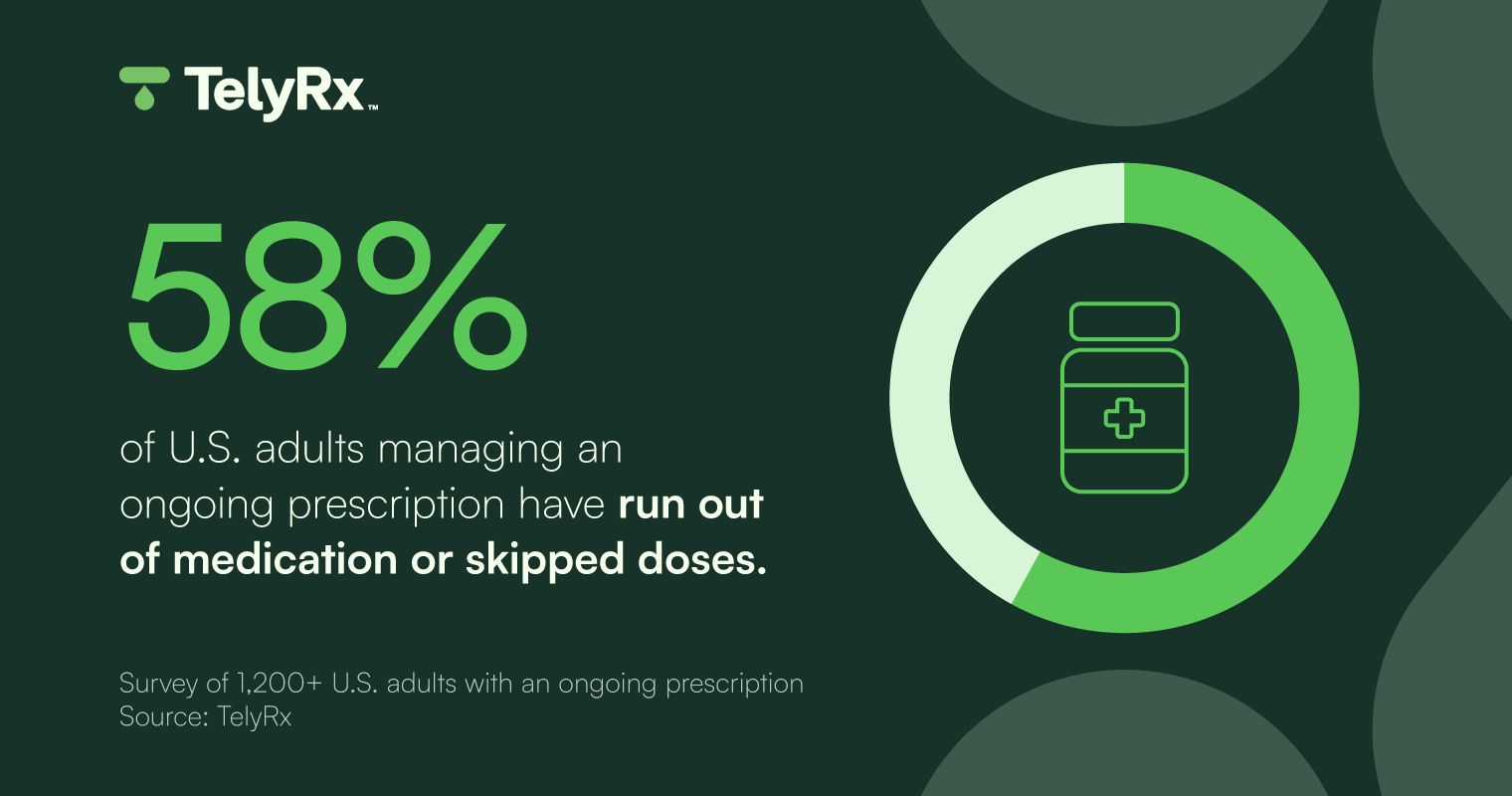
Paying for prescriptions out of pocket can add up quickly, especially for medications you take regularly. To combat costs, many people end up stretching what they have. In a TelyRx survey of more than 1,200 U.S. adults who manage an ongoing prescription, 58% said they had run out of medication or rationed doses to make their supply last longer.
But there are other things you can do to make your medication more affordable without endangering your health by skipping doses. Even if you do not have health insurance, you can lower your prescription costs.
Key Takeaways
- Without insurance, comparing pharmacies can make a bigger difference in what you pay than many people realize.
- Generic medications are typically the lowest-cost option when one is available.
- TelyRx lists medication prices upfront and charges a flat $22 provider review fee per order, with no subscription required.
- Discount cards are free to use, and comparing their prices against a pharmacy’s cash price can lower what you pay when you fill a prescription.
- Community health centers, patient assistance programs, and Medicaid offer income-based help with prescription costs.
Below, we cover eight ways to lower your costs, from using digital pharmacy platforms and discount cards to finding programs that provide free or reduced-cost medication.
1. Use an Online Pharmacy or Digital Pharmacy Platform (Like TelyRx)
Cost range: Varies by platform
Online pharmacies fulfill and ship medications for those with existing prescriptions. If you do not have a current prescription, a digital pharmacy platform like TelyRx can bridge the gap between telehealth and medication access.
Many digital pharmacy platforms let you request a prescription online and have it filled and shipped to your home, often without needing an in-person doctor’s visit. For people paying out of pocket, this can make costs easier to plan for because there is no separate doctor’s appointment fee and most platforms show medication costs upfront.
For example, with TelyRx, all medication costs are clear and visible for browsing, even before you create an account. TelyRx operates outside of insurance, so patients do not need to worry about coordinating pre-authorizations, deductibles, insurance plan formularies, and unexpected costs. Browse more than 500 FDA-approved medications and submit your prescription request online.
If you request a new prescription, TelyRx works behind the scenes to have an independent provider licensed in your state review your request and your health attestation. If appropriate and safe, the provider issues a prescription, which TelyRx’s licensed pharmacies fulfill and ship to your door in discreet packaging.
Here’s how pricing works:
- Medication price: On most platforms, medication prices are listed upfront.
- Provider review fee: Platforms that include a telehealth component allow patients to request a new prescription when placing an order. This may incur a provider fee, which is typically lower than the cost of an in-person doctor visit. For example, TelyRx has a flat $22 fee, which covers the provider review for your entire order, whether you request one medication or several. If you already have a prescription and TelyRx carries an exact match, you can transfer it instead and waive the review fee.
- No subscriptions: Some platforms require an ongoing subscription; to save on costs, make sure the platform you’re using doesn’t have this requirement. For example, TelyRx doesn’t require a membership or charge recurring subscription fees, so you only pay when you submit a request.
If your request isn’t approved, your medication cost is automatically refunded. Requests can be submitted seven days a week, including evenings, and most reviews are completed within hours. Learn more about how TelyRx works.
Ready to explore prescription access without insurance constraints?
2. Use a Prescription Discount Card
Cost range: $0 to use; your price depends on the card’s negotiated rate at that pharmacy
A prescription discount card is a card or digital coupon that can reduce the price of your medication at the pharmacy. Unlike insurance, it doesn’t involve premiums or claims. The company behind the card negotiates set prices with participating pharmacies, and you get that rate when you show the card.
These cards are usually offered by third-party companies through a website or app, and you don’t need insurance to use one. Most are free because the card company earns a small fee from the pharmacy each time it’s used.
Before you use one:
- Prices vary by card: Different discount cards negotiate different rates, so the same medication at the same pharmacy can cost more or less depending on which card you use. Checking multiple cards before filling your prescription can help you find the lowest price.
- You still need a prescription: A discount card brings down your cost at the pharmacy, but it doesn’t replace the prescription itself.
- You shouldn’t pay for a card: The FTC has taken action against schemes that charged consumers for discount cards that were otherwise available at no cost. If a card requires an upfront or membership fee, look elsewhere. The same caution applies to online pharmacy scams that promise deep discounts.
3. Shop Around at Different Pharmacies
Cost range: $0 to compare; cash prices for the same prescription vary by pharmacy
Pharmacies set their own cash prices, so the same medication can cost noticeably more at one store than another. Those prices depend on what each pharmacy pays its suppliers, its pricing policies, and its prescription-filling fees.
Comparing a few options before you fill your prescription is one of the simplest ways to lower your cost. Start by calling nearby pharmacies and asking for the cash price of your exact medication, including the strength and quantity listed on your prescription.
Once you find a lower price, the new pharmacy can typically transfer your prescription from your current pharmacy, though rules are stricter for certain controlled substances.
4. Ask for Generic Medications
Cost range: Typically about 85% less than the brand-name version
A brand-name medication is the version of a drug made by the company that developed it. Once its patent expires, other companies can make a generic version that contains the same active ingredient and is FDA-approved to work the same way, usually at a lower price.
If you’re prescribed a brand-name medication, ask your pharmacist whether a generic version is available.
Pharmacists can often substitute an FDA-approved generic at the counter, but each state has its own rules for when and how that substitution can happen. Your prescriber can also mark a prescription to be filled exactly as written, in which case you’d need their approval to switch from a brand-name prescription to a generic formulation.
If no generic exists for your medication, ask your prescriber whether a different drug that treats the same condition is available as a generic. Medications in the same class don’t always work the same way for everyone, so only your prescriber can decide whether a switch makes sense for you.
You can also check whether a generic version of your medication exists using the FDA’s Orange Book, which lists approved drugs and identifies which generics are considered therapeutically equivalent to brand-name products.
5. Request a 90-Day Supply
Cost range: Higher upfront cost, but often a lower cost per dose at some pharmacies
If you take medication every day for an ongoing condition, like high blood pressure or high cholesterol, ask your prescriber about filling a supply that lasts longer than a month. A 90-day supply is the most common option, but any quantity that covers more than a month can help reduce overall costs.
At some pharmacies, filling a larger supply at once lowers your cost per dose and reduces the number of refill trips. The supply is measured by how many days your medication will last. If you take two pills a day, for example, a 90-day supply would be 180 pills.
Your prescriber will need to write the prescription for that quantity, so it’s easiest to ask when you’re getting a new prescription or renewing one. This option works best once you’re settled on a medication and dose. If you’re starting something new, your prescriber may begin with a shorter supply to see how it works for you.
Some medications, including certain controlled substances, also have limits on how much can be dispensed at once.
6. Visit a Community Health Clinic or Federally Qualified Health Center (FQHC)
Cost range: Income-based, from a small nominal fee to the full fee. Medication discounts vary by center.
Federally qualified health centers (FQHCs), often called community health centers, are clinics supported by the Health Resources and Services Administration (HRSA) that provide primary care to people of all ages, regardless of insurance status.
What you pay is based on a sliding fee scale tied to your income, so a visit to get a new prescription or to renew an existing one may cost less than at a private practice.
FQHCs can also help lower the cost of the medication itself. Health centers are eligible for the federal 340B Drug Pricing Program, which allows them to purchase outpatient medications at reduced prices.
Many centers use those savings to offer discounted or free medications to their uninsured patients. However, the covered medications vary by location.
To find a health center near you, search by address or ZIP code using HRSA’s Find a Health Center tool.
7. Apply for a Patient Assistance Program (PAP)
Cost range: Free to apply; eligible patients get medication free or at a reduced cost
Patient assistance programs (PAPs) are run by drug manufacturers and provide medications for free or at a reduced cost to eligible individuals.
They mostly cover brand-name drugs, so they’re especially helpful when a medication has no generic option. Eligibility is usually based on income, and many programs require that you have no other prescription coverage.
To apply, submit a separate application for each medication, along with proof of income, plus a section completed by your prescriber.
Approval can take several weeks, so apply before you run low on your current supply. To find a program, check the manufacturer’s website or search by drug name using PhRMA’s free America’s Medicines tool.
8. Check Medicaid or Other Government Program Eligibility
Cost range: $0 to about $8 per prescription for most enrollees
Medicaid provides free or low-cost health coverage to people with limited incomes, and every state’s program covers outpatient prescription drugs. Medication copays under Medicaid are typically small, and some enrollees pay nothing at all.
Eligibility is largely based on your income and household size, and the rules vary by state. Some will change in 2027, so check with your state’s Medicaid agency for current requirements.
Medicaid doesn’t have an enrollment period, so you can apply at any time through your state Medicaid agency or HealthCare.gov.
Why Prescription Costs Vary Without Insurance
When you pay out of pocket, you’re charged the pharmacy’s cash price, which can vary widely for the same medication. Knowing what drives those differences can help you decide which of the options above to try first.
The factors that tend to have the biggest impact on cash prices:
- Generic vs. brand-name: When several companies make the same generic, prices are typically about 85% lower than the brand-name version. Newer drugs still under patent won’t have a generic option yet.
- Pharmacy type: Cash prices for generic drugs tend to be lowest at big-box pharmacies and highest at independent and small-chain pharmacies. Brand-name prices vary less across pharmacy types.
- Location: Two pharmacies near each other can charge different prices for the same prescription.
- Dosage and supply: Your prescribed strength and form also affect the total, along with how many days’ supply you fill at once.
Because these factors combine differently for every medication, the cheapest route for one prescription won’t always be the cheapest for the next.
Get Your Prescription Filled Without Overpaying
The cheapest way to get a prescription without insurance depends on the medication you need and how often you fill it, so it helps to compare a few options before you fill it.
With TelyRx, you can see your medication’s price upfront and submit your request online. We’ll arrange for an independent provider licensed in your state to review your request. If the provider issues a prescription, we’ll fill your prescription and deliver it to your door.
Search for your medication on TelyRx today.