Having medicine delivered to your door has become a routine part of getting care. Whether you are refilling a prescription or ordering medication you’d rather not pick up in person, the process is generally safe and hassle free. Or at least, it should be. But not every online pharmacy is legitimate, and the wrong one can put your health and personal information at risk.
That risk is easier to miss than you’d think, with 64% of online pharmacy users saying they’ve never doubted the safety or authenticity of a medication they ordered, according to TelyRx’s unsafe assumptions report. But instead of assuming safety, know how to check for it before placing an order.
That starts with knowing the red flags that signal a pharmacy isn’t what it claims to be. From there, it’s about confirming that a pharmacy is licensed and a real provider is behind every prescription, what to check once your order arrives, and safer ways to lower your costs without cutting corners on safety.
How Online Pharmacy Purchases Actually Work
When working with a legitimate digital platform, every prescription you fill goes through a real, licensed pharmacy. You’ll usually come across one of two types of legitimate pharmacies:
- Digital arms of brick-and-mortar pharmacies: Like CVS or Walgreens. These let you order refills or transfer prescriptions online, but the pharmacy itself is tied to a physical location you could walk into.
- Digital pharmacy platforms: These operate entirely online, but must hold the same state pharmacy licensure as traditional brick-and-mortar pharmacies.
Either way, the pharmacy has to be licensed by the state board of pharmacy, including in the state it ships to. That’s why checking a platform’s license matters before you order.
Red Flags That Signal a Fraudulent Online Pharmacy
Knowing how legitimate pharmacies operate makes it easier to spot the ones that don’t follow the same standards. A few warning signs come up again and again with illegitimate pharmacies. If you spot any of these, treat it as a reason to stop and look elsewhere:
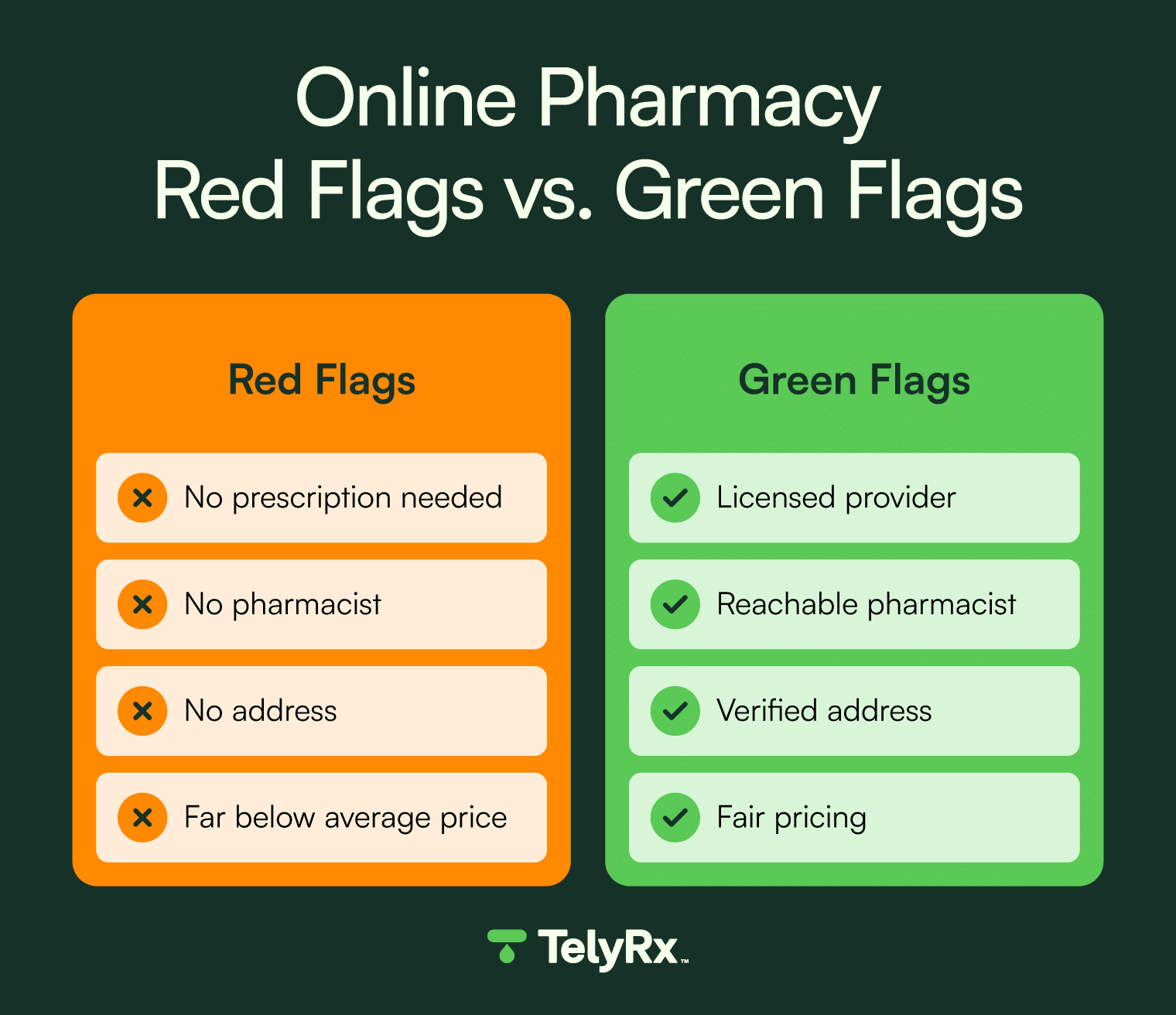
- No prescription required: A legitimate pharmacy will never sell prescription medication without one.
- No way to reach a pharmacist: If there’s no pharmacist or licensed staff to answer questions, that’s a problem.
- No verifiable U.S. address: A missing or incomplete physical address is a common trait of unlicensed online pharmacies.
- Prices far below market rate: Deep discounts on prescription drugs are often a warning sign. If it seems too good to be true, it likely is.
If you want a full breakdown of warning signs, research ways to spot online pharmacy scams.
Step-by-Step Guide to Buying Medication Online Safely
Buying medication online safely comes down to a few checks before you order, and a few more once your medication arrives.
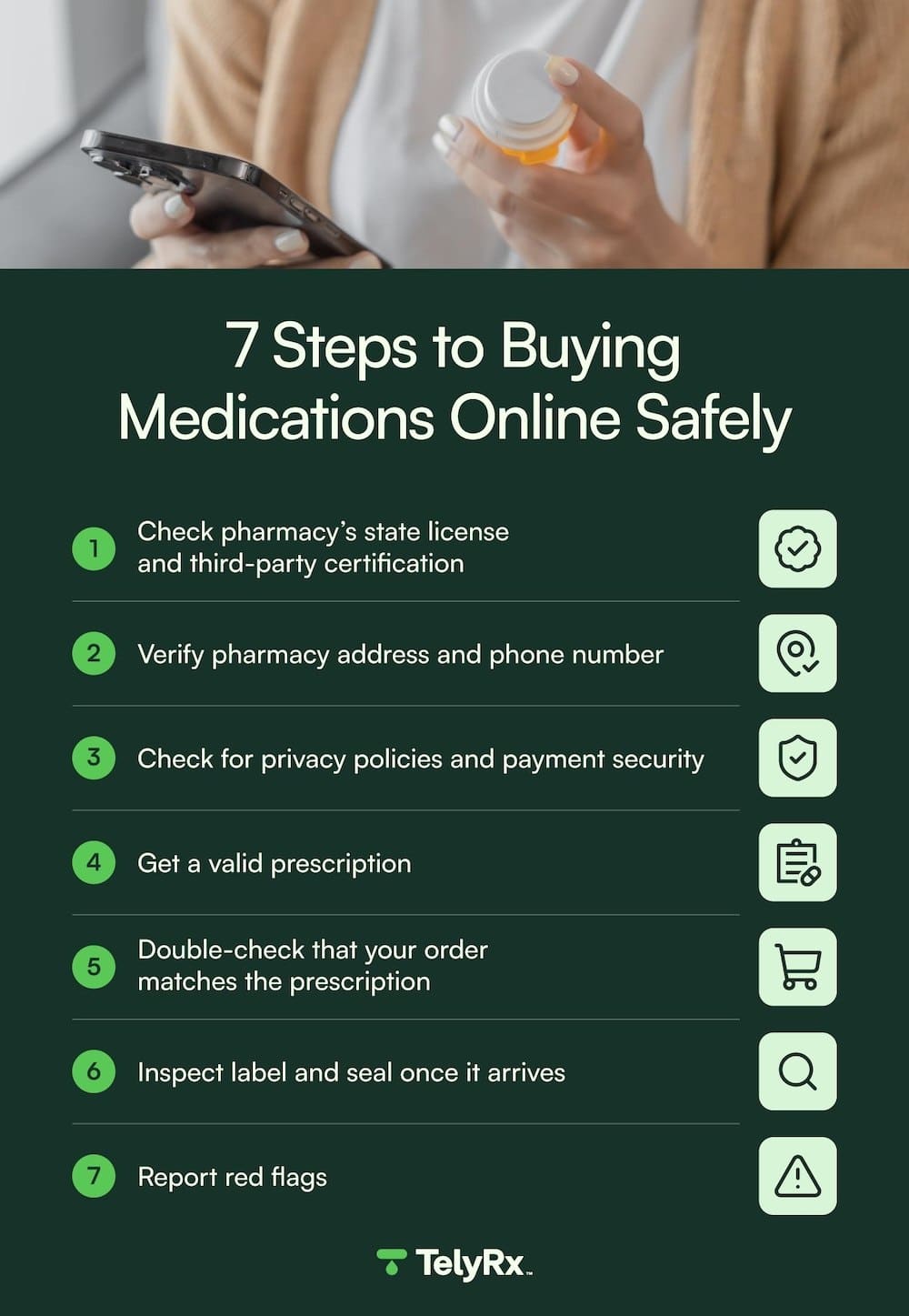
Follow these steps to confirm the pharmacy is legitimate and your medication is what your provider prescribed.
Step 1: Research and Verify the Pharmacy
Before you share any health information or submit a request, confirm that the pharmacy is legitimate.
Start with your state’s board of pharmacy website. Every state licenses the pharmacies operating within it, and most boards offer a free lookup tool where you can search by pharmacy name and confirm the license is active. Be sure to use your state board’s official directory instead of relying on a third-party directory that may be out of date.
You’ll also want to check whether the platform holds a third-party certification like LegitScript certification. LegitScript is an independent organization that reviews pharmacies against U.S. pharmacy laws and regulations, so a certified pharmacy has already been vetted against that standard. A certified pharmacy will display that certification on its site.
If you’re comparing multiple platforms at this stage, our roundup of the best online pharmacy options is a good place to start.
Step 2: Confirm the Platform’s Contact Information Is Real
A legitimate pharmacy will list a working phone number and a real street address, along with a way to reach a licensed pharmacist with questions about your medication. If that information is missing or leads nowhere, it’s a sign the pharmacy may not be who it claims to be.
A quick check goes a long way. Search the listed address to confirm it’s a real business location, and make sure the address matches the one on the pharmacy’s state license.
Step 3: Check Payment and Privacy Policies
Next, check how the platform handles your information. The platform should have robust privacy protocols, and all health information should be kept safe with Health Insurance Portability and Accountability Act (HIPAA)-level protections. HIPAA limits how pharmacies can use and share your health information, including selling it to other businesses without your permission.
Look for information about how your health information and other data will be stored and protected. For example, TelyRx follows strict HIPAA-level privacy requirements.
Then, look for a secure checkout, indicated by “https” in the URL, and stick to payment methods like a credit card, which generally offer more consumer protections if you need to dispute a charge for any reason. A pharmacy that only accepts wire transfers or gift cards should be an immediate dealbreaker.
Step 4: Get a Valid Prescription
Once you’ve confirmed the pharmacy is legitimate, you’ll need a prescription. No legitimate pharmacy, online or otherwise, will dispense a prescription drug without one. This is a legal requirement and non-negotiable. But you do not necessarily have to wait weeks for an opening in your doctor’s schedule to get a much-needed prescription.
Some digital pharmacy platforms require an appointment with one of their providers, but TelyRx doesn’t. There’s no call to schedule or exam to sit through. Instead, you fill out a health profile when you create an account as well as a physical attestation. When you order medication, an independent, state-licensed provider reviews it along with your prescription request and health history for safety.
If the provider determines that the medication is appropriate for you, they issue you a new prescription, which TelyRx fulfills at one of our pharmacy locations and ships to your door.
Step 5: Review Your Order Before Checkout
This step is a quick check to catch simple mistakes before you pay. Before you complete your order, double-check that the checkout page matches exactly what your provider prescribed: same drug name, dosage, and quantity.
Small mix-ups, like selecting a different dosage strength or a lower quantity than you meant to, are worth catching before you pay rather than after your order ships.
If anything doesn’t match, edit your order before submitting it.
Step 6: Inspect the Medication When It Arrives
The last check happens the moment your medication lands on your doorstep. Check that the packaging is intact and that the label matches your prescription details, including:
- Your full name
- The correct drug name
- The correct dosage
- The expected quantity
Confirm the medication’s expiration date gives you enough time to use the medication, and note the lot number in case you need to reference it later.
Contact the pharmacy before taking the medication if anything looks off, like damaged packaging or a label that doesn’t match what you ordered.
Step 7: Report Suspicious Entities or Products
If you come across a pharmacy that seems fraudulent, or you receive medication that arrives tampered with or mislabeled, don’t just move on.
Report a suspected counterfeit or adverse reaction to the FDA’s MedWatch program, which tracks safety and product quality problems with medical products, including prescription drugs.
You can also report the pharmacy itself to the National Association of Boards of Pharmacy (NABP) through its suspicious site reporting form. NABP maintains a list of pharmacies that fail to meet state licensing and safety standards, and reporting a suspicious site helps flag it for other consumers, even if you’ve already resolved the issue with your own order.
What to Do If You Received Counterfeit or Unsafe Medication
Counterfeit medication doesn’t always announce itself, so treat any warning sign as a reason to pause rather than assume it’s fine.
Here’s what to do:
- Stop taking the medication immediately.
- Contact your healthcare provider, or call Poison Control at 1-800-222-1222 if you’re experiencing any adverse reactions.
- Keep the packaging, shipping materials, and any remaining pills. Don’t throw them away. They may be needed for reporting or testing.
- Report the product to the FDA through MedWatch, either online at fda.gov/safety/medwatch or by phone at 1-800-FDA-1088.
- File a complaint with the NABP and with the state board of pharmacy where the pharmacy is licensed.
- Report the website to the FBI’s Internet Crime Complaint Center (IC3) if you suspect fraud.
- Dispute the charge with your bank if you paid by credit card.
Signs you’ll want to watch for include a pill that looks different from previous refills, medication in an unusual color or imprint, a broken or resealed safety seal, misspellings on the label, or a medication that doesn’t seem to work the way it should.
A different-looking pill isn’t always a red flag, though. Generic formulations are often made by multiple manufacturers, so your refill may look different if your pharmacy switches suppliers. When in doubt, check with the pharmacy before taking it.
Safer Ways to Reduce Medication Costs Without Risking Your Health
Steep prices at the local pharmacy counter can make a heavily discounted, unlicensed website look appealing, even when something about it feels off.
But affordability and safety aren’t mutually exclusive. There are legitimate ways to lower your medication costs without gambling on where that medication came from.
FDA-Approved Generic Substitutions
Generic medications go through FDA review to confirm they’re bioequivalent to their brand-name counterparts, meaning they work the same way in the body at the same dose.
The only real differences are inactive ingredients like fillers or dyes, which don’t affect how the medication works.
Because generics don’t carry the same development and marketing costs as brand-name drugs, they’re often significantly cheaper. According to the FDA, a single generic competitor can bring prices down by 30%, and once five or more generics are on the market, prices can drop by nearly 85%.
Before assuming you need the brand-name medication, ask your provider or pharmacist whether a generic version is available.
Manufacturer Patient Assistance Programs (PAPs)
Many pharmaceutical manufacturers offer Patient Assistance Programs, which provide free or reduced-cost medication to patients who meet certain income or insurance criteria. These programs are typically run directly by the drug manufacturer and are available regardless of where you fill your prescription.
To find one, start with NeedyMeds.org or RxAssist.org. Both let you search by medication name to see which manufacturer programs exist, what the eligibility requirements are, and how to apply.
Prescription Discount Tools
Prescription discount tools let you pay less for medication by using a discount code or card at checkout instead of your insurance. Look up your medication ahead of time to generate a discount, then present it at the pharmacy counter.
These tools are widely accepted at licensed retail and mail-order pharmacies, and using one doesn’t compromise the legitimacy of where you’re filling your prescription. Note that acceptance may vary.
Digital Pharmacy Platforms Like TelyRx
Digital pharmacy platforms like TelyRx bundle prescription review and medication delivery into a single service, replacing what would otherwise be a separate doctor’s visit and a separate trip to the pharmacy.
Your request goes to an independent, state-licensed provider, and if approved, your medication is filled in one of TelyRx’s pharmacies and shipped directly to you.
Because the provider review and pharmacy fulfillment happen in one place, you’re paying the $22 review fee and the cost of the medication, with no separate office visit fee in between. The provider reviewing the prescription request still meets the same licensing standard as any other prescriber.
State Assistance Programs and 340B Pharmacies
Many states run their own pharmaceutical assistance programs, often aimed at seniors or low-income residents who don’t qualify for other coverage.
Programs vary by state, but they can help cover the cost of prescription medications directly or supplement Medicare Part D coverage for those on an eligible Medicare plan. Check with your state’s health department or Medicaid office to see what’s available where you live.
Separately, federally qualified health centers that participate in the 340B Drug Pricing Program can purchase outpatient drugs at a discount and pass those savings on to eligible patients.
If you receive care through a community health center, it’s worth asking whether they participate in 340B and whether you qualify.
Get a Prescription Online With TelyRx
Buying medicine online doesn’t have to feel like a gamble. Once you know what to check, verifying a legitimate pharmacy takes a few minutes, and TelyRx is built around that standard, from licensing to prescription review. If you want to see the full process before you get started, check out our breakdown of how TelyRx works.
Browse our full catalog of conditions and medications to check pricing, then get started with a provider review.