

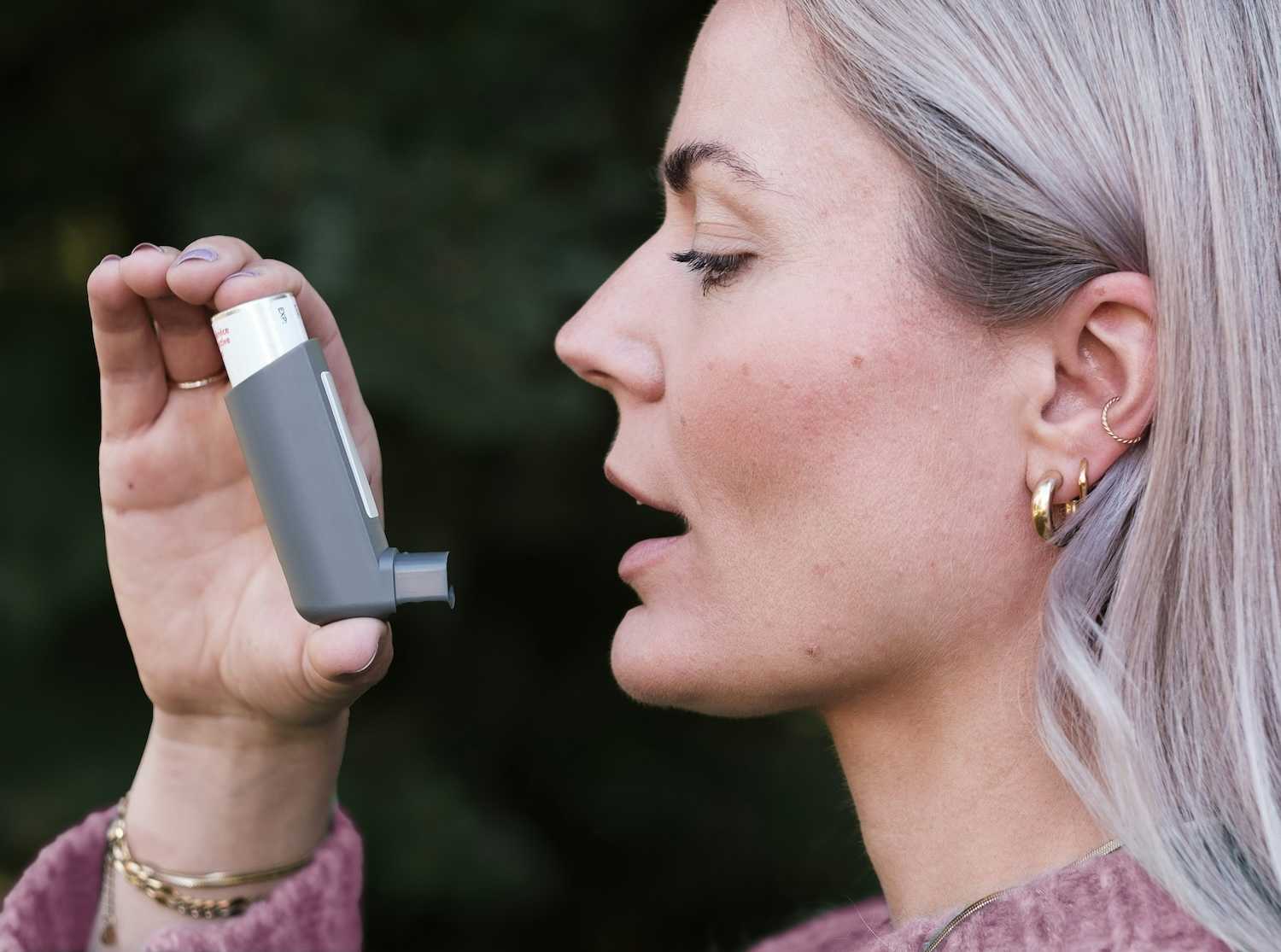
Inhalers deliver medication needed to manage chronic lung conditions, like asthma and COPD. There are two general types of inhalers: maintenance and rescue. Maintenance inhalers are used on a regular basis to control the inflammation symptoms of asthma and make breathing more comfortable. Rescue inhalers are used as needed to prevent or treat a flare-up, such as an asthma attack caused by cold air or another trigger.
But beyond maintenance and rescue, inhalers can take many forms to deliver medication in different ways. Learn what these delivery methods are, how they work, and how pharmacists and other healthcare providers determine who gets which type of inhaler.
Why Does Your Inhaler Spray, Click, or Puff?
All inhalers release medication into your lungs through your mouth as you inhale, but what the medication is, how it is released, and the formulation can vary. Perhaps the best-known inhaler type is the classic HFA inhaler, which uses propellants to push medication into your lungs when you press on its canister.
In contrast, a breath-actuated inhaler delivers medication without propellants, relying instead on your own deep breath to bring the medicine out of the inhaler and into your lungs. Other inhalers release medication as a soft mist, while still others use a fine powder.
Depending on your inhaler and medicine formulation, patients must practice different breathing techniques to get the correct dosage of medication. For example, dry powder inhalers like Diskus require you to breathe in a rapid huff to draw the medicine into the lungs. HFA and other propellant inhalers require you to take a slow, deep breath. Those using nebulizers can breathe normally through the device, but often must do so for up to 20 minutes.
These inhaler types can accommodate different needs. For example, inhalers that use a press-and-breathe delivery can be convenient for some people, but difficult for others to operate because of the coordination required. Likewise, inhalers that require a deep, fast breath can be difficult for those with weaker lungs.
Different delivery methods allow doctors to prescribe the type of inhaler that best matches the patient’s needs and capabilities.
Common Inhaler Types At a Glance
| Inhalation Method | Maintenance or Rescue? | Common Formulations | |
| HFA, Propellant, or Pressurized Metered-Dose Inhaler (pMDI) | Slow, deep inhalation/td> | Both, depending on medication | Liquid aerosol |
| Breath-Actuated Inhaler (BAI) or Breath-Actuated Metered Dose Inhaler (BAMDI) | Depends on medicine formulation | Both, depending on medication | Liquid aerosol, dry powder |
| Dry Powder Inhaler (DPI) | Fast, hard inhalation | Both, depending on medication | Dry powder |
| Soft Mist Inhaler (SMI) | Slow, deep inhalation | Maintenance only | Aerosol mist |
| Nebulizer | Breathe slowly until completed | Both, depending on medication | Aerosol mist |
HFA Inhalers: Classic Aerosol Sprays
When most people think of an inhaler, the HFA inhaler comes to mind. With an HFA inhaler, you press down on the canister to release the medication. HFA inhalers are also called propellant inhalers because they use a gas to propel the medication out, as well as pressurized metered-dose inhalers because they release a set amount of medication in each puff.
The name of this type of inhaler refers to how it releases medication, not the type of medication it releases. HFA stands for hydrofluoroalkanes, which is the gas that propels the medicine out of the HFA inhaler. HFA inhalers commonly contain albuterol, a quick-acting medication that treats asthma and chronic obstructive pulmonary disease (COPD) attacks.
This explains the difference between albuterol sulfate vs. albuterol sulfate HFA: albuterol sulfate refers to the medication itself, while albuterol sulfate HFA specifically describes the HFA inhaler that dispenses albuterol sulfate. In general, albuterol sulfate HFA vs. albuterol sulfate may seem to describe different things, but they are ultimately both terms for an albuterol sulfate inhaler.
How To Use an HFA Inhaler
To use an HFA inhaler, follow the instructions provided by your doctor, pharmacist, and/or medication packaging. Generally, the process is as follows:
- Before using an inhaler, follow instructions to prime it. Generally, this means to remove the cap and to then shake the inhaler 10 times (or as many times as the package indicates). This mixes the propellant with the medicine, which ensures you will receive the correct dose. If you were instructed to use a spacer with your inhaler, attach the spacer after priming.
- Stand or sit up straight.
- Turn your head away from the inhaler and breathe in and out a few times normally. Then, fully exhale while still facing away from the inhaler.
- Face the inhaler. Put the inhaler or spacer in your mouth between your teeth, using your lips to form a seal around it. Keep your tongue below the inhaler or spacer so it stays out of the way.
- Begin to breathe in, then press the top of the canister to release a puff of medicine.
- Continue to slowly breathe in for 3 to 5 seconds. Breathe as deeply as you can.
- Hold your breath for 10 seconds, then remove the inhaler from your mouth before exhaling.
- Wipe off the mouthpiece, then put the cap back on. Keep your inhaler stored in a cool, dry place.
If your inhaler contains a corticosteroid medication, rinse your mouth with water after using it, then spit the water out to reduce your risk of developing oral thrush.
Breath-Actuated Inhalers
Instead of releasing medication from pressing the inhaler canister, breath-actuated inhalers (also called breath-activated inhalers) rely on your inhale to dispense the medicine. Because these devices don’t require timing your breath with pressing a canister or button, they can be a good option for people who struggle with coordination.
Unlike an HFA inhaler, which always contains liquid medicine, a breath-actuated inhaler can contain dry or liquid medication. These are the types of breath-actuated inhalers available:
- Dry powder inhaler (DPI): With this type of inhaler, the medication is a fine, dry powder, rather than a liquid. Diskus, RespiClick, and Ellipta are all breath-actuated, dry powder inhaler types. Dry powder inhalers are generally activated by a sharp, strong inhalation. Patients with weaker lungs may not be good candidates for this type of inhaler.
- Breath-actuated metered dose inhaler (BA-MDI or BA-pMDI): Like an HFA inhaler, a breath-actuated metered dose inhaler releases a measured amount of liquid medication using a propellant. The difference is a BA-MDI is triggered by your inhale rather than by pressing on the canister. Unlike dry powder inhalers, BA-MDIs do not require a fast, hard breath to be activated, so they may feel easier to use.
How To Use a Breath-Activated Dry Powder Inhaler
It is important to follow the instructions provided by your doctor, pharmacist, and/or medication packaging. Generally, the process to use a breath-actuated dry powder inhaler is as follows:
- Stand up straight or, if that’s not possible, sit up straight.
- Open or remove the inhaler’s cover. Hold the inhaler in the position shown in its instructions. Diskus inhalers should be held flat, like hamburgers.
- Load a dose of medication into the inhaler by following its instructions. This generally involves twisting it in some way or flipping a lever. Do not shake the inhaler.
- Turn your head away from the inhaler, then breathe in and out a few times normally. Then, fully exhale while still facing away from the inhaler.
- Face the inhaler. Put the inhaler mouthpiece between your teeth and use your lips to form a seal around it. Keep your tongue below the mouthpiece so it doesn’t block the medication from entering your lungs.
- Take a fast, hard breath in through your mouth. Make this as forceful and as big of a breath as you can.
- Hold your breath for 10 seconds. This counts as one “puff” or dose. If your instructions are to take more than one puff or dose, remove the inhaler from your mouth, wait one minute, then repeat the steps again.
- Remove the inhaler from your mouth. Wipe it off and put the cap back on. Keep your inhaler stored in a cool, dry place.
If your inhaler contains a corticosteroid medication, rinse your mouth with water after using it, then spit the water out to reduce the risk of developing oral thrush.
How To Use a Breath-Activated Metered Dose Inhaler
It is important to follow the instructions provided by your doctor, pharmacist, and/or medication packaging. Generally, the process to use a breath-actuated inhaler is as follows:
- Stand up straight or, if that’s not possible, sit up straight.
- Open or remove the inhaler’s cover. Hold the inhaler in the position shown in its instructions. Be sure not to block any of the inhaler’s air vents with your hands.
- If your inhaler has a lever on top, push it so it clicks into place. Do not shake the inhaler.
- Turn your head away from the inhaler, then breathe in and out a few times normally. Then, fully exhale while still facing away from the inhaler.
- Face the inhaler. Put the inhaler mouthpiece between your teeth, using your lips to form a seal around it. Keep your tongue below the mouthpiece so it doesn’t block the medication from entering your lungs.
- Breathe in slowly and deeply. You should hear or feel the device click and automatically release the medication. Continue breathing as slowly and deeply as possible.
- Hold your breath for 10 seconds. This counts as one dose. If your instructions are to take more than one dose, remove the inhaler from your mouth, wait one minute, then repeat the steps again.
- Remove the inhaler from your mouth. Wipe it off, then put the cap back on. Keep your inhaler stored in a cool, dry place.
If your inhaler contains a corticosteroid medication, rinse your mouth with water after using it, then spit the water out to reduce the risk of developing oral thrush.
Soft Mist Inhalers
Like all metered dose inhalers, soft mist inhalers release liquid medication that has been turned into an aerosol, or tiny, airborne particles of liquid. But instead of using a propellant gas like HFA inhalers, soft mist inhalers use a mechanical spring to push out the medicine. Respimat is a well-known type of soft mist inhaler.
Some people find soft mist inhalers more comfortable to use because the medication is released more gently. In addition, because soft mist inhalers release medication slowly, coordination between inhaling and pressing a canister is not as crucial as it is with HFA inhalers.
How To Use a Soft Mist Inhaler
It is important to follow the instructions provided by your doctor, pharmacist, and/or medication packaging. Generally, the process to use a soft mist inhaler is as follows:
- Soft mist inhalers need to be primed once, but not every time you use them. If you have never used your soft mist inhaler before, follow the instructions that came with it to prime it.
- Turn the clear base of the inhaler in the direction of the arrows for half a turn, or until the inhaler makes a click sound.
- Open the inhaler’s cap.
- Fully exhale away from the inhaler.
- Hold your head up straight, and face forward, without bending your neck. Aim the inhaler toward the back of your throat, then put your lips around the inhaler’s mouthpiece.
- Press the inhaler’s release button.
- Breathe in slowly and deeply. Keep your mouth on the inhaler until the spray stops.
- Hold your breath for 10 seconds. This counts as one “puff” or dose. If your instructions are to take more than one puff or dose, remove the inhaler from your mouth, wait one minute, then repeat the steps again.
- Remove the inhaler from your mouth, then put the cap back on. Keep your inhaler stored in a cool, dry place.
Nebulizers
A nebulizer is not technically an inhaler, but it is still a device that delivers medication into the lungs. Like inhalers, asthma and COPD patients may use nebulizers for their treatment.
There are a few key differences when comparing an albuterol inhaler vs. nebulizer. An inhaler is smaller and hand-held, making it easily portable. A nebulizer, on the other hand, is less portable in comparison to most inhalers. In addition, an inhaler generally works faster, with a dose taking less than a minute to administer. In contrast, a nebulizer may take 5 to 20 minutes to deliver medication.
However, nebulizers do not require the coordination of an HFA inhaler, nor the fast, hard inhale required to use a dry powder inhaler. Nebulizers also can deliver larger doses of medication for those with more severe cases of asthma or COPD.
There are three main types of nebulizers:
- Jet Nebulizer: This type of nebulizer turns liquid medication into a mist by pulling the liquid into a jet of compressed air. The air jet shatters the liquid into particles. This fine mist can penetrate deeply in the lungs.
- Mesh Nebulizer: Like a jet nebulizer, a mesh nebulizer turns liquid medication into a fine mist that can penetrate deeply in the lungs. Instead of using compressed air to do so, a mesh nebulizer pushes liquid medication through a microscopic mesh to create a mist.
- Ultrasonic Nebulizer: An ultrasonic nebulizer uses high-frequency vibrations to turn liquid medication into a mist.
How To Use a Nebulizer
It is important to follow the instructions provided by your doctor, pharmacist, and/or medication packaging. Generally, the process to use a nebulizer is as follows:
- Use soap and warm water to wash your hands.
- Connect the tubing and any other parts, like a mask or medicine cup, to the nebulizer as outlined in the instructions that came with it.
- Pour the prescribed medicine into the nebulizer medicine cup. Be sure to pour the exact amount prescribed and outlined in instructions. Tighten the cap over the cup.
- Put the nebulizer mouthpiece in your mouth and seal your lips around it. If you use a mask, make sure it covers your nose and mouth and fits snugly.
- Turn on the nebulizer according to its instructions. A light mist should begin to rise up through the tubing.
- Breathe through your mouth until the mist stops and all of the medicine has been used up. This takes about 10 minutes on average, but can take between 5 and 20 minutes.
- Take the mouthpiece out of your mouth and remove the mask if you use one. Turn off the machine.
- Clean the medicine cup and mouthpiece or mask by rinsing with hot water, then let them air dry.
If the medication in the nebulizer contains a corticosteroid, rinse your mouth with water after using it, then spit the water out to reduce the risk of developing oral thrush.
Comparing Rescue Inhalers
Most inhalers can be considered either a rescue inhaler or a maintenance inhaler. Rescue inhalers are intended to treat symptoms as they arise or reduce the risk of an asthma attack prior to engaging in something that may trigger them, like exercise. Rescue inhalers contain medications called quick-relief medicines. Rescue inhalers commonly take the form of HFA inhalers, but in some cases, other types of inhalers may also be prescribed as rescue inhalers.
Rescue Inhaler Medications
| Medication | Common Brand Name(s) |
| Albuterol | Ventolin HFA, ProAir HFA, ProAir RespiClick |
| Levalbuterol | Xopenex |
| Albuterol/budesonide | Airsupra |
Albuterol Vs. Other Types
Albuterol is widely prescribed as a quick-relief medicine for people with asthma and COPD. Inhaling albuterol can help with shortness of breath, wheezing, coughing, and a tight chest. Albuterol should begin providing relief within minutes and then last for several hours. This medication is considered a short-acting beta-agonist (SABA), because it binds to beta-2 adrenergic receptors in the lungs.
Although albuterol is a very common treatment, it isn’t the only option. Here’s a comparison of albuterol and other quick-relief medicines that may be prescribed for asthma:
- Ventolin vs. albuterol vs. salbutamol: Technically, all three of these medications are albuterol. Albuterol is the generic name of the drug, and Ventolin is a brand name formulation of albuterol. Albuterol is the name of the drug in the United States, but most other countries and the World Health Organization use the name salbutamol for the same medication.
- Levalbuterol vs. albuterol: Both levalbuterol and albuterol are SABA medications used to provide quick relief to people experiencing symptoms of lung disorders. Albuterol tends to be more affordable, but doesn’t provide relief for as long as levalbuterol does. Doctors and patients may consider which drug gives them the fewest or least severe side effects, or which is more affordable based on insurance coverage.
- Albuterol/budesonide vs. albuterol: Generally, fast-acting inhalers like albuterol only provide short-term relief and do not address underlying lung inflammation. These medications are called bronchodilators because they open up the airway. Inhalers that contain albuterol/budesonide are considered combination or dual-action treatments. These treatments combine quick-relief medication with a steroid that reduces inflammation. Combination medications are part of the anti-inflammatory reliever therapy (AIR) and single maintenance and reliever therapy (SMART) asthma treatment plans.
Comparing Maintenance Inhalers
In contrast to rescue inhalers, maintenance inhalers are used on a regular basis to maintain lung health, not to treat immediate symptoms. For example, a person may be prescribed a maintenance inhaler that they use once or twice a day, every day. Maintenance inhalers are used on schedule, not in an emergency situation or in response to sudden symptoms.
Maintenance inhalers are also called controller medicines or long-term medicines. They reduce inflammation and some may also reduce mucus production in the lungs. Patients who find themselves using their rescue inhalers more than twice a week may be prescribed a maintenance inhaler to better control their asthma or COPD.
Maintenance Inhaler Medications
| Medication | Common Brand Name(s) |
| Fluticasone/salmeterol | Advair HFA, Advair Diskus |
| Budesonide/formoterol | Symbicort |
| Ipratropium | Atrovent |
Your Maintenance Inhaler Options
- Advair HFA vs. Advair Diskus: The Advair HFA and Advair Diskus inhalers both contain the same type of medication (fluticasone and salmeterol), but deliver it differently. The Advair HFA delivers the medication with a propellant, whereas the Advair Diskus is breath-actuated.
- Budesonide/formoterol (Symbicort): The Symbicort inhaler is a maintenance inhaler that contains a corticosteroid (budesonide), and a bronchodilator (formoterol). The budesonide helps reduce lung inflammation, while the formoterol helps open the airways.
- Ipratropium (Atrovent): The Atrovent inhaler is most commonly used as a maintenance inhaler for COPD, but it may also be used as an asthma rescue inhaler in severe situations. Ipratropium is considered an anticholinergic medication. It opens the airways and helps reduce mucus production in the lungs.
Atrovent vs. Albuterol: Which To Choose?
Whether you are prescribed Atrovent or albuterol depends on your diagnosis, the severity of your symptoms, and the other treatments you’ve tried. The biggest difference between Atrovent or ipratropium vs. albuterol is that Atrovent (ipratropium) is most commonly used as a maintenance inhaler for COPD, while albuterol is commonly used as a rescue inhaler for both COPD and asthma.
In rare cases, Atrovent may be prescribed as a rescue inhaler for asthma, such as for patients who cannot tolerate albuterol due to an allergy or severe side effects.
How To Switch Your Inhaler Online To Upgrade Your Breathing
According to the Asthma and Allergy Foundation of America, between 70% and 90% of people make mistakes when using their inhaler. Inhaler mistakes aren’t always the result of a lack of information. Sometimes people struggle to use their inhaler correctly, because it isn’t the ideal inhaler for them given their unique situation.
There are many reasons you may want to switch to a different inhaler or try a new inhaler type. For example, exploring a new inhaler may be a good idea if you:
- Struggle to coordinate pressing your HFA inhaler canister with your inhale
- Cannot always take a breath that is forceful or deep enough to trigger your breath-actuated inhaler
- End up swallowing more inhaler medication than you breathe into your lungs
- Find your inhaler difficult to use for any reason
- Experience side effects or an allergic reaction to your inhaler
- Cannot afford your current inhaler type
- Have been using a rescue inhaler more than twice a week
If you are having issues with your inhaler, tell your doctor about your concerns and ask about your other options. Once instructed by the provider you are under care with which inhaler you want to try, you can use TelyRx to submit an order request for your preferred inhaler. An independent, licensed provider will review your order and if approved, they will write you a new inhaler prescription and one of our licensed pharmacies will send the inhaler to your home.
Your Next Steps
It’s important to understand what inhaler you have been prescribed and how it works, especially if you suspect you would be better off using a different type of inhaler. Inhalers can seem complicated because there are so many different delivery methods and medication types available. But if you feel you aren’t getting the most out of your inhaler, it is worth considering other options to make your asthma and COPD management easier.
Our experts

Written by
Jay Vera Summer, NBC-HWC
Jay Vera Summer is a health writer specializing in sleep, nutrition, fitness, mental health, and women's health. As a wellness coach, she holds certifications from Mayo Clinic and the National Board of Health and Wellness Coaches. She's also earned a Bachelor's of Science in psychology and Master's degrees in writing and public policy.

Reviewed by
Ashley Robinson, PharmD
Ashley Robinson oversees daily operations at TelyRx's Clearwater pharmacy location, optimizes workflow efficiency, and ensures compliance with regulatory standards while maintaining a strong focus on patient safety and quality of care. She collaborates closely with clinical and operations teams to evaluate new medications, support formulary development, and implement process improvements that enhance both patient outcomes and team performance.
This blog post is for informational purposes only and does not constitute medical advice, diagnosis, or treatment. The content provided here is not a substitute for professional medical advice, consultation, or care from a qualified healthcare provider. Always seek the guidance of your physician or another licensed health professional with any questions you may have regarding a medical condition or treatment. Do not disregard or delay seeking professional medical advice based on information read on this site. Learn more about our editorial standards.