

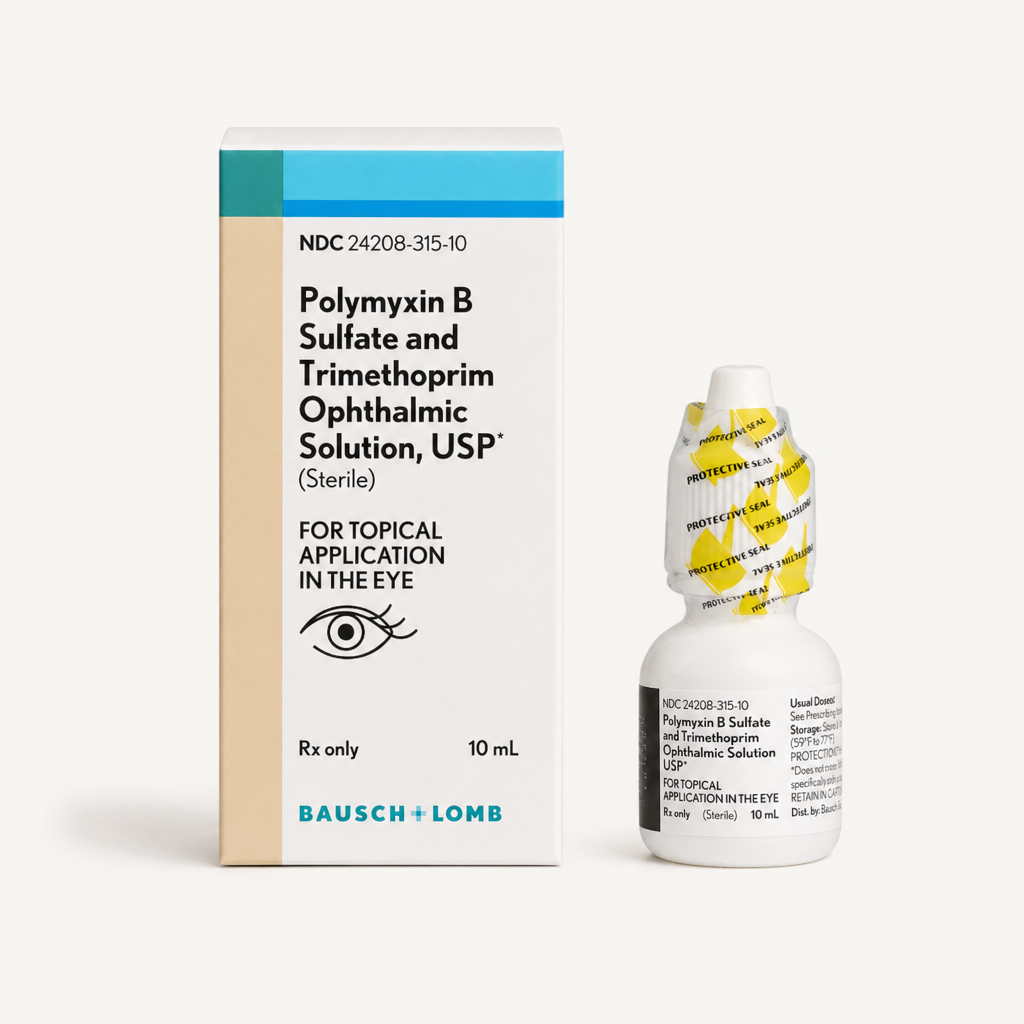
How It Works
Polymyxin B and trimethoprim work by using two antibiotics:
- Polymyxin B is a polypeptide antibiotic that binds to phospholipids in the outer membrane of Gram-negative bacteria. This causes holes to form in the bacterial cell wall and kills the bacteria.
- Trimethoprim is a bacterial cell growth inhibitor that blocks enzymes the bacteria use to synthesize folic acid, which is needed for bacterial DNA production and replication. This prevents the bacteria from growing or multiplying.
By killing existing bacteria and preventing replication of more bacterial cells, polymyxin B and trimethoprim eliminate the infection.
| Quick Facts | |
|---|---|
| Common Brands | Polytrim |
| Drug Class | Ophthalmic Combination Antibiotic |
| Generic Status | Generic version available |
| Availability | Prescription only |
Dosing
Treating eye infections with polymyxin B and trimethoprim follow these standard guidelines for most patients:
- Frequency: Most providers recommend instilling one drop of polymyxin B and trimethoprim solution every 3 hours while the patient is awake.
- Daily limit: Unless your provider instructs you otherwise, standard guidelines for this drug recommend no more than 6 doses administered over a 24-hour period.
- Application: To prevent contamination, it is advised for patients to thoroughly wash their hands before applying polymyxin B and trimethoprim solution eye drops. It is also recommended to avoid touching the tip of the dropper with your eye or eyelashes. Patients are advised to tilt back their head, pull down their lower eyelid, and apply the drop in the area between the lower eyelid and eyeball. To ensure full absorption, patients are recommended to close their eyes for 1 to 2 minutes without blinking.
- Duration: Most treatment courses for polymyxin B and trimethoprim last 7 to 10 days. Per standard guidelines, patients should complete their entire prescribed course.
Note: Dosing information below is educational only. Your prescribing physician will determine your specific dose based on your individual health needs. Always follow your healthcare provider’s instructions for exact dosing.
Uses
FDA-Approved Uses
Polymyxin B and trimethoprim is FDA-approved to treat two medical conditions:
- Bacterial conjunctivitis: Commonly known as “bacterial pink eye,” this is an infection characterized by redness, swelling, and pus-like discharge in and around the eyes.
- Blepharoconjunctivitis: This is a group of infections that affect the conjunctiva of the eye and the perimeter of the eyelids.
Off-Label Uses
You may see polymyxin B and trimethoprim prescribed for uses that are not “FDA-approved.” This is a common and legal practice called “off-label” prescribing, where a doctor uses their clinical judgment to prescribe a drug for a different (but well-researched) purpose.
Common off-label uses for polymyxin B and trimethoprim found in clinical research and practice include:
- Prophylaxis after foreign object removal: Doctors may prescribe the drug to prevent infections after procedures to remove dust, debris, and other contaminants from the eye.
- Corneal abrasion: Doctors may prescribe polymyxin B and trimethoprim to prevent infections for patients who have corneal abrasions, or scratches on the eye surface that require time to heal.
Side Effects
Common Side Effects
Most patients tolerate polymyxin B and trimethoprim eye drops well. Side effects are typically localized to the eyes and surrounding areas. Common side effects from using polymyxin B and trimethoprim include:
- Local irritation, burning, or stinging after the drop is instilled
- Temporary redness in the whites of the eyes
- Itching or eyes watering
- Blurred vision for a few minutes after application
Serious Side Effects
Serious side effects are rare, but it’s important to know what to look for if they do occur.
Serious side effects of taking polymyxin B and trimethoprim include:
- Respiratory distress: If wheezing or heavy breathing occurs after the eye drops are applied, this could be a sign of a serious issue that warrants immediate medical attention.
- Worsening infection: Increases in pain or discharge thickness up to 48 hours after use may indicate a resistant bacteria strain, or a different type of infection altogether.
- Eyelid edema: Swelling of the eyelids that prevents them from opening
- Severe allergic reaction: Polymyxin B and trimethoprim may cause anaphylaxis in patients who are allergic to one or more of the drug’s ingredients.
Call your doctor immediately if you experience any concerning or prolonged symptoms.
Pharmacist Tips
Learn the “Pocket Method”
For best results using the eye drops, standard guidelines suggest pulling down the lower eyelid and instilling the drop into the “pocket” between the eyelid and the eyeball. This helps the medication remain in the eye.
Pinch the Inside Corner of the Eye
After the eye drops have been applied, patients are advised to press their finger against the inside corner of their eye for 1 minute. This can help prevent the drop from entering the tear duct and throat.
Skip the Contacts
Per standard guidelines for polymyxin B and trimethoprim, it is not recommended to wear contact lenses during the drug’s treatment course. Contact lenses may interfere with the healing process, and preservatives in the eye drops may damage them.
Check the Solution
If the eye drop solution is cloudy or has changed color since the last application, it is advised to discard the solution bottle and obtain a new one before resuming your treatment course. These qualities can indicate solution contamination.
Drive Carefully
The eye drops may temporarily cause blurred vision, so it is not recommended to drive a vehicle or operate machinery until this side effect has resolved.
Drug Interactions
Polymyxin B and trimethoprim eye drops have low absorption, so systemic interactions with other drugs are not likely. However, taking precautions is standard with any new medication. Potential interactions with polymyxin B and trimethoprim eye drops include:
- Other eye medications: Providers generally recommend waiting 5 to 10 minutes between using other types of eye drops and the polymyxin B and trimethoprim solution. This waiting period prevents the first eye drop from being washed out by subsequent drops.
- Steroid eye drops: Steroid eye drops may be prescribed in combination with polymyxin B and trimethoprim solution, but your provider will closely monitor the results to ensure the steroids don’t damage or worsen the eye infection.
Always give your doctor and pharmacist a complete list of all your medications, vitamins, and supplements to check for potential interactions.
FAQs
Can I wear contact lenses while using these eye drops?
It is generally not recommended to wear contact lenses while using polymyxin B and trimethoprim until the infection has completely cleared and the treatment course is over. If your doctor specifically allows the use of contact lenses, standard guidelines recommend waiting at least 15 minutes after applying the eye drops to insert the lenses. This prevents preservatives in the medication from damaging the contact lenses.
Does this medication treat viral pink eye?
No, polymyxin B and trimethoprim does not treat viral pink eye. This is an antibiotic medication formulated for bacterial eye infections. Viral pink eye does not respond to antibiotics and must be managed with supportive care that may include antiviral medication.
Why does my eye sting or burn after putting the drop in?
Mild stinging or burning in the eyes after using polymyxin B and trimethoprim is a common and temporary side effect. For most people, this discomfort subsides after a few seconds. Patients are advised to contact their provider if the irritation lasts longer.
Can I use polymyxin B and trimethoprim for a stye?
Polymyxin B and trimethoprim is not formulated or FDA-approved to treat styes. The medication may help stye infections from spreading to the eye’s surface, but a different antibiotic is typically needed to treat the stye itself.
Is this medication a steroid?
No, polymyxin B and trimethoprim is a combination antibiotic. The medication does not contain dexamethasone, prednisolone, or any other corticosteroidal components.
How long does it take for the redness and discharge to go away?
Patients who use polymyxin B and trimethoprim generally notice an improvement in their symptoms within 24 to 48 hours. However, they are advised to complete the entire treatment course to eliminate the infection, even if their symptoms have cleared.
Is polymyxin B and trimethoprim safe to use during pregnancy?
Polymyxin B and trimethoprim may be used with caution during pregnancy, but discuss the issue with your healthcare provider or OB/GYN. The drug interferes with folic acid metabolism and has been associated with a small risk of certain birth defects.
Do I need to keep the bottle in the refrigerator?
No, standard guidelines do not require or recommend that you keep the bottle of polymyxin B and trimethoprim solution in your refrigerator. It is advised to make sure the bottle is tightly closed and store the medication at room temperature away from exposure to light or moisture.
Should I continue using the drops even after my eye looks better?
Yes, it is recommended to complete your polymyxin B and trimethoprim treatment course until the prescribed final date, even if the eye looks better. Finishing the treatment prevents antibiotic-resistant bacteria from forming.
Does this medication treat allergic conjunctivitis?
No, polymyxin B and trimethoprim does not treat allergic conjunctivitis. The solution treats bacterial infections and cannot treat conditions like allergic conjunctivitis that are caused by allergens.
Can I drive immediately after using these drops?
It is not recommended to drive immediately after using polymyxin B and trimethoprim eye drops if you experience blurred or otherwise affected vision. Standard guidelines advise waiting until full vision is restored before driving a vehicle or operating machinery.
What is the difference between polymyxin B and trimethoprim solution and erythromycin ointment?
Polymyxin B and trimethoprim solution and erythromycin ointment are both antibiotic medications used to treat eye infections. Polymyxin B and trimethoprim solution is a broader-spectrum drug, meaning it can treat a wider range of conditions than erythromycin ointment.
Does this medication protect against MRSA eye infections?
Yes, polymyxin B and trimethoprim solution has been shown to be effective against ocular MRSA . However, resistance is common, especially with corneal infections, and newer antibiotics might be preferred for resistant cases.
Comparable Medications
Polymyxin B and Trimethoprim, Ofloxacin, Ciprofloxacin, Sulfacetamide, Erythromycin Ophtalmic Ointment, or Bacitracin/Polymyxin B?
Polymyxin B and trimethoprim is an antibiotic medication that’s effective against certain bacterial eye infections, but cannot treat infections of viral, fungal, or allergic origin. Your provider may recommend this medication or an alternative to polymyxin B and trimethoprim, depending on your medical history and severity of symptoms.
Polymyxin B and trimethoprim alternatives include:
Ofloxacin Eye Drops
From $39.98
The generic for Ocuflox, ofloxacin is a fluoroquinolone drug used for treating severe eye infections or corneal ulcers. Polymyxin B and trimethoprim eye drops are typically prescribed for simpler bacterial eye infections.
Ciprofloxacin Eye Drops
From $48.99
Ciprofloxacin offers broader-spectrum coverage against more severe conditions like pseudomonas infections, but side effects may be more intense.
Sulfacetamide
The generic for Bleph-10, sulfacetamide is an older sulfa antibiotic less commonly used today because many strains of bacterial eye infection have developed resistance to it. Additionally, patients with sulfa allergies cannot use sulfacetamide or other medications within the sulfa subgroup.
Erythromycin Ophthalmic Ointment
From $36.99
Erythromycin ophthalmic ointment is used to treat bacterial infections in the eye, but it may cause temporary blurring of vision that lasts longer than the blurry vision caused by polymyxin B and trimethoprim eye drops.
The generic for Polysporin Ophthalmic, this drug is a combination antibiotic used to treat bacterial eye infections. It does not offer the same level of coverage as polymyxin B and trimethoprim for different bacteria types.
We Have Polymyxin B and Trimethoprim in Stock. Get Yours Today!
Important: Information on this page is for educational purposes only. Prescribing decisions are made by independent, licensed providers. TelyRx operates technology-enabled pharmacies and a telehealth platform that connects patients with licensed providers. Prescriptions, when provider-approved and issued, are filled and shipped by TelyRx-affiliated pharmacies. We do not employ physicians or make prescribing decisions. Learn more about our editorial standards here.