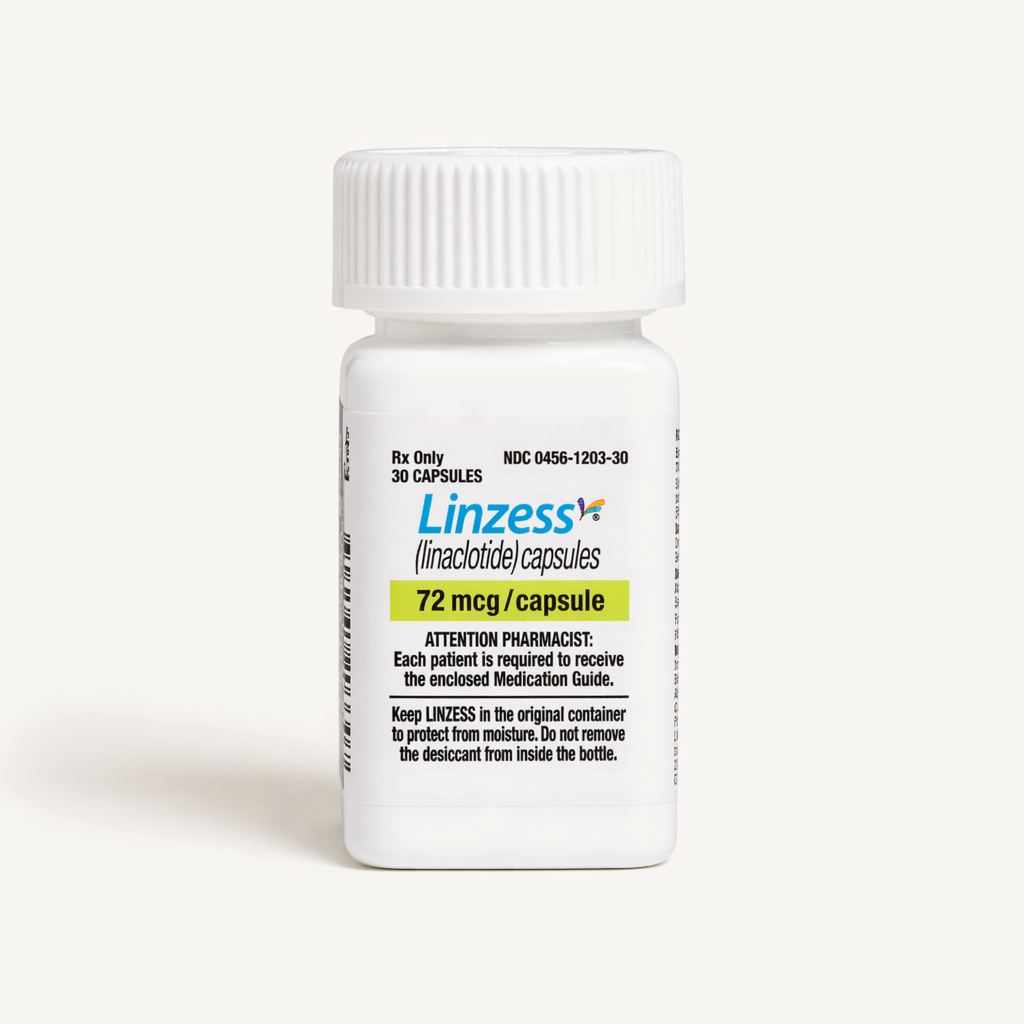
How It Works
Linzess works locally within your intestinal tract. The mechanism of action involves three key effects:
- Increasing fluid secretion: Linzess activates a specific protein on the surface of your intestinal cells. This increases fluid secretion into the intestines. This moisture helps soften the stool, making it easier to pass.
- Speeding up transit time: By increasing fluid, the medication accelerates the movement of food and waste through the digestive system.
- Reducing pain sensitivity: In conditions such as IBS-C, gut nerves can become hypersensitive. Linzess has been shown to decrease the activity of pain-sensing nerves in the intestines, which can help alleviate heavy, bloated, and painful feelings in the abdomen.
| Quick Facts | |
|---|---|
| Common Brands | Linzess |
| Drug Class | Guanylate cyclase-C (GC-C) agonist |
| Generic Status | No generic available |
| Availability | Prescription only |
Dosing
Linzess is a once-daily capsule available in three strengths: 72 mcg, 145 mcg, and 290 mcg. The specific dose prescribed typically depends on the condition being treated and how you respond to the medication.
- For IBS-C: Providers typically recommend 290 mcg once daily.
- For Chronic Constipation (CIC): Standard guidelines suggest 145mcg once daily or 72mcg for tolerability.
- Timing is important: Linzess should be taken on an empty stomach at least 30 minutes before your first meal of the day. Taking it with food can increase the risk of diarrhea.
- Administration: Providers typically recommend swallowing the capsule whole. If you have difficulty swallowing pills, you can open the capsule and sprinkle the beads onto a teaspoon of applesauce or into an ounce of water. Standard guidelines suggest consuming the mixture immediately without chewing the beads.
Note: Dosing information below is educational only. Your prescribing physician will determine your specific dose based on your individual health needs. Always follow your healthcare provider’s instructions for exact dosing.
Uses
FDA-Approved Uses
The FDA approves Linzess to treat IBS-C and chronic idiopathic constipation (CIC).
Off-Label Uses
You may see Linzess prescribed for uses that are not FDA-approved. This is a common and legal practice called off-label prescribing, where a doctor uses their clinical judgment to prescribe a drug for a different (but well-researched) purpose.
Linzess may be prescribed off-label for the following conditions:
- Opioid-induced constipation (OIC): While not its primary indication, some specialists use Linzess to help patients experiencing severe constipation as a side effect of long-term pain medication use.
- Slow transit constipation: Doctors may prescribe it for patients whose digestive systems move significantly more slowly than average, even if they don’t strictly meet the IBS-C diagnosis.
Side Effects
While Linzess is effective for many, it can cause changes in bowel habits that range from mild to significant.
Common Side Effects
- Diarrhea
- Abdominal pain and cramping
- Gas (flatulence) and bloating
- Feeling of fullness or pressure in the stomach
Serious Side Effects
Serious side effects are rare, but it’s important to know what to look for if they do occur. It’s generally accepted that you stop taking the medication and immediately call the doctor if you experience any of the following symptoms:
- Severe diarrhea: Persistent or severe diarrhea can lead to dehydration. Symptoms may include dizziness, confusion, extreme thirst, reduced urination, or dark-colored urine. Contact your doctor if diarrhea becomes severe or if you notice blood in your stool or black, tarry stools.
- Allergic reactions: Seek emergency medical help if you develop facial, lip, or tongue swelling, trouble breathing, or a severe rash.
Call your doctor immediately if you experience any concerning or prolonged symptoms.
Pharmacist Tips
Stick To The 30-Minute Rule
Taking Linzess at least 30 minutes before breakfast can help reduce the risk of diarrhea and help the medication work as intended.
Keep It In The Original Bottle
Linzess is sensitive to moisture. The original bottle contains a special desiccant packet to keep the capsules dry. Providers typically advise against moving the capsules to a weekly pill organizer, as they may lose their effectiveness.
Don’t Chew The Beads
If you open the capsule to mix it with applesauce, standard guidelines do not recommend crushing or chewing the small beads inside. The medication is on the surface of the beads and must be swallowed whole to work properly.
Hydrate Proactively
If you develop diarrhea while starting Linzess, increase your fluid and electrolyte intake to help prevent dehydration.
Missing a Dose
If you miss your morning dose, skip it and take your next dose at the regular time the following day. Do not take two doses at once.
Drug Interactions
While taking Linzess, providers typically recommend:
- Timing other medications: Because Linzess can speed up movement through the intestines, some providers recommend taking other oral medications, vitamins, or supplements later in the morning.
- Laxative use: Using additional laxatives with Linzess can increase the risk of excessive diarrhea. Talk with your healthcare provider before combining them.
Always give your doctor and pharmacist a complete list of all your medications, vitamins, and supplements to check for potential interactions.
FAQs
Why does the bottle say I must take this capsule on an empty stomach before my first meal?
Taking Linzess with food can increase its effects on the intestines and raise the risk of diarrhea. Taking it on an empty stomach before your first meal can help reduce this risk.
How long does it typically take for Linzess to produce a bowel movement after taking the morning dose?
Many patients report a bowel movement within 1 to 4 hours after taking the medication. It may take up to a week of daily use to see a consistent change in your overall regularity.
Is it safe to take this medication as needed for occasional constipation, or do I have to take it every single day?
Linzess is intended to be taken every day. Taking it sporadically may not allow the medication to effectively provide relief from abdominal pain.
Will taking Linzess cure my IBS-C?
There is currently no permanent cure for IBS-C. Linzess is a management tool that treats the symptoms. If you stop taking the medication, your symptoms of constipation and pain will likely return.
What should I do if I forget my morning dose – should I skip it until the next day?
Yes. If you miss your dose, wait until the following morning to take your next dose. Taking Linzess later in the day, especially after eating, may increase the risk of diarrhea.
Does this medication interact with acid reflux pills?
No significant interactions have been reported. Linzess stays in the gut while most acid reflux pills are absorbed into the body or work on stomach acid levels.
Is it safe to continue using over-the-counter laxatives while taking this prescription?
Avoid using other laxatives unless your healthcare provider tells you to do so. Combining them with Linzess can increase the risk of severe diarrhea.
Can taking this medication cause my body to become physically dependent on it to go to the bathroom?
Unlike some stimulant laxatives, Linzess is not known to cause physical dependency or lazy bowel syndrome. It works by stimulating natural fluid secretion.
Is it safe to take my vitamins or other prescriptions at the same time as my Linzess capsule?
Standard guidelines suggest taking Linzess first on an empty stomach at least 30 minutes before breakfast. Vitamins and other medications can usually be taken later with your first meal of the day.
Why shouldn’t you put Linzess in a pill organizer?
Linzess capsules are sensitive to humidity and moisture in the air. Leaving them in an unsealed pill organizer can cause the medication to break down and become less effective before you take it.
Comparable Medications
Miralax, Trulance, or Amitiza?
Choosing the right digestive aid often depends on the severity of your symptoms and how your body responds to different mechanisms.
Miralax
Miralax is an osmotic laxative that draws water into the intestines to help relieve constipation. It may be used for occasional or chronic constipation. Linzess works differently by increasing intestinal fluid secretion and gut movement and is also used to treat IBS-C symptoms such as abdominal pain.
Trulance
Trulance is a GC-C agonist taken once daily. Trulance can be taken with or without food, whereas Linzess must be taken on an empty stomach.
Amitiza
Amitiza works by activating chloride channels in the gut to increase fluid. Amitiza is approved for opioid-induced constipation, whereas Linzess is FDA-approved for IBS-C and CIC.
We Have Linzess in Stock. Get Yours Today!
Important: Information on this page is for educational purposes only. Prescribing decisions are made by independent, licensed providers. TelyRx operates technology-enabled pharmacies and a telehealth platform that connects patients with licensed providers. Prescriptions, when provider-approved and issued, are filled and shipped by TelyRx-affiliated pharmacies. We do not employ physicians or make prescribing decisions. Learn more about our editorial standards here.