
If you’ve ever wondered whether a symptom could be an STI, or put off getting tested because you weren’t sure where to start, you’re far from alone.
The latest STI statistics show that sexually transmitted infections (STIs) are likely more common than official numbers suggest. U.S. health departments reported more than 2.2 million cases of chlamydia, gonorrhea, and syphilis. But those totals only reflect infections that were diagnosed and reported, so anyone who has an STI and hasn’t been tested isn’t counted.
Other STIs, including herpes and HPV, aren’t tracked nationally at all. Both often cause no visible symptoms, so many people who have them don’t know they’re infected.
We took a look at the data to find out which STIs are most common, who’s most affected, and how each is treated.
STI Rates by Infection Type
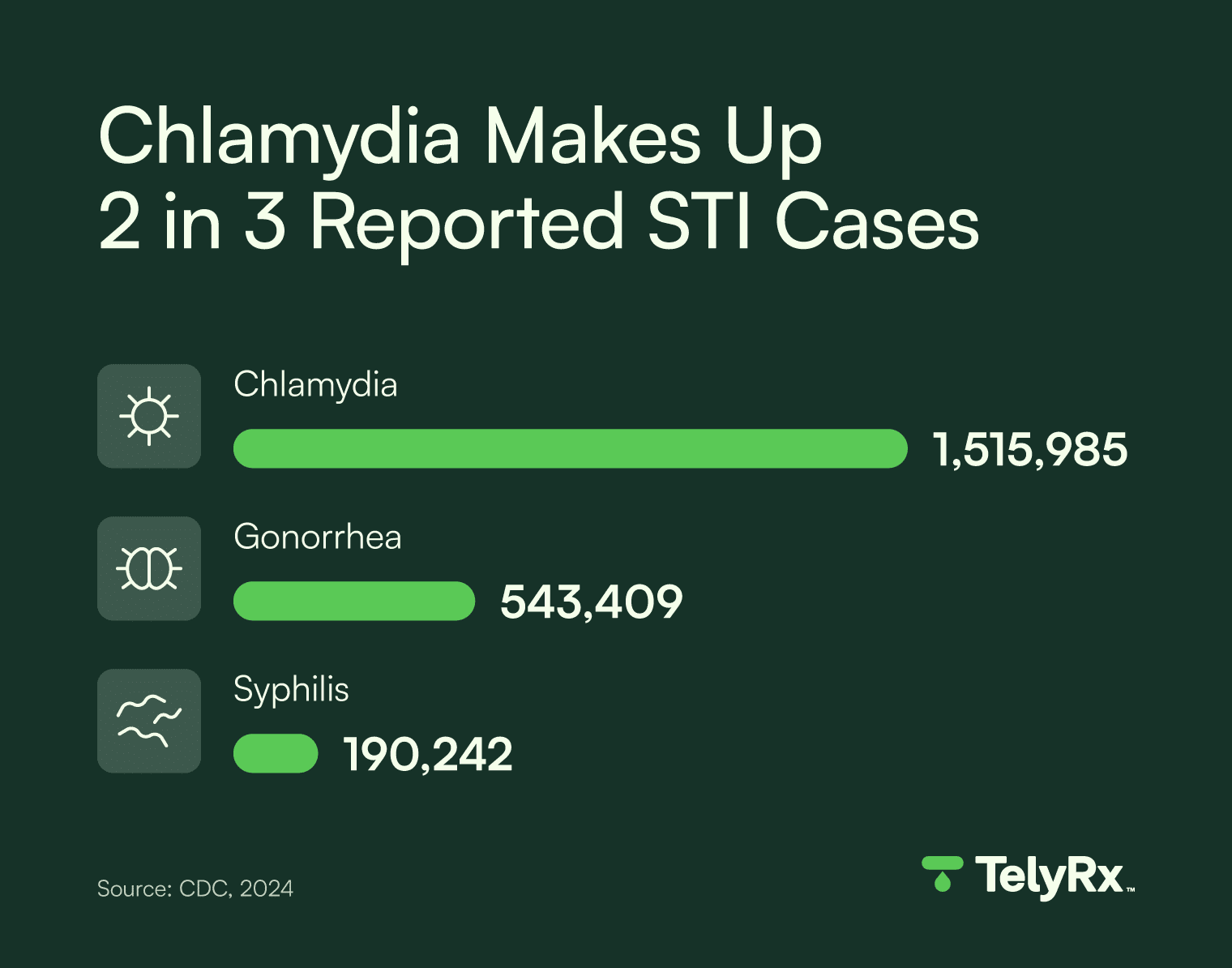
Chlamydia, gonorrhea, and syphilis are the only STIs tracked nationally in the U.S., and chlamydia alone makes up about 2 in 3 reported cases. Below, we break down the latest numbers for each infection, including STIs like herpes and HPV that are measured through other sources.
Chlamydia
Chlamydia is the most commonly reported STI in the U.S., and it’s also one of the easiest to miss. Most infections cause no symptoms, so many people only find out through routine STI screening.
Because early signs can overlap with those of other infections, it helps to know how chlamydia differs from them.
- U.S. health departments reported 1,515,985 chlamydia cases in 2024, 8% fewer than in 2023. That works out to a rate of 445.7 cases per 100,000 people. (CDC)
- Women accounted for 943,890 reported chlamydia cases in 2024, about 62% of the total. Their rate was 549.5 cases per 100,000, compared with 335.3 for men. (CDC)
- Reported chlamydia cases fell 8.6% among women and 7.5% among men from 2023 to 2024. (CDC)
- CDC recommends annual chlamydia screening for all sexually active or pregnant women under 25. (CDC)
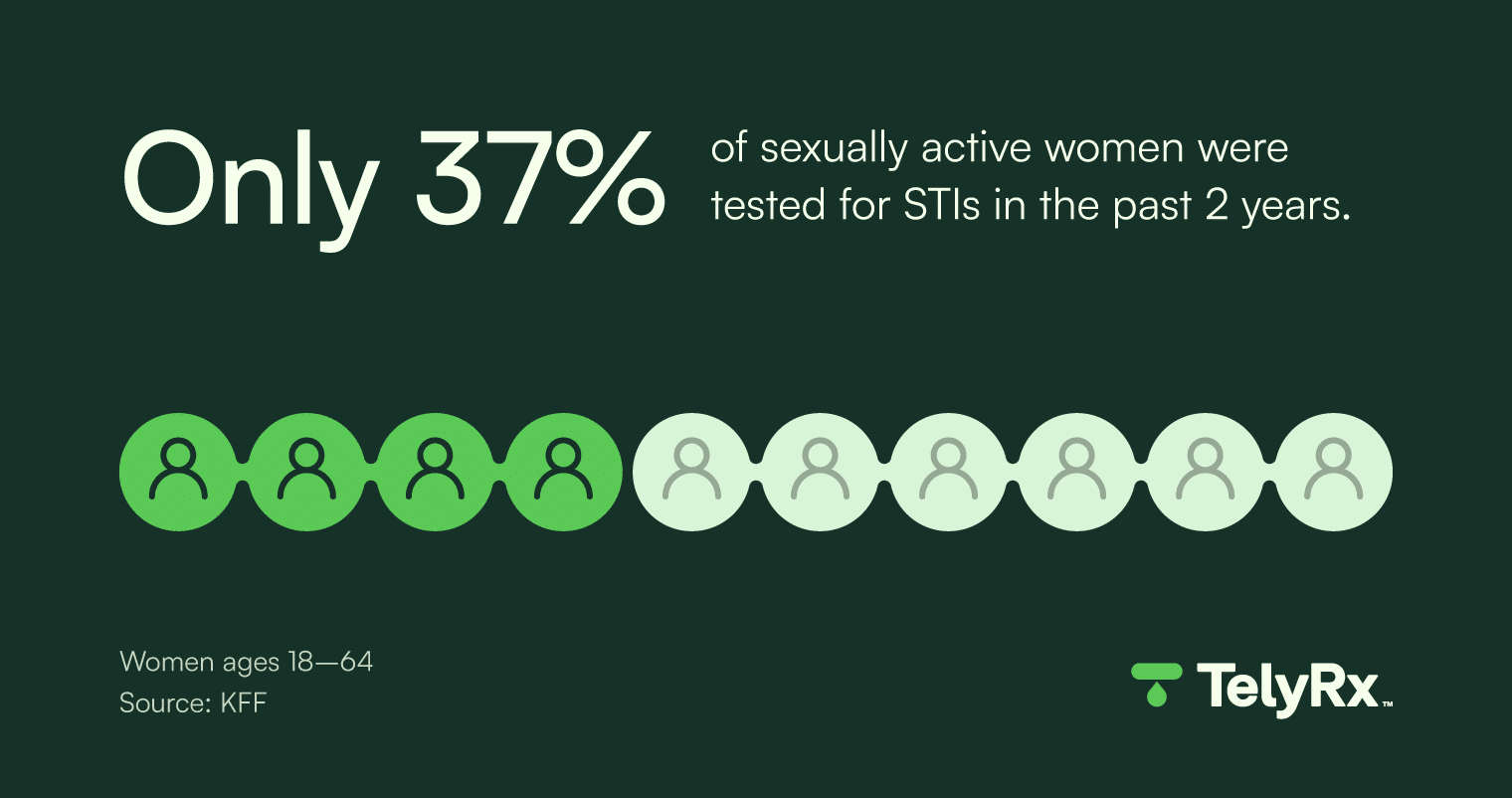
- Only 37% of sexually active women ages 18–64 reported being tested for STIs like chlamydia or gonorrhea in the past two years. (KFF)
- Black, American Indian/Alaska Native, and Hawaiian/Pacific Islander populations have higher chlamydia rates than Hispanic, multiracial, white, and Asian populations. Poverty, unemployment, and limited access to care can make regular STI screening and treatment harder to access. (America’s Health Rankings)
- Louisiana had the highest chlamydia rate of any state in 2023, at 792.4 cases per 100,000 people, followed by Mississippi, Alaska, Alabama, and Georgia. (America’s Health Rankings)
- New Hampshire had the lowest rate in 2023, at 196.6 cases per 100,000 people, about one-quarter of Louisiana’s rate. (America’s Health Rankings)
- WHO’s 2022–2030 global strategy aims to cut new chlamydia cases in half by 2030. (WHO)
Gonorrhea
Gonorrhea is the second most commonly reported STI in the U.S. after chlamydia. Unlike chlamydia, more reported cases are among men than women. Growing antibiotic resistance has also made developing new treatment options a priority.
- Gonorrhea cases declined for the third straight year in 2024, falling nearly 10% to 543,409 reported cases. That works out to a rate of 159.8 cases per 100,000 people. (CDC)
- Men accounted for 341,667 reported gonorrhea cases in 2024, about 63% of the total, with a rate of 203.0 cases per 100,000 compared with 115.8 for women. (CDC)
- Reported gonorrhea cases dropped 19.8% between 2020 and 2024. Among women specifically, the decline was 31.6%. (CDC)
- Gonorrhea has developed resistance to nearly all the antibiotics used to treat it. CDC’s first-line recommendation is a single injection of the antibiotic ceftriaxone. (CDC)
- CDC has not received any reports of verified treatment failures with cephalosporins, the antibiotic class that includes ceftriaxone, in the U.S. (CDC)
- In December 2025, the FDA approved two new oral medications for uncomplicated urogenital gonorrhea: Nuzolvence (zoliflodacin) and Blujepa (gepotidacin). Blujepa is approved for patients who have few or no other treatment options. (FDA)
- In a clinical trial, 91% of patients who took Nuzolvence were cured, compared with 96% who received standard treatment. (FDA)
- In a separate trial, 93% of patients who took Blujepa were cured, compared with 91% who received standard treatment. (FDA)
Syphilis
Syphilis is less common than chlamydia or gonorrhea, but it can cause serious complications when left untreated, especially during pregnancy.
The infection moves through stages, starting with primary and secondary syphilis, the most contagious stages, which can cause sores and rashes. Cases in those stages are declining, but infections that have moved past them within the first year are rising among women.
- The U.S. Preventive Services Task Force recommends syphilis screening for every pregnancy as early as possible, regardless of risk factors. (USPSTF)
- Reported syphilis cases across all stages totaled 190,242 in 2024. That’s 9.1% fewer than in 2023 but 42% more than in 2020. (CDC)
- Primary and secondary syphilis, the most infectious stages, dropped 21.7% to 41,496 cases in 2024. This was the second consecutive annual decline. (CDC)
- About 71% of primary and secondary syphilis cases were among men. The rate for men was 17.6 cases per 100,000, compared with 6.9 for women. (CDC)
- Early non-primary non-secondary syphilis rose 7.9% among women from 2023 to 2024, while it fell 17.5% among men. This category covers infections acquired within the past year that are past the primary and secondary stages. (CDC)
- An estimated 1.1 million pregnant women worldwide had syphilis in 2022, resulting in more than 390,000 adverse birth outcomes. (WHO)
Herpes (HSV-1 and HSV-2)
Herpes is one of the most widespread STIs in the world, and most people who have it don’t know it. The CDC doesn’t track individual herpes cases, so the most complete numbers come from WHO’s global estimates and smaller national studies.
- An estimated 846 million people ages 15–49 are living with genital herpes, more than 1 in 5 people in that age group worldwide. (WHO)
- Fewer than 25% of people with HSV-2 antibodies know they are infected, so it often spreads through people who are unaware that they have HSV-2. (HHS)
- HSV-1 has become the leading cause of first-episode genital herpes in several high-income regions, including North America, especially among adolescents and young adults. (Journal of Infection)
- HSV-2 infection raises the risk of acquiring HIV about threefold. (WHO)
- HSV-2 infects women almost twice as often as men because sexual transmission is more efficient from men to women. (WHO)
- People with genital HSV-2 have a median of about five recurrent outbreaks a year, compared with a median of one for genital HSV-1. (Journal of Infection)
- Herpes has no cure, but antiviral medications like valacyclovir can shorten outbreaks and make them less severe. Treatment for a recurrent outbreak works best when started within 48 hours of symptom onset, and taking an antiviral daily can reduce the frequency of outbreaks. (WHO)
- About two-thirds of U.S. patients diagnosed with genital herpes were treated with antivirals. Of those, 80% received short-term episodic treatment rather than daily suppressive therapy. (Open Forum Infectious Diseases)
HPV (Human Papillomavirus)
HPV is so common that nearly everyone who isn’t vaccinated will get it at some point. Most infections clear on their own, but certain types can cause cancer years later, so vaccination and screening rates matter as much as infection counts.
- About 9 out of 10 HPV infections clear on their own within two years. (CDC)
- Only 2.7% of adults ages 27–45 who weren’t vaccinated before age 27 went on to get the HPV vaccine. (American Journal of Preventive Medicine)
- About 49,908 cancers are diagnosed each year in the U.S. in parts of the body where HPV is often found. CDC estimates that about 39,300 of them (79%) are caused by HPV. (CDC)
- Men account for about 22,827 of the HPV-associated cancers diagnosed in the U.S. each year, or roughly 46%. Cancers of the back of the throat, including the base of the tongue and tonsils, are the most common HPV-associated cancers among men. (CDC)
- The American Cancer Society projects about 13,490 new cases of invasive cervical cancer and about 4,200 cervical cancer deaths in the U.S. in 2026. (American Cancer Society)
- The U.S. cervical cancer death rate has fallen by more than half since the mid-1970s, largely because of screening and prevention. (American Cancer Society)
- Cervical cancer rates among women ages 20–31 were 27% lower in 2016–2021, after the HPV vaccine became available, than in 2000–2005. (American Cancer Society)
- Worldwide, an estimated 604,000 women were diagnosed with cervical cancer in 2024, and about 280,000 died from it. (WHO)
- Women living with HIV are six times more likely to develop cervical cancer than the general population. (WHO)
HIV
CDC tracks HIV from diagnosis through treatment, so the data shows how many people stay in care as well as how many are diagnosed. With early diagnosis and effective treatment, people with HIV can stay healthy, which makes routine testing especially important.
- There were 38,793 HIV diagnoses in the U.S. and its territories in 2024. The U.S. diagnosis rate was 13.3 per 100,000 people. (CDC)
- Men accounted for 80% of HIV diagnoses in 2024. Their diagnosis rate was 21.6 per 100,000, compared with 5.3 for women. (CDC)
- Black Americans make up 12% of the U.S. population, but accounted for 39% of HIV diagnoses in 2024. (CDC)
- The South accounted for 51% of HIV diagnoses in 2024 and had the highest regional diagnosis rate. (CDC)
- More than 1 in 5 people (22%) diagnosed with HIV in 2024 already had AIDS, the most advanced stage of HIV infection. (CDC)
- At the end of 2024, 1,158,701 people in the U.S. and its territories were living with diagnosed HIV. (CDC)
- Viral suppression among people with HIV rose to 69% in 2024. People who stay virally suppressed through treatment do not transmit HIV through sex. (CDC)
- In June 2025, the FDA approved Yeztugo (lenacapavir), the first HIV prevention option given as a twice-yearly injection. In a clinical trial of more than 5,300 cisgender women, no one who received Yeztugo acquired HIV. (HCPLive)
- In a separate trial of 3,265 men and gender-diverse people, including transgender women, only 2 people who received Yeztugo acquired HIV, compared with 9 who took a daily oral PrEP pill. (HCPLive)
- Worldwide, an estimated 41 million people were living with HIV in 2025, and nearly 5 million of them didn’t know it. (UNAIDS)
Trichomoniasis
Trichomoniasis, or “trich,” is caused by a parasite and treated with an oral medication like metronidazole. Trich isn’t nationally reportable, so it doesn’t show up in official case counts, but CDC estimates it’s the most common curable STI in the U.S. Reinfection is also common, so follow-up testing matters as much as the first test.
- About 70% of people with trich have no signs or symptoms. Without treatment, the infection can last for months or even years. (CDC)
- Trich is more common in women than in men, and older women are more likely than younger women to have it. (CDC)
- About 1 in 5 people get trich again within three months of treatment. CDC recommends retesting about three months after treatment, even if partners were treated, too. (CDC)
- Trich is linked to a 1.5 times higher risk of acquiring HIV. (WHO)
Why Most STIs Go Undetected
The case counts above likely undercount how common STIs really are. STIs can go undetected for several reasons:
- No symptoms: Many STIs often cause no noticeable symptoms. People can carry and spread these infections without realizing they’re infected.
- Symptoms look like other conditions: Discharge and itching can easily be mistaken for a yeast infection or a UTI. This overlap is one reason STIs are often misdiagnosed in women.
- Gaps in screening guidelines: Routine screening recommendations focus on specific groups. The U.S. Preventive Services Task Force doesn’t recommend routine chlamydia and gonorrhea screening for men, so many may never be offered a test unless they ask for one.
- Some infections aren’t tracked: Healthcare providers and labs are required to report chlamydia, gonorrhea, and syphilis cases to state health departments, which share that data with CDC. Herpes, HPV, and trich aren’t on that list, so many cases never show up in official counts.
- Stigma: Embarrassment keeps many people from asking for a test, even if they suspect something is wrong. Worries about being judged by a provider, or about a partner or family member finding out, can lead people to put off testing for months.
- Late diagnosis: Because many people only get tested once they notice symptoms, infections can go untreated long enough to cause complications.
Since many STIs don’t cause symptoms, routine testing is the most reliable way to find out whether you have one. Getting tested after a new partner or possible exposure, and following the screening schedule recommended for your age and sex, helps catch infections before they cause complications.
Testing is also easier and more private than it used to be. At-home options now cover several common STIs, and self-collected samples for HPV testing are as reliable as samples collected by a provider.
Treatment Options for Common STIs
The treatment plan for an STI depends on the specific infection. Bacterial and parasitic STIs like chlamydia and trich can be cured with medication, while viral STIs like herpes can’t be cured but can be managed to reduce outbreaks. Vaccines and PrEP can prevent some STIs before they start, and safer sex practices lower the risk of all of them.
Curable STIs: Antibiotic and Antiparasitic Treatments
Chlamydia, gonorrhea, syphilis, and trich can all be cured with the right medication. Treatment is usually short, and taking it early lowers the risk of complications.
- Chlamydia: Treated with antibiotic tablets such as doxycycline or azithromycin.
- Gonorrhea: Treated with an injection of the antibiotic ceftriaxone, which has to be given in person.
- Syphilis: Treated with penicillin, usually given as an injection.
- Trichomoniasis: Treated with oral medications such as metronidazole or tinidazole.
Reinfection is common with several of these infections, so partners should be treated simultaneously. Retesting after treatment is recommended for some infections, including trich.
Manageable STIs: Antiviral Treatments
Herpes and HIV are lifelong infections, but medication can keep them under control.
- Herpes: Antivirals like valacyclovir and acyclovir can shorten outbreaks and reduce their severity. Taking an antiviral daily can reduce how often outbreaks happen.
- HIV: Antiretroviral therapy keeps the virus under control. People who stay virally suppressed won’t transmit HIV through sex.
Prevention-Based Interventions: Vaccines and PrEP
Some of the most effective STI tools work before an infection starts.
- HPV vaccine: The vaccine protects against the HPV types most likely to cause cancer and genital warts. It’s recommended for adults through age 26 who weren’t vaccinated earlier. Adults ages 27–45 can talk with a provider about whether it makes sense for them.
- PrEP: Pre-exposure prophylaxis greatly lowers the risk of getting HIV. Options include daily pills and Yeztugo, an injection given just twice a year.
Safer Sex Practices
Barrier methods like condoms and open communication with partners lower the risk of acquiring an STI and of reinfection after treatment. A few habits make the biggest difference:
- Condoms: External and internal condoms greatly reduce the risk of most STIs when used correctly every time. They offer less protection against infections spread through skin-to-skin contact, like herpes and HPV, since they don’t cover every area that can be affected.
- Dental dams: These thin latex or polyurethane sheets act as a barrier during oral sex.
- Waiting until treatment is finished: Having sex before you and your partner have both completed treatment can result in reinfection. Your provider can tell you how long to wait.
- Testing and talking with partners: Getting tested before having sex with a new partner and sharing results helps both of you make informed decisions.
If you know which medication you need, TelyRx makes it easy to request a prescription online. An independent, state-licensed provider reviews your health and physical attestation, and approved medications ship to your door in discreet packaging.
Get Confidential Treatment Online With TelyRx
STIs are common, and many are treatable after diagnosis
Once you have your diagnosis, you can treat your STI discreetly from home. With TelyRx, you can request STI medication online by completing a short health and physical attestation form.
An independent, state-licensed provider reviews your request, and if it’s approved, your medication ships to your door in discreet packaging, as early as the day after approval. Prices are listed up front, so you know what you’ll pay before you order.
Find your STI treatment with TelyRx and get the care you need privately.