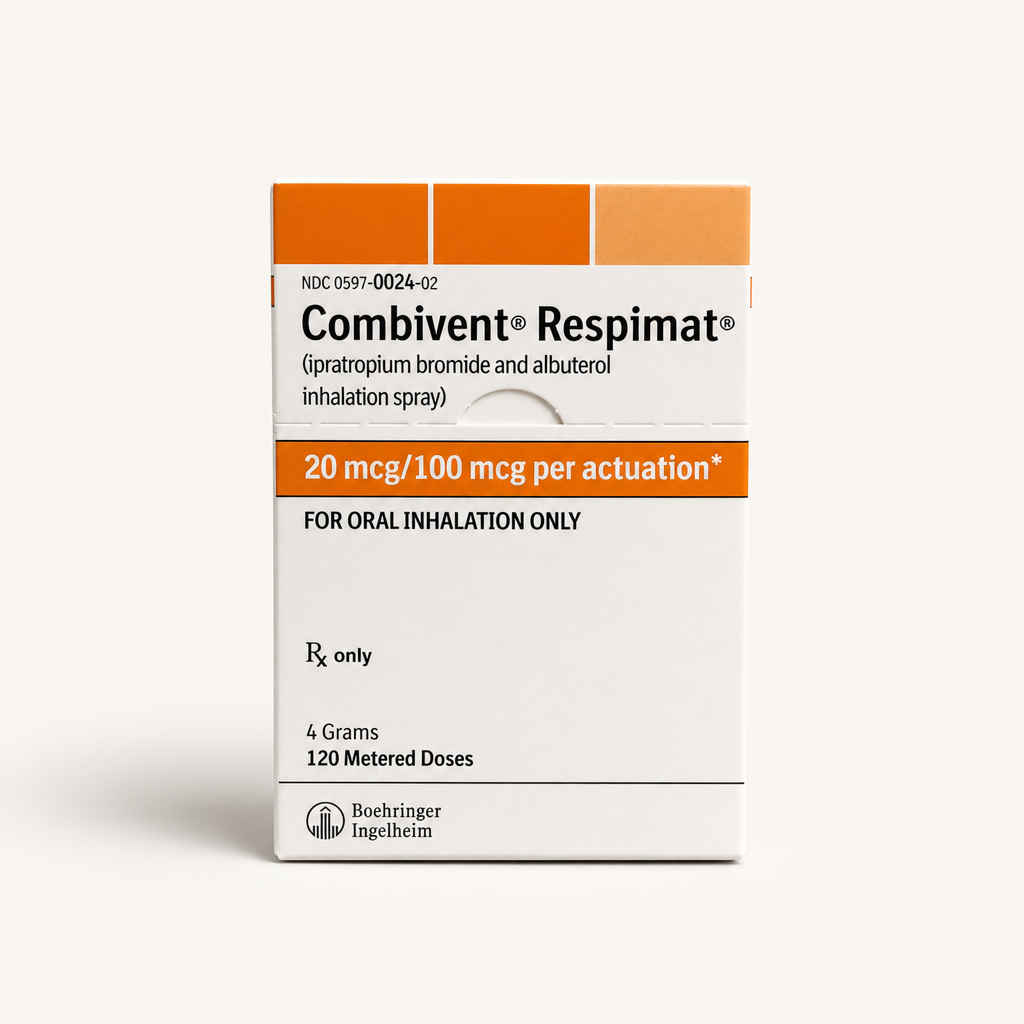
How It Works
The Combivent Respimat Inhaler treats COPD from two angles:
- The relax signal: Albuterol relaxes the muscles around your airways. This widens air passages almost immediately.
- The stop-tightening signal: Ipratropium blocks the body’s lung-tightening signal. Stopping the signal helps keep your airways open for a longer period.
Together, these medicines help keep your airways relaxed and open, making it easier for air to move in and out of your lungs.
| Quick Facts | |
|---|---|
| Common Brands | Combivent Respimat |
| Drug Class | Anticholinergic / beta-2 agonist bronchodilator |
| Generic Status | No lower-cost generic available (brand name only) |
| Availability | Prescription only |
Dosing
The Combivent Respimat Inhaler is designed for a consistent daily routine. It is typically supplied as an inhaler device with a separate medication cartridge.
- Typical schedule: Providers typically recommend one inhalation (puff) four times a day.
- Maximum dose: Standard guidelines suggest not exceeding six inhalations in 24 hours.
- No shaking required: Unlike many other inhalers, you do not need to shake the Combivent Respimat device before use.
- Timing: Space your doses throughout the day (for example: morning, noon, late afternoon, and bedtime) to provide all-day benefits.
- Wait between puffs: If your doctor has prescribed two puffs at a time, you generally do not need to wait between them.
Note: Dosing information below is educational only. Your prescribing physician will determine your specific dose based on your individual health needs. Always follow your healthcare provider’s instructions for exact dosing.
Uses
FDA-Approved Uses
The FDA approves Combivent Respimat Inhaler for COPD maintenance. This medication is used for long-term treatment of airflow obstruction in patients with chronic obstructive pulmonary disease (COPD) who require a second bronchodilator.
Off-Label Uses
You may see the Combivent Respimat Inhaler prescribed for uses that are not FDA-approved. This is a common and legal practice called off-label prescribing, where a doctor uses their clinical judgment to prescribe a drug for a different (but well-researched) purpose.
The Combivent Respimat Inhaler may be prescribed off-label for the following conditions:
- Severe asthma: While not FDA-approved for asthma, some specialists may prescribe it for patients whose asthma symptoms are not controlled with standard steroid/LABA inhalers.
- Acute bronchitis relief: Occasionally used to provide temporary relief from the intense wheezing and chest tightness that can follow a severe lung infection.
Side Effects
Most people tolerate the soft mist delivery well, but because the medication can affect the nervous system and heart rate, some side effects are common.
Common Side Effects
- Headache or dizziness
- Dry mouth
- Mild cough or throat irritation
- Cold-like symptoms (runny or stuffy nose)
- Nervousness or tremors
Serious Side Effects
Serious side effects are rare, but it’s important to know what to look for if they do occur. It’s generally accepted that you stop taking the medication and immediately call the doctor if you experience any of the following symptoms:
- Heart effects: Fast, pounding, or irregular heartbeat (palpitations) or chest pain.
- Vision changes: If the mist gets into your eyes, it can cause sudden blurred vision or worsen glaucoma. It is generally advised to watch for halos around lights.
- Urinary retention: Difficulty passing urine, which is more common in men with an enlarged prostate.
- Paradoxical bronchospasm: A rare, sudden worsening of breathing immediately after use.
- Severe allergic reaction: Standard guidelines typically advise seeking help for hives, swelling of the face or tongue, or severe difficulty breathing.
Call your doctor immediately if you experience any concerning or prolonged symptoms.
Pharmacist Tips
Assemble It Carefully
When you get a new inhaler, insert the clear end of the medication cartridge into the bottom of the inhaler and press it firmly against a hard surface until it clicks. Providers typically suggest writing the discard date (3 months from assembly) on the label.
Use the TOP Technique
Standard guidelines typically advise remembering the steps: turn the base, open the cap, and press the button while breathing in slowly and deeply.
Hold Your Breath
After you breathe in the mist, it is generally advised to hold your breath for 10 seconds (or as long as is comfortable) to allow the medicine to settle into your lungs.
Clean The Mouthpiece
Once a week, wipe the mouthpiece and the inner metal part with a damp cloth or tissue. Providers generally advise against using soap or water inside the device.
Watch the Counter
The device has a dose indicator. When the pointer enters the red area, you have about 7 days of medicine left. Ensure you have a replacement ready before your dosages run out.
Protect Your Eyes
It is generally advised to avoid spraying the mist directly into your eyes, as ipratropium can cause temporary blurred vision or pupil dilation.
Drug Interactions
The Combivent Respimat Inhaler can interact with other medications that affect your heart, blood pressure, or nervous system. Let your doctor know if you take any of the following:
- Beta-blockers: Common blood pressure and heart medications (such as metoprolol or propranolol) can block albuterol’s effects and may cause your airways to tighten.
- Other anticholinergics: It is generally recommended to avoid using other medications in this class (such as Spiriva) at the same time unless directed by your doctor.
- Diuretics: Some water pills can lower your potassium levels, which when combined with albuterol, could cause issues with your heart rate.
- Antidepressants: MAOIs and tricyclic antidepressants can increase the impact the medicine has on your heart rate.
Always give your doctor and pharmacist a complete list of all your medications, vitamins, and supplements to check for potential interactions.
FAQs
How do you assemble and insert the medication cartridge into a new Combivent Respimat Inhaler?
Keep the cap closed while pressing the safety catch and pulling off the clear base. Push the narrow end of the cartridge into the inhaler. Place the inhaler on a hard surface and push down firmly until the cartridge clicks into place.
What is the priming process before using a Combivent Respimat inhaler for the first time?
With the cap closed, standard guidelines typically recommend turning the base toward the arrows until it clicks. You will then open the cap, point the inhaler toward the ground, and press the dose-release button. Providers generally advise repeating this until you see a mist, then repeat 3 more times. If you haven’t used the inhaler for more than 3 days, you can release 1 puff toward the ground before your dose.
What is the difference between the Combivent Respimat mist delivery system and a traditional metered-dose inhaler?
Traditional inhalers (MDIs) use a chemical propellant, which requires you to inhale quickly to receive the medication dosage. The Combivent Respimat Inhaler uses a spring to create a slower-moving and longer lasting mist that makes it easier to inhale deeply for most patients.
How many times a day should Combivent Respimat be used for COPD maintenance?
The standard maintenance dose is one puff four times a day. Your doctor may increase this depending on your response to the medication.
Can Combivent Respimat be used as a rescue inhaler during a shortness of breath episode?
Combivent Respimat is primarily indicated for maintenance treatment of COPD. Patients should follow their healthcare provider’s instructions regarding rescue medications for sudden breathing symptoms.
Is Combivent Respimat safe for patients with a peanut or soy allergy?
Yes. Some older versions of combination inhalers contained soy lecithin, which was a risk for patients with these allergies, but the Respimat device does not contain soy or peanut derivatives.
Can taking Combivent Respimat cause heart palpitations?
Yes. Albuterol is a stimulant that can cause your heart to race or pound. This is a common side effect that usually goes away shortly after you take the dose. If palpitations are severe, worsening, accompanied by chest pain, fainting, or significant shortness of breath, seek immediate emergency care.
Does the Combivent Respimat Inhaler interact with beta-blocker blood pressure medications?
Yes. Beta-blockers can interfere with albuterol’s action and sometimes worsen your breathing symptoms.
Can the Combivent Respimat Inhaler be used with a plastic spacer device?
No. Spacers are designed for high-pressure puffer inhalers. Because the Respimat already creates a slow-moving mist, a spacer is not needed and could prevent the medicine from reaching your lungs.
Comparable Medications
Albuterol, DuoNeb, Spiriva, or Symbicort?
Here are possible alternatives to the Combivent Respimat Inhaler:
Albuterol HFA
From $43.99
Albuterol is a single-ingredient rescue medicine. Combivent is a two-ingredient maintenance medicine. Combivent is generally more effective for COPD because it uses two paths to keep the airways open.
DuoNeb
Both DuoNeb and Combivent contain the same active ingredients. The difference is in the delivery: DuoNeb is a liquid used with a home nebulizer, while Combivent Respimat is a portable inhaler.
Tiotropium Dry Powder Inhaler
From $479.99
Spiriva is a long-acting anticholinergic that works for 24 hours. Combivent is short-acting and must be taken 4 times a day. Some patients may be prescribed both.
Symbicort
Symbicort contains a steroid to lower inflammation and a long-acting bronchodilator. Combivent Respimat does not contain a steroid.
We Have Combivent Respimat Inhaler in Stock. Get Yours Today!
Important: Information on this page is for educational purposes only. Prescribing decisions are made by independent, licensed providers. TelyRx operates technology-enabled pharmacies and a telehealth platform that connects patients with licensed providers. Prescriptions, when provider-approved and issued, are filled and shipped by TelyRx-affiliated pharmacies. We do not employ physicians or make prescribing decisions. Learn more about our editorial standards here.