

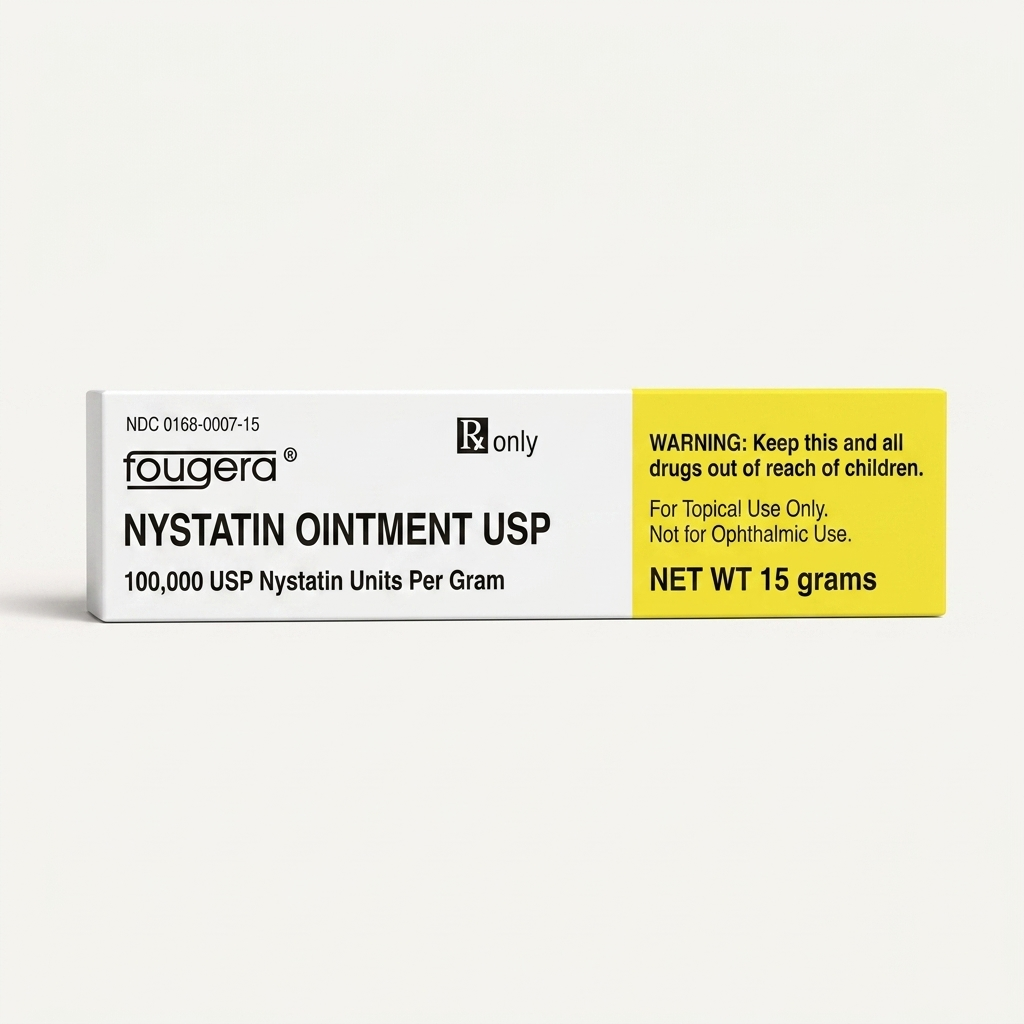
How It Works
Nystatin works by disrupting the integrity of the fungal cell membrane, which causes fungal death to eliminate the infection.
| Quick Facts | |
|---|---|
| Common Brands | Mycostatin, Nystop, Nyamyc, Klayesta, and Nilstat |
| Drug Class | Topical polyene antifungal |
| Generic Status | Lower-cost generic is available |
| Availability | Prescription only |
Dosing
Standard guidelines suggest applying a generous amount of nystatin ointment directly to the affected area(s) of the skin.
Providers typically recommend applying the medication 2 times daily. Depending on the severity of your infection, your provider may recommend applying up to 4 times daily.
Note: Dosing information below is educational only. Your prescribing physician will determine your specific dose based on your individual health needs. Always follow your healthcare provider’s instructions for exact dosing.
Uses
FDA-Approved Uses
Nystatin ointment is FDA-approved to treat skin infections caused by Candida species, such as cutaneous candidiasis and other localized fungal skin infections.
Off-Label Uses
You may see nystatin ointment prescribed for uses that are not “FDA-approved.” This is a very common and legal practice called “off-label” prescribing, where a doctor uses their clinical judgment to prescribe a drug for a different (but well-researched) purpose.
Providers may sometimes prescribe nystatin off-label to address other fungal skin infections.
Side Effects
Like all medications, nystatin ointment can cause side effects. The most common side effects are localized to the area of skin where the ointment is applied. Other side effects may be serious and require medical attention.
Common Side Effects
- Allergic reactions
- Burning
- Itching
- Rash
- Irritation
- Eczema (dry, itchy, and inflamed skin)
- Pain
Serious Side Effects
Serious side effects are rare, but it’s important to know what to look for if they do occur. Stop using nystatin ointment and call your doctor immediately if you experience:
- Severe allergic reactions: Symptoms include swelling of the face, lips, tongue, or throat (angioedema); difficulty breathing or swallowing; racing heart; severe rash or itching; and/or fever.
- Severe skin reactions: Nystatin ointment may cause severe skin irritation, redness, swelling, itching, blistering, or peeling.
Call your doctor immediately if you experience any concerning or prolonged symptoms.
Pharmacist Tips
Apply Consistently
Applying the ointment at around the same times each day can help you stay on schedule and avoid skipping a dose.
Finish The Course
It’s strongly recommended to finish the full prescribed course of the medication, even if your skin begins to look better. Stopping treatment early may cause the fungal infection to return and become harder to treat.
Nystatin Ointment Is Strictly For External Use On The Skin
It should never be put into the eyes, nose, or ears. Additionally, it should never be placed inside the vagina to treat a vaginal yeast infection.
Wash Your Hands Before And After Applying
This helps prevent you from accidentally getting the medication in your eyes. If the infection is located on your hands, wash them only before applying the medication. If the medication does get into your eyes, rinse them immediately with plenty of cool tap water or saline solution.
Avoid Using Airtight Bandages
You can cover the treated area with a sterile gauze dressing or bandage, but avoid using airtight coverings or plastic bandages on the application site.
Ask Your Healthcare Provider Before Using Skincare Or Cosmetics
They can advise whether it’s safe to apply these to the affected area during treatment.
Store At Room Temperature
Nystatin ointment should be stored at 68°F to 77°F (20°C to 25°C) in a cool, dry place away from light.
Tell Your Provider If You’re Pregnant Or Breastfeeding
It is not known if nystatin ointment can affect pregnancy or if the medication passes into breast milk. Tell your provider if you are pregnant, breastfeeding, or planning to be, so they can advise you whether it’s safe to use the medication.
Drug Interactions
There are no known interactions between topical nystatin and foods, drinks, or other prescription medicines. However, it is generally recommended to avoid using any other skin care products, cosmetics, or topical treatments on the affected area without first consulting your doctor.
Always give your doctor and pharmacist a complete list of all your medications, vitamins, and supplements to check for potential interactions.
FAQs
Why is nystatin ointment prescribed for yeast infections but ineffective against ringworm?
Nystatin is designed to treat fungal infections caused by the Candida yeast. Studies show it does not work well for treating ringworm, which is caused by a different type of fungus. Providers typically recommend other antifungal medications that are designed to treat ringworm, such as clotrimazole or ketoconazole.
What is the difference between prescribing nystatin ointment versus nystatin cream?
Both the ointment and cream formulations contain the same active antifungal medicine and treat similar conditions. The difference lies in their texture and application. Ointments are thicker and may be better for dry or scaly skin, while creams may be recommended for larger or moist areas of skin.
Can nystatin ointment be applied inside the mouth or swallowed to treat oral thrush?
No. Topical nystatin is specifically designed for external use on the skin only. It should not be swallowed or applied inside the mouth, eyes, nose, ears, or vagina. There are separate oral formulations of nystatin designed specifically for oral thrush.
Does nystatin ointment contain a topical corticosteroid or any antibacterial ingredients?
No. Nystatin is a polyene antifungal medication. It contains no steroids, nor does it have any antibacterial or antiviral properties.
How many times a day should nystatin ointment be applied to an active infection?
Providers typically recommend applying the ointment to the affected skin 2 to 4 times a day. Always follow the exact frequency and instructions prescribed by your provider.
Is it safe to apply nystatin ointment to the face or near the eyes?
Nystatin ointment can be safely applied to facial skin to treat topical fungal infections. However, it’s recommended to avoid getting the medication anywhere near or inside the eyes.
Is nystatin ointment effective against bacterial skin infections such as staph?
No. Nystatin is an antifungal medication, meaning it treats skin infections caused by fungi. It is ineffective against bacterial or viral infections.
What is the standard medical protocol if a fungal infection does not visibly improve after two weeks of consistent nystatin ointment application?
If symptoms like itching or burning do not improve, or if they worsen over time, let your prescriber know immediately. They may need to re-evaluate your infection and potentially prescribe a different treatment.
Does nystatin ointment interact with other topical skin care products or moisturizers?
While severe interactions are not expected, standard guidelines advise against using any other skin products on the treated area without first talking to your provider.
Why must you continue applying nystatin ointment after all visual symptoms disappear?
Stopping the medication too early can allow microscopic amounts of the fungus to survive. Skipping doses or ending treatment early can cause the infection to persist, return, and ultimately become harder to treat.
Comparable Medications
Nystatin ointment, clotrimazole, nystatin/triamcinolone, nystatin topical powder, ketoconazole, or fluconazole?
There are several medications your doctor can prescribe instead of nystatin ointment. Here are a few possible alternatives below.
Clotrimazole
A topical antifungal used for fungal infections like ringworm, jock itch, and athlete’s foot.
Nystatin / Triamcinolone Topical
From $29.99
A combination topical antifungal and corticosteroid used for fungal skin infections caused by yeast.
Nystatin Powder
From $29.99
A powder form of nystatin that may be used for fungal infections in areas of the body that can be very moist or sweaty, such as the groin.
Ketoconazole
From $39.99
A topical antifungal used for various fungal infections, including ringworm, athlete’s foot, jock itch, seborrheic dermatitis, and skin infections caused by yeast.
Fluconazole
From $24.99
An oral antifungal used for various fungal infections, including vaginal yeast infections, oral thrush, and urinary tract infections (UTIs).
We Have Nystatin Ointment in Stock. Get Yours Today!
Important: Information on this page is for educational purposes only. Prescribing decisions are made by independent, licensed providers. TelyRx operates technology-enabled pharmacies and a telehealth platform that connects patients with licensed providers. Prescriptions, when provider-approved and issued, are filled and shipped by TelyRx-affiliated pharmacies. We do not employ physicians or make prescribing decisions. Learn more about our editorial standards here.