

How It Works
Migraine involves changes in nerve activity and chemical signaling in the brain. Frovatriptan activates serotonin receptors on certain nerves and blood vessels. This is thought to reduce migraine pain signals and narrow blood vessels involved in an attack.
Frovatriptan works through a dual process:
- Targeting serotonin receptors: The medication activates certain serotonin receptors on blood vessels involved in migraine, causing them to narrow.
- Interrupting pain signals: Frovatriptan also blocks the release of chemicals that send pain messages to the brain. This helps calm overactive nerves that cause symptoms such as nausea and light sensitivity.
Because frovatriptan stays in the body longer than most other triptans, some doctors choose it for patients whose migraines tend to last a long time, or come back a few hours after other medications wear off.
Who should not take frovatriptan: Frovatriptan is not safe for everyone. Do not take it if you have heart disease, including a past heart attack or chest pain from narrowed or spasming heart arteries (angina), certain heart rhythm problems, a history of stroke or TIA (mini-stroke), hemiplegic or basilar migraine (rare types of migraine your doctor would have diagnosed by name), poor circulation in your arms or legs, reduced blood flow to the bowel, high blood pressure that is not controlled, or an allergy to frovatriptan.
| Quick Facts | |
|---|---|
| Common Brands | Frova |
| Drug Class | Serotonin (5-HT1) receptor agonist (triptan) |
| Generic Status | Generic version available |
| Availability | Prescription only |
Dosing
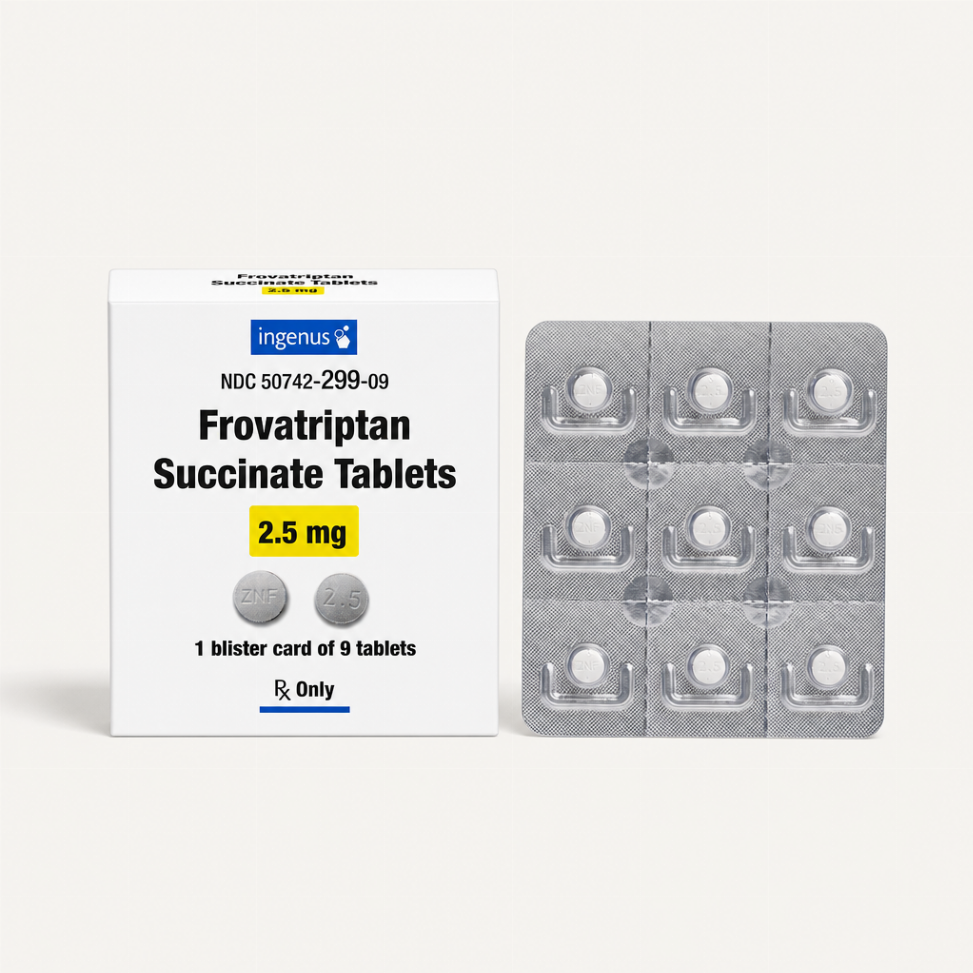
Frovatriptan is available as a 2.5 mg tablet. Follow your prescription and the dosing instructions below, unless directed otherwise by your doctor.
- Initial dose: Take a single 2.5 mg tablet with water at the first sign of a migraine headache.
- The two-hour rule: If your migraine comes back, or if the first tablet only gave you some relief, you can take a second tablet at least 2 hours after the first. If the first tablet does not help your headache at all, do not take a second one without talking to your doctor first.
- Daily maximum: Do not take more than 7.5 mg (three 2.5mg tablets) within any 24-hour period.
- Food: Frovatriptan can be taken with or without food.
Note: Dosing information below is educational only. Your prescribing physician will determine your specific dose based on your individual health needs. Always follow your healthcare provider’s instructions for exact dosing.
Uses
FDA-Approved Uses
Frovatriptan is FDA-approved to treat migraine attacks, with or without aura, in adults.
Off-Label Uses
You may see frovatriptan prescribed for uses that are not FDA-approved. This is a common and legal practice called off-label prescribing, where a doctor uses their clinical judgment to prescribe a drug for a different purpose. The amount of research behind an off-label use varies.
Frovatriptan may be prescribed off-label for the following conditions:
- Menstrual migraine prevention: Frovatriptan may be prescribed to be taken for a few days surrounding a woman’s menstrual period to prevent predictable hormonal migraine attacks.
- Cluster headache prevention: Some specialists prescribe frovatriptan off-label for short-term prevention, including nighttime attacks.
Side Effects
Most people tolerate frovatriptan well, but because it narrows blood vessels by turning on serotonin receptors, some side effects can occur.
Common Side Effects
- Dizziness and tiredness
- Headache (separate from the migraine itself)
- Flushing (a warm or burning feeling in the face)
- Dry mouth
- Indigestion
- Tingling or numbness in the hands or feet – however, numbness can also be a sign of reduced blood flow which is serious (see next section)
Serious Side Effects
Serious side effects are rare, but it’s important to be aware of them so that you know what to do if they occur.
- Heart and circulation issues: Severe pain or tightness in the chest, throat, neck, or jaw, shortness of breath, or cold/numb fingers and toes.
- Serotonin syndrome: A dangerous buildup of serotonin that can cause a racing heart, hallucinations, muscle stiffness, or extreme agitation.
- Extreme blood pressure elevation: Frovatriptan can cause significant increases in blood pressure that can be dangerous.
- Stroke symptoms: Sudden weakness on one side of the body, slurred speech, or facial drooping.
- Stomach and bowel problems: Sudden or severe stomach pain, stomach pain after eating, or bloody diarrhea can mean blood flow to the bowel is reduced.
Stop taking frovatriptan and get emergency medical help immediately if you have symptoms of a heart attack, stroke, or signs of a severe allergic reaction such as swelling of the face, mouth, tongue, or throat or trouble breathing.
Call your doctor immediately if you experience any concerning or prolonged symptoms.
Pharmacist Tips
Act Early
Frovatriptan works better when taken at the first sign of migraine. Do not wait until the migraine is severe to take your dose.
Rest After Dosing
Since dizziness and tiredness are common, it is generally recommended to avoid driving or operating machinery until you know how the medication affects you.
Use a Calendar to Keep Track
If you need frovatriptan for more than four migraine attacks in 30 days, contact your doctor to review your treatment. The safety of treating attacks with frovatriptan this often has not been established.
Alcohol Caution
Alcohol is a trigger for many migraine sufferers and can worsen the dizziness caused by the medication.
Talk to your doctor
Tell your doctor if you are pregnant, planning a pregnancy, breastfeeding, or have liver problems. Also mention any heart disease risk factors, since your doctor may want to check your heart before you start or have you take the first dose in their office.
Drug Interactions
Frovatriptan has several important interactions that can affect your safety, particularly concerning other medications that impact serotonin or blood vessels.
Let your doctor know if you take:
- Other migraine medications:Do not take frovatriptan within 24 hours of another triptan (such as sumatriptan) or ergot-type medication (such as Migranal).
- Antidepressants: Certain antidepressants raise serotonin levels, including SSRIs, SNRIs, and older tricyclic antidepressants. Combining them with frovatriptan increases the risk of serotonin syndrome.
- MAOIs: Tell your doctor if you take an MAOI, or if you stopped taking one recently. MAOIs raise serotonin levels, and some are not safe to combine with migraine medicines like this one, so your doctor will decide whether frovatriptan is right for you and when you can take it.
Tell your doctor your full medical history before you take frovatriptan, including a complete list of all your medications, vitamins, and supplements to check for potential interactions.
FAQs
Why is frovatriptan prescribed for the prevention of menstrual migraines compared to other triptan medications?
Frovatriptan has the longest half-life of all triptans, which means it stays in the body longer than the others. That makes it an option some doctors use off-label for short-term prevention around a predictable menstrual migraine window.
Why does frovatriptan typically take longer to provide initial pain relief compared to other triptans like sumatriptan?
Frovatriptan is a slower-acting oral option than some other migraine treatments, especially injections. Some people get relief within two hours, while others need longer. How quickly it helps, and how long the relief lasts, varies from person to person.
What should I do if the first dose of frovatriptan fails to relieve a migraine?
If the first tablet gives you no relief at all, there is no evidence that a second tablet will help that same headache. If this is the case, speak with your doctor about other options. If the first dose only gave you some relief, or if the migraine came back later, you can take a second tablet 2 hours after taking the first one. Do not take more than 3 tablets in 24 hours.
Does taking frovatriptan with an SSRI or SNRI antidepressant increase the risk of serotonin syndrome?
Yes. Let your doctor know if you are taking one or the other.
Can taking frovatriptan too frequently lead to the development of medication overuse headaches (rebound headaches)?
Yes. Using acute migraine medications such as triptans for more than 10 days a month can create a cycle where the medication itself causes medication-overuse headaches.
Does frovatriptan actively treat migraine-associated symptoms like nausea?
Yes. Stopping the migraine process in the brain can help resolve the nausea, vomiting, and sensitivity to light that may come with the migraine attack.
Can you safely take an NSAID at the same time as frovatriptan?
Yes. Taking an NSAID like naproxen (Aleve) alongside a triptan is a common way to treat a severe migraine, as they work through different pathways. However, consult your doctor first to ensure NSAIDs are safe for you.
Does taking frovatriptan temporarily elevate your systemic blood pressure?
Yes. Because it constricts blood vessels, it can temporarily raise blood pressure. Do not take frovatriptan if you have high blood pressure that is not controlled.
Comparable Medications
Sumatriptan, Rimegepant, or Topiramate?
Choosing the right migraine therapy depends on whether you need immediate relief or long-term prevention.
Sumatriptan
From $29.99
Sumatriptan is the most common triptan and when administered as an injection or nasal spray, may provide faster relief. Frovatriptan stays in the body longer and may suit people whose headaches tend to return. The best choice depends on how you respond and on your medical history.
Rimegepant
Rimegepant belongs to a newer class called gepants. Rimegepant does not narrow blood vessels the way triptans do, so a doctor may consider it when a triptan is not suitable. It still needs a review of your medical history, and it can cause new or worsening high blood pressure, or Raynaud’s phenomenon, a circulation problem affecting the fingers and toes.
Naproxen
Naproxen is a non-steroidal anti-inflammatory (NSAID). While helpful for mild migraines, it is not a targeted treatment. A doctor may suggest taking naproxen along with frovatriptan if one medicine alone does not give enough relief, since the two work in different ways. Ask your doctor first, because NSAIDs are not suitable for everyone.
Topiramate
These usually serve different roles. Topiramate is a daily pill taken to help prevent migraine attacks Frovatriptan can be considered as the “rescue pill” for a migraine that has already begun.
We Have Frovatriptan in Stock. Get Yours Today!
Important: Information on this page is for educational purposes only. Prescribing decisions are made by independent, licensed providers. TelyRx operates technology-enabled pharmacies and a telehealth platform that connects patients with licensed providers. Prescriptions, when provider-approved and issued, are filled and shipped by TelyRx-affiliated pharmacies. We do not employ physicians or make prescribing decisions. Learn more about our editorial standards here.