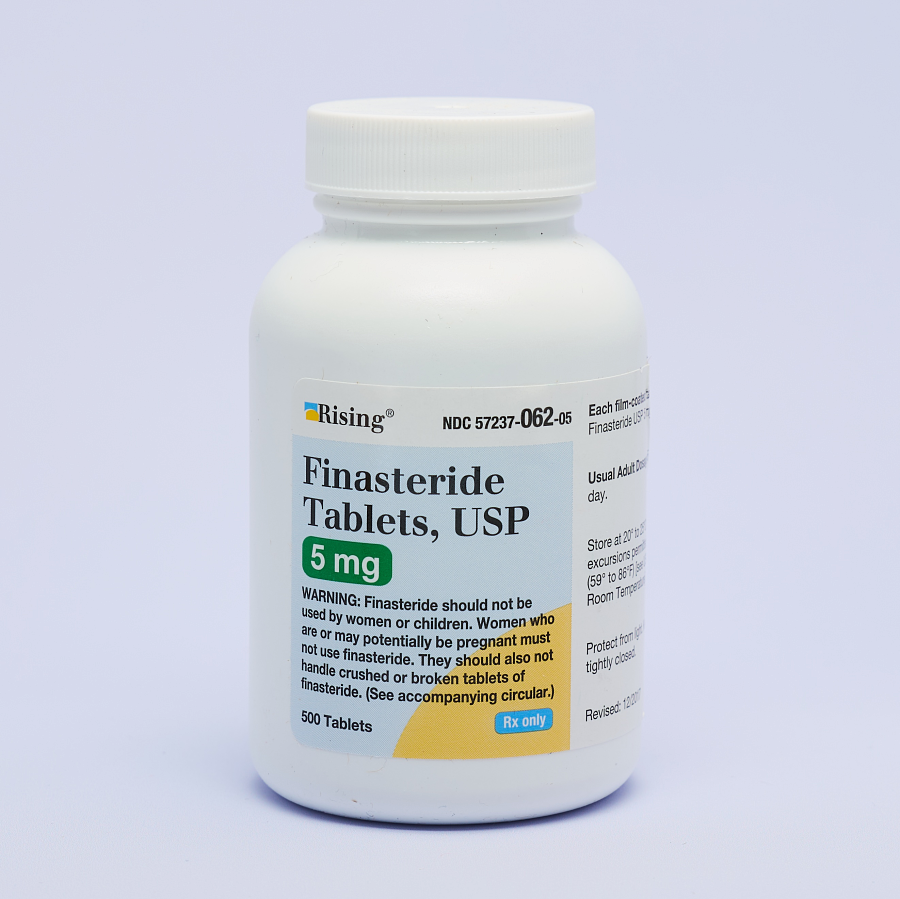
How It Works
Finasteride works by binding to and inhibiting 5-alpha reductase, the enzyme responsible for converting testosterone into dihydrotestosterone (DHT). DHT is crucial to healthy fetal development, but high DHT levels in adult men can lead to undesirable effects such as shrinking hair follicles and an enlarged prostate.
To treat male pattern baldness, finasteride reduces DHT levels to slow the process of miniaturizing hair follicles – a precursor to thinning. Finasteride can also help the prostate gland reduce its volume by decreasing DHT levels and, in doing so, relieve pressure on the urinary tract to improve flow and minimize how often you need to urinate.
| Quick Facts | |
|---|---|
| Common Brands | Propecia (for male pattern baldness), Proscar (for enlarged prostate) |
| Drug Class | 5-alpha reductase inhibitor |
| Generic Status | Generic version of Propecia, Proscar |
| Availability | Prescription only |
Dosing
Dosing finasteride is based on whether the patient is using the drug to treat male pattern baldness or an enlarged prostate. Other factors like age and medical history may come into play.
- For hair loss: When treating hair loss, the standard dose for finasteride is 1 milligram (mg) taken daily. Clinical studies suggest taking a higher dose is not more effective, and can also increase the risk of side effects.
- For enlarged prostate: The standard finasteride dose for treating prostate enlargement is 5 mg daily.
- Missed dose: If you forget to take your daily finasteride dose, standard guidelines recommend skipping it and waiting until the next day’s dose. “Double dosing” is not advised.
- Topical application: Rather than taking an oral tablet, some physicians may instead recommend applying compounded topical finasteride solutions directly to the scalp. This can reduce systemic absorption of the drug while reducing DHT levels in a localized area.
- Results timeline: For most people, finasteride does not produce immediate results. Many wait 3 to 6 months before noticing a reduction in hair loss or an improvement in enlarged prostate symptoms. Providers typically recommend a 12-month dose to evaluate the medication’s peak effectiveness.
Note: Dosing information is educational only. Your prescribing physician will determine your specific dose based on your individual health needs. Always follow your healthcare provider’s instructions for exact dosing.
Uses
FDA-Approved Uses
Finasteride is FDA-approved for two uses:
- Increasing hair growth and preventing further hair loss for men with androgenetic alopecia, or male pattern baldness.
- Treating symptomatic enlarged prostate, preventing acute urinary retention, and reducing the need for corrective surgery in people with benign prostatic hyperplasia.
Off-Label Uses
You may see finasteride prescribed for uses that are not “FDA-approved.” This is a very common and legal practice called “off-label” prescribing, where a doctor uses their clinical judgment to prescribe a drug for a different (but well-researched) purpose.
Common off-label uses for finasteride currently used in clinical research and practice include:
- Female pattern hair loss: Finasteride is not FDA-approved to treat pattern hair loss in women, but providers may still prescribe the drug to treat hormonal thinning in post-menopausal women and women who are not of childbearing age.
- Hirsutism: Finasteride may be used off-label to treat excessive body hair growth in women by reducing the androgenic stimulation of body hair follicles.
Get Savings Updates for Finasteride
Join our mailing list for exclusive deals and more.
Side Effects
Although finasteride is generally well-tolerated, the drug’s impact on the body’s hormonal levels can produce some side effects.
Common Side Effects
- Decreased libido
- Erectile dysfunction
- Decrease in volume or changes to ejaculation
- Mild skin rash
- Dizziness
Serious Side Effects
Serious side effects are rare, but it’s important to know what to look for if they do occur. Serious side effects of taking finasteride can include:
- Breast changes: Men should consult their provider if they notice any lumps, pain, nipple discharge, or enlargement of tissue, as all of these systems require an evaluation for breast cancer.
- Mood changes: Taking finasteride can lead to worsening depression, anxiety, and suicidal ideation.
- High-grade prostate cancer: Finasteride can reduce a patient’s overall risk of prostate cancer, but the drug can slightly increase the risk of a rare, aggressive form of the disease called high-grade prostate cancer.
- Severe allergic reaction: As with many other types of medication, finasteride can cause anaphylaxis for people who are allergic to one or more of its ingredients.
Call your doctor immediately if you experience any concerning or prolonged symptoms.
Pharmacist Tips
Keep Away From Pregnant People
The medicine inside finasteride tablets absorbs quickly into the skin and has been linked to fetal birth defects. It is advised for pregnant women or those who may become pregnant to never handle crushed or broken finasteride tablets.
Patience Goes a Long Way
Most men who take finasteride for hair loss do not see immediate results – in many cases, the drug can take months to reach peak effect. Some people even notice a “shedding” phase before hair regrowth occurs, though this is considered a sign that the drug is working as intended.
Wait to Donate
Standard guidelines recommend waiting at least 1 month after your last finasteride dose to donate blood. This prevents blood containing levels of finasteride from being transfused to a pregnant person.
Be Consistent With Dosing
It is recommended to take your finasteride dose at the same time each day to ensure consistent levels of the medication in your body.
Give Your Doc a Head’s Up
Finasteride can alter the lab results for prostate-specific antigen (PSA) levels during routine health screenings. If you are over the age of 40 or undergoing a prostate exam, be sure to let your doctor know you take the drug.
Drug Interactions
Compared to other maintenance medications, finasteride has relatively few known interactions. These include:
Always give your doctor and pharmacist a complete list of all your medications, vitamins, and supplements to check for potential interactions.
FAQs
What is the difference between Finasteride 1 mg (Propecia) and Finasteride 5 mg (Proscar)?
Propecia and Proscar both contain finasteride as the active ingredient, but each drug is primarily prescribed for different uses. The 1-mg Propecia is optimized to treat hair loss, while the 5-mg Proscar provides a higher concentration of the drug to help shrink the prostate.
Why is my hair falling out more now that I started taking finasteride (the u0022shedding phaseu0022)?
When finasteride starts working, the medication essentially pushes hair follicles from the “resting” phase into a phase for new growth. As part of this process, the follicle must first shed the old hair. Shedding is not only a normal side effect of taking finasteride, but also considered a positive sign that the drug is working.
Does finasteride lower testosterone levels?
Finasteride does not necessarily lower testosterone levels, and in many cases, the opposite is true. Since finasteride halts the process of converting testosterone into dihydrotestosterone, men who take the drug may notice an increase of 10% to 15% in their circulating testosterone levels.
Can finasteride cause permanent sexual dysfunction (u0022Post-Finasteride Syndromeu0022)?
The phenomenon dubbed “Post-Finasteride Syndrome” (PFS) refers to lingering sexual, physical, and mental health effects that can persist for people who stop taking the drug. While observed and studied in clinical trials, PFS requires more research to be fully understood as a medical condition.
Why should pregnant women not touch a finasteride tablet?
The medicine inside finasteride tablets absorbs quickly into bare skin, and has been linked to birth defects in male fetuses. For these reasons, pregnant people should never touch or handle finasteride tablets that have been cracked or broken.
How long does it take to see results for hair loss?
Most men see an increase in hair growth within 3 to 6 months of first taking finasteride. That said, full regrowth and thickening generally takes about 12 months to peak.
Will I lose my hair again if I stop taking finasteride?
Yes, you will lose your hair again if you stop taking finasteride. This is a maintenance medication, not a permanent cure, and your DHT levels will return to their former state without the drug to keep them in check. Most people who stop taking finasteride lose their regrown hair within 6 to 12 months.
Can I take finasteride and minoxidil (Rogaine) at the same time?
Yes, you can take finasteride and minoxidil (Rogaine) at the same time. Many providers recommend taking both drugs together, as finasteride addresses the underlying hormonal causes of hair loss while Rogaine stimulates blood flow and hair growth.
Why can’t I donate blood while taking finasteride?
Finasteride has been linked to birth defects in male fetuses. If blood containing finasteride is given to a pregnant person, this can cause birth defects.
How does finasteride affect my PSA (Prostate-Specific Antigen) test results?
Finasteride lowers PSA levels by roughly 50%, making prostate screenings harder to interpret for doctors who do not know their patient is taking the drug. Providers typically need to double the PSA number for these patients in order to make an accurate interpretation of prostate screenings results.
Can finasteride cause depression?
The biological link between finasteride and depression is still being researched, but some people who take the drug report mood changes. When discussing the possibility of taking finasteride, it is advised to tell your doctor if you have a history of depression.
Is topical finasteride safer than oral finasteride?
Topical finasteride is not necessarily safer than oral finasteride. Since the topical provides localized follicle stimulation, the medication is not absorbed into the body as much as the oral tablet, but some of the drug still finds its way into the bloodstream.
Does finasteride affect sperm count or fertility?
Some men who take finasteride have noted an increase in sperm count or volume while taking the drug. In most cases, these effects are reversible and will resolve when the patient stops taking the medication.
Does finasteride work for women with hair loss?
While finasteride may work for women with certain types of female hair loss, standard guidelines state pregnant people and those who may become pregnant should strictly avoid the drug.
Is there a u0022best ageu0022 to start taking finasteride?
The general rule of thumb for finasteride is that the earlier a patient starts taking the medication, the more hair they’ll “save” from loss. It is easier to preserve existing hair than regrowing hair from a dormant follicle.
Comparable Medications
Dutasteride
From $29.99
Available as a generic or brand-name Avodart, dutasteride is essentially a more potent version of finasteride that blocks two types of 5-alpha reductase enzymes. This results in potentially a more significant decrease in DHT levels. However, finasteride has a longer half-life and remains in the body for longer.
Tamsulosin
From $24.99
Also sold under the brand name Flomax, tamsulosin is an alpha-blocker that relaxes muscles in the prostate and bladder to reduce enlargement. Finasteride belongs to a different drug class, and works to shrink the prostate over a longer period of time. Providers often prescribe both drugs in combination for holistic treatment of benign prostatic hyperplasia (BPH).
Minoxidil
Minoxidil, sold under the brand name Rogaine, is a vasostimulator that promotes follicle growth through improved blood flow. Finasteride addresses the underlying hormonal causes of hair loss. In this sense, Rogaine and finasteride both accomplish the same goal through different means.
Ketoconazole Shampoo
From $29.99
Ketoconazole shampoo is an antifungal treatment with anti-androgenic properties. It is often prescribed alongside finasteride or minoxidil to provide relief from scalp inflammation that can occur when taking hair loss drugs.
We Have Finasteride in Stock. Get Yours Today!
Important: Information on this page is for educational purposes only. Prescribing decisions are made by independent, licensed providers. TelyRx operates technology-enabled pharmacies and a telehealth platform that connects patients with board-certified licensed providers. Prescriptions, when provider-approved and issued, are filled and shipped by TelyRx-affiliated pharmacies. We do not employ physicians or make prescribing decisions. Learn more about our editorial standards here.