

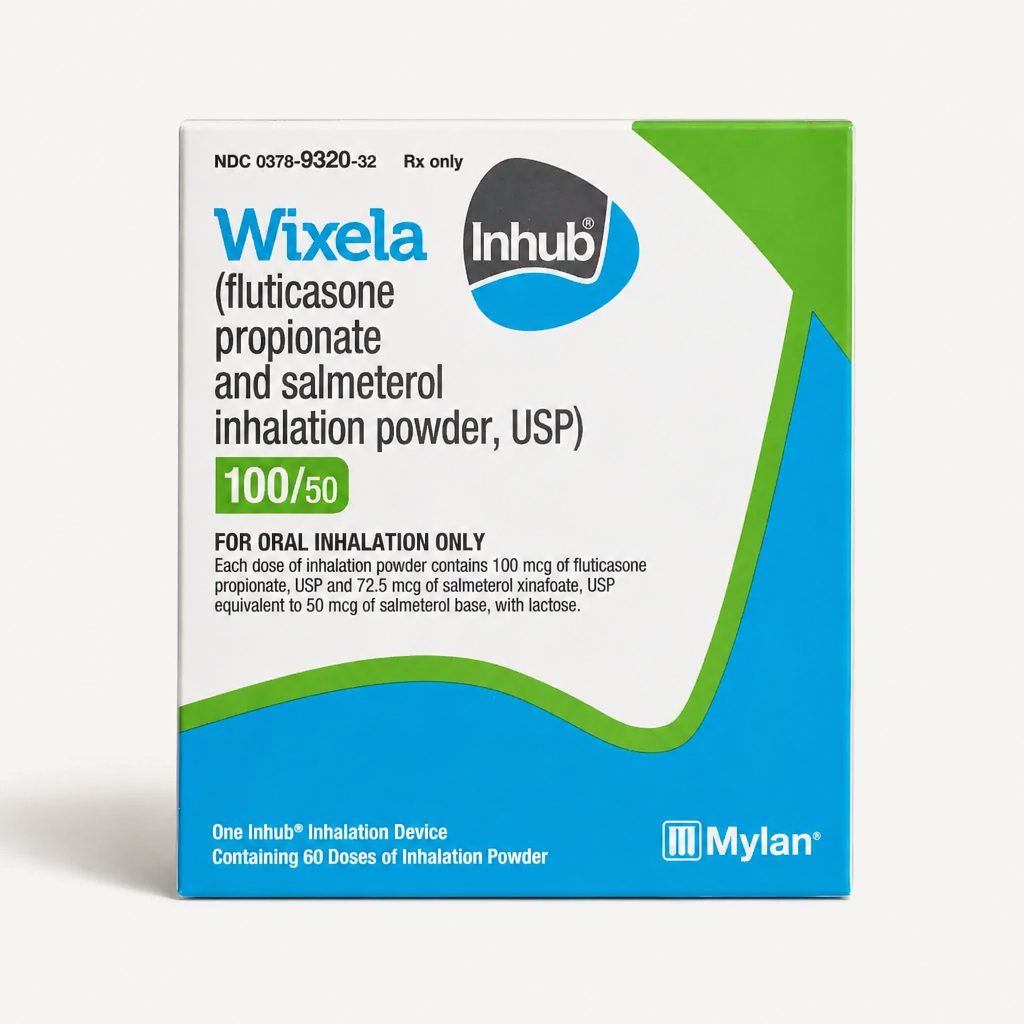
How It Works
Wixela Inhub combines two active ingredients that work together to open up the airways and improve lung function:
- Fluticasone propionate: This inhaled corticosteroid reduces chronic airway inflammation and swelling.
- Salmeterol: This long-acting beta2-agonist (LABA) relaxes the smooth muscle in the airways, helping keep them open.
Together, these effects make it easier for people with asthma or COPD to breathe.
| Quick Facts | |
|---|---|
| Common Brands | Advair Diskus, Advair HFA, AirDuo RespiClick, AirDuo Digihaler |
| Drug Class | Inhaled corticosteroid and long-acting beta-2 agonist (LABA) |
| Generic Status | Generic is available |
| Availability | Prescription only |
Dosing
Wixela Inhub comes in three fluticasone/salmeterol strengths: 100 mcg/50 mcg, 250 mcg/50 mcg, and 500 mcg/50 mcg. The recommended dosage strength depends on what you’re taking it for:
- Maintenance treatment of asthma: Your provider will determine the appropriate strength based on your asthma severity.
- Maintenance treatment of COPD: The recommended dosage strength is 250 mcg/50 mcg.
For both asthma and COPD, the recommended dose is one inhalation twice daily. Each dose should be about 12 hours apart.
The prescription packet included with your medication will include specific instructions for using the Wixela Inhub inhaler. Here are some general guidelines:
- Get out the inhaler when you’re ready to use it. You do not need to shake or prime the inhaler.
- Open the inhaler and press the yellow lever down until you hear a click.
- Hold the inhaler upright.
- Exhale fully and slowly, keeping the inhaler away from your mouth.
- Place your lips firmly around the mouthpiece and take a very fast, deep breath.
- Remove the inhaler from your mouth and hold your breath for up to 10 seconds (or as long as comfortably possible).
- Exhale fully and slowly.
- Close the inhaler and rinse your mouth, spitting the water out after rinsing.
Note: The dosing information below is for educational purposes only. Your prescribing physician will determine your specific dose based on your individual health needs. Always follow your healthcare provider’s instructions for exact dosing.
Uses
FDA-Approved Uses
Wixela Inhub is FDA-approved for the maintenance treatment of asthma and chronic obstructive pulmonary disease (COPD).
Off-Label Uses
You may see some medications prescribed for uses that are not FDA-approved. This is a very common and legal practice called “off-label” prescribing, where a doctor uses their clinical judgment to prescribe a drug for a different (but well-researched) purpose.
There are currently no common off-label uses for Wixela Inhub.
Side Effects
Like all medications, Wixela Inhub can cause side effects. Some common side effects may improve over time as your body adjusts to the medication. Other side effects may be serious and require medical attention.
Common Side Effects
- Common cold symptoms
- Throat irritation or sore throat
- Hoarseness
- Oral thrush (a fungal infection in the mouth and throat)
- Bronchitis
- Cough
- Headaches
- Nausea or vomiting
- Muscle or back pain
Serious Side Effects
Serious side effects are rare, but it’s important to know what to look for if they do occur. Call 911 or your doctor immediately if you experience the following:
- Severe allergic reactions: Symptoms include swelling of the face, lips, tongue, or throat (angioedema); difficulty breathing or swallowing; racing heart; severe rash or itching; and/or fever.
- Paradoxical bronchospasm: Instead of relaxing the airways, Wixela Inhub may cause them to tighten instead. Symptoms include difficulty breathing or choking.
- Oral thrush (candidiasis): Wixela Inhub may cause a fungal infection in the mouth or throat. Symptoms include loss of taste, cracking in the corners of the mouth, and raised white spots or red or white patches in the mouth or throat.
- Reduced adrenal function: Long-term corticosteroid use can lead to low cortisol levels. Symptoms include weakness, unusual fatigue, low blood pressure, nausea, and vomiting.
- Cardiovascular effects: Wixela Inhub may increase the risk of certain cardiovascular effects, including elevated blood pressure, abnormal heart rhythms (arrhythmias), and increased heart rate. Symptoms include chest pain and a fast or irregular heartbeat.
- Pneumonia: Wixela Inhub may increase the risk of developing pneumonia. The risk may be higher in people with COPD. Symptoms include difficulty breathing, worsening cough, change in mucus color or production, and fever or chills.
- Infection: Wixela Inhub may increase the risk of infection. Symptoms include cough, fever, chills, sweating, muscle aches, shortness of breath, stomach pain, diarrhea, and weight loss.
- Vision problems: Wixela Inhub may increase intraocular pressure, which could cause or worsen narrow-angle glaucoma. Symptoms include vision loss, eye pain or redness, severe headache, vomiting, and the appearance of bright colorful halos around lights.
- Low potassium levels (hypokalemia): Wixela Inhub may lower blood potassium levels. Symptoms include unusual tiredness, muscle cramps, weakness, and constipation.
- Bone problems: Long-term use of Wixela Inhub may contribute to weaker bones and reduced bone density (osteopenia). This may increase your risk of osteoporosis, in which your bones break or fracture more easily.
- High blood sugar: Using Wixela Inhub may raise blood sugar levels. Symptoms include increased thirst, frequent urination, fatigue, headaches, and blurred vision.
- Nervous system effects: Wixela Inhub can cause tremors or shaking.
Call your doctor immediately if you experience any concerning or prolonged symptoms.
Pharmacist Tips
Take Your Dose Consistently
Choose two times of day, 12 hours apart, when you can consistently take your dose. Wixela Inhub works best when you take it regularly.
Prevent Oral Thrush
It is highly recommended to rinse your mouth with water after each dose and spit it out immediately. Do not swallow the water. This practice lowers the risk of developing oral thrush.
Keep A Rescue Inhaler Nearby
Wixela Inhub is intended for use as a maintenance inhaler only. It will not treat an active asthma attack. Use a rescue inhaler if you experience a sudden breathing emergency. Contact your healthcare provider if you notice you need to use your rescue inhaler more often after starting Wixela Inhub.
Do Not Open The Foil Pouch Until You’re Ready To Use It
Once the foil pouch is opened, the medication should be used within 30 days. Pharmacists recommend writing the expiration date directly on the inhaler’s label. After 30 days, any remaining medication should be discarded.
Track Your Dose Count
The device features a built-in dose counter on the front. The counter starts at 60 (i.e., two doses per day for a month). Watch this counter so you know when to order a refill of your prescription.
Do Not Wash The Inhaler
Never wash the inhaler or expose it to moisture, as this may cause the dry powder to clump and clog the device. If cleaning is necessary, you can wipe the mouthpiece with a dry cloth.
Store At Room Temperature
Wixela Inhub should be stored at 68°F to 77°F (20°C to 25°C) in a dry place away from heat or sunlight.
Tell Your Provider If You’re Pregnant Or Breastfeeding
It is unknown if Wixela Inhub could affect pregnancy, harm an unborn baby, or pass into breast milk. Tell your healthcare provider if you’re pregnant, breastfeeding, or planning to be, so they can advise whether the medication is safe for you to take.
Try To Avoid Missing A Dose
If you miss a dose of Wixela Inhub, skip the missed dose and take your next dose at the regularly scheduled time. Do not take double or extra doses of Wixela Inhub to make up for a missed one.
Drug Interactions
Certain medications and substances can interact with Wixela Inhub, potentially altering its effectiveness or increasing the risk of side effects. For example:
- Beta-blockers: Medications such as metoprolol and propranolol, often used to treat blood pressure or heart conditions, may reduce the inhaler’s effectiveness. These medicines may also trigger breathing issues in patients with asthma.
- Antidepressants: Taking tricyclic antidepressants or monoamine oxidase inhibitors (MAOIs) or having stopped them within the past 2 weeks may increase the risk of serious side effects with Wixela Inhub.
- Antifungals: Drugs used to treat fungal infections — such as ketoconazole, itraconazole, posaconazole, and voriconazole — may increase the blood levels of the inhaler’s active ingredients.
- Diuretics: Also known as “water pills,” these blood pressure medications may increase the risk of low potassium levels when taken with Wixela Inhub.
- HIV/AIDS medications: Antivirals such as ritonavir and indinavir may cause serious side effects when used with Wixela Inhub, such as systemic corticosteroid and cardiovascular effects.
- Other LABAs: Taking Wixela Inhub at the same time as other long-acting beta-2 agonists — such as formoterol, olodaterol, or vilanterol — may increase the risk of overdose.
Always give your doctor and pharmacist a complete list of all your medications, vitamins, and supplements to check for potential interactions.
FAQs
Does this inhaler instantly stop a sudden asthma attack?
No. Wixela Inhub is not a rescue inhaler. It is not designed to provide immediate relief and will not stop a sudden asthma attack or COPD flare-up. Keep a rescue inhaler with you for sudden breathing emergencies.
How long does it usually take for this daily inhaler to start improving my asthma or COPD symptoms?
Some people might notice some improvement within 30 minutes of the first dose. However, it generally takes one week of consistent use to feel the full effects of the Wixela Inhub inhaler.
Why does this inhaler expire 30 days after I open the foil pouch?
Wixela Inhub is formulated as a dry powder. Once the protective foil pouch is opened, the device is exposed to environmental factors. Moisture in the air can cause the powder to clump, which may eventually clog the inhaler’s internal mechanisms and reduce the efficacy of the delivered dose. That’s why the medication expires after 30 days.
What is the difference between Wixela Inhub and name-brand Advair Diskus?
Wixela Inhub is the FDA-approved generic equivalent of the brand-name medication Advair Diskus. Both medications contain the same active ingredients and work the same way. The main difference is that Wixela Inhub is held vertically, whereas the Advair Diskus is held horizontally like a hamburger.
Can I use my rescue inhaler on the same day I use Wixela?
Yes, people can use a short-acting rescue inhaler, such as albuterol, for immediate relief during sudden breathing difficulties or an asthma attack.
Is it true that you cannot use this inhaler if you have a milk or dairy allergy?
Yes, it is strongly recommended to inform your healthcare provider if you have an allergy to milk proteins before using Wixela Inhub. The dry powder formulation in the inhaler uses lactose (a sugar made from milk) as an inactive ingredient.
Does the steroid in this inhaler cause weight gain like oral steroid pills do?
While systemic corticosteroids taken orally are well known to cause weight gain, the inhaled fluticasone in this medication acts locally in the lungs. As a result, weight gain is a less likely side effect compared to oral steroid medications.
How should the powder be inhaled vs. liquid inhalers?
Metered-dose inhalers usually require shaking and a slow, coordinated inhalation. Dry powder inhalers work differently and do not need to be shaken before use. Instead, patients should exhale fully away from the device, place their lips firmly around the mouthpiece, and take a fast, deep breath inwards. They should then hold their breath for up to 10 seconds.
What should I do if I do not feel or taste the powder entering my lungs — should I take another dose?
It is common to not taste or feel the powder, so check the dose counter on your device to confirm if the dose was delivered. Standard medical instructions strongly advise against taking double or extra doses under any circumstances.
How many times a day am I supposed to use Wixela Inhub?
Standard dosing guidelines recommend twice-daily dosing. These doses should be spaced around 12 hours apart to ensure a steady level of the medication in your system.
What happens if I forget to take my morning dose — should I double up in the evening?
No, medical guidelines explicitly state that you should never take double or extra doses of Wixela Inhub to make up for a missed dose. If you miss a scheduled dose, skip that missed dose and use the inhaler at the next normally scheduled time.
Comparable Medications
Wixela Inhub, Advair Diskus, albuterol, Advair HFA, or Breo Ellipta?
There are several medications your doctor can prescribe instead of Wixela Inhub, or that you may hear about and wonder how it compares. Here are a few possible alternatives and common comparisons below.
Advair Diskus
The brand name version of Wixela Inhub, a twice-daily maintenance inhaler for asthma and COPD
Albuterol HFA
From $43.99
A short-acting bronchodilator (“rescue inhaler”) used for sudden asthma attacks or COPD flare-ups. This is not a true alternative for Wixela Inhub because it is strictly a rescue inhaler and not a maintenance inhaler.
Advair HFA
A twice-daily maintenance inhaler for asthma that uses the same active ingredients as Wixela Inhub (fluticasone propionate and salmeterol). However, Advair HFA delivers the medication in a metered-dose inhaler rather than a dry powder inhaler.
Breo Ellipta
From $589.99
A once-daily maintenance inhaler for asthma and COPD. The active ingredients are fluticasone furoate and vilanterol, which differs from Wixela Inhub.
We Have Wixela Inhub in Stock. Get Yours Today!
Important: Information on this page is for educational purposes only. Prescribing decisions are made by independent, licensed providers. TelyRx operates technology-enabled pharmacies and a telehealth platform that connects patients with licensed providers. Prescriptions, when provider-approved and issued, are filled and shipped by TelyRx-affiliated pharmacies. We do not employ physicians or make prescribing decisions. Learn more about our editorial standards here.