

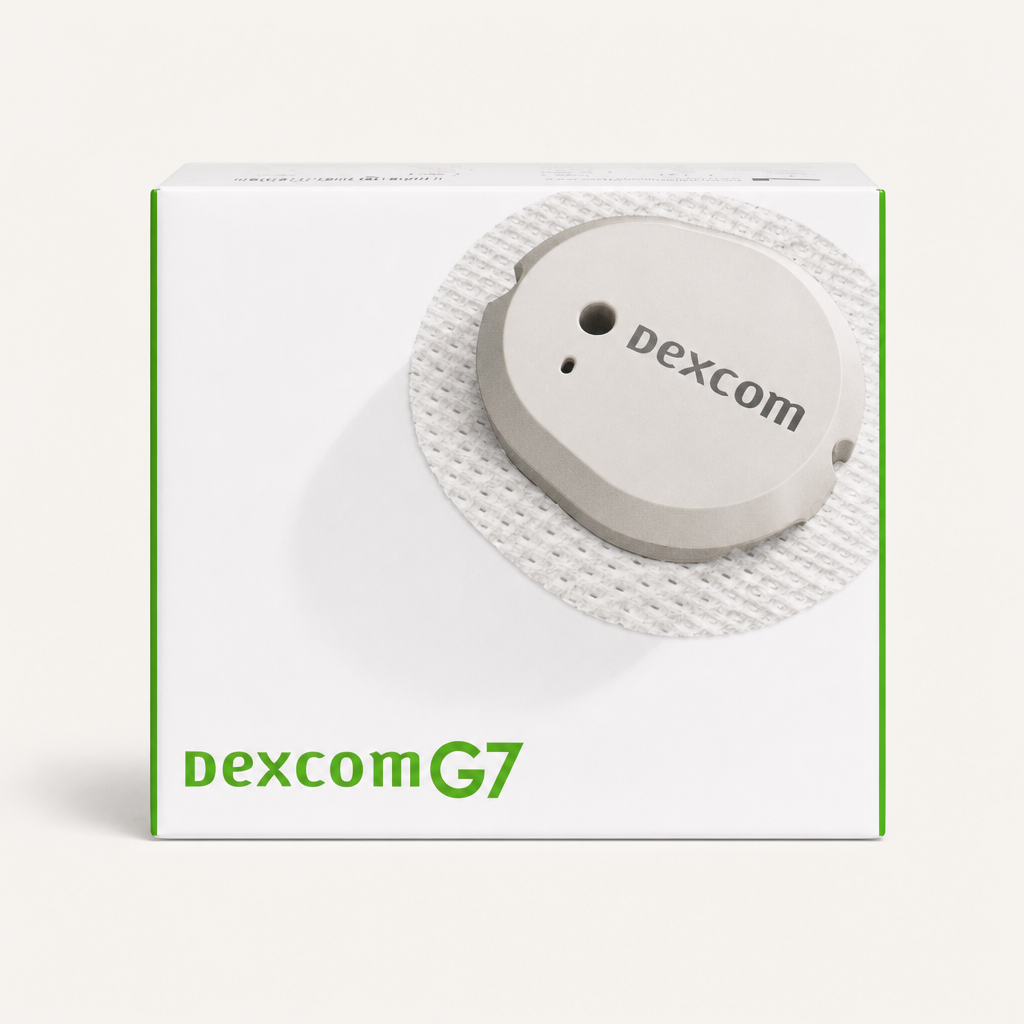
How It Works
The Dexcom G7 Sensor works differently from traditional meters that use a blood sample from the fingertip to monitor glucose levels. The G7 measures glucose in the interstitial fluid surrounding your body’s cells.
The sensor’s built-in transmitter sends your glucose value via Bluetooth to the display device you’ve chosen. The Dexcom G7 sensor warms up quickly and can be fully operational within 30 minutes of being switched on.
| Quick Facts | |
|---|---|
| Common Brands | Dexcom G7 |
| Drug Class | Continuous glucose monitoring (CGM) system |
| Generic Status | No generic version available |
| Availability | Prescription only |
Dosing
Since Dexcom G7 owners wear their sensor at all times, traditional dosing protocols do not apply.
- Sensor lifespan: The Dexcom G7 sensor is disposable. It is designed to be worn continuously for up to 10 days.
- Grace period: One unique feature of the G7 is its 12-hour grace period. Even after the sensor expires and needs to be replaced, it will continue to collect and transmit data for up to 12 hours. This gives flexibility to swap out the old sensor for a new one at a convenient time, rather than the exact moment of expiration.
- Application site: Standard guidelines suggest placing the sensor at the back of your upper arm. Talk to your doctor if this application site isn’t working.
- Warm-up period: The G7’s 30-minute warm-up period begins as soon as you apply the sensor.
Note: Dosing information below is educational only. Your prescribing physician will determine your specific dose based on your individual health needs. Always follow your healthcare provider’s instructions for exact usage.
Uses
FDA-Approved Uses
The Dexcom G7 is FDA-approved for monitoring glucose levels in people with type 1 or type 2 diabetes, and for monitoring glucose for people with gestational diabetes.
The sensor is intended to replace fingerstick glucose testing for diabetes treatment decisions, but manual tests may still be recommended if the patient’s symptoms do not match their sensor readings.
Off-Label Uses
You may see the Dexcom G7 Sensor prescribed for uses that are not “FDA-approved.” This is a very common and legal practice called “off-label” prescribing, where a doctor uses their clinical judgment to prescribe a drug for a different (but well-researched) purpose.
Common off-label uses for the Dexcom G7 sensor currently found in clinical research and practice include:
- Metabolic health optimization: Some providers prescribe continuous glucose monitoring (CGM) systems like Dexcom G7 to patients with prediabetes or metabolic syndrome who want to see how specific foods impact their insulin response, even if they do not yet require insulin.
- Athletic performance: Elite athletes sometimes use CGMs off-label to optimize fueling strategies during endurance training and recovery.
- Polycystic ovary syndrome (PCOS) management: Some specialists use CGM data to help people with PCOS manage insulin resistance through dietary adjustments.
Side Effects
The Dexcom G7 is considered a non-invasive device. However, wearing the sensor may lead to minor localized issues.
Common Side Effects
Common side effects from using the Dexcom G7 sensor include:
- Redness, itching, or a mild rash at the application site where the sensor’s adhesive touches the skin
- Brief pressure or pinch when the microneedle is inserted
- Sticky adhesive residue buildup left on the skin after the sensor is removed
Serious Side Effects
Serious side effects are rare, but it’s important to know what to look for if they do occur. Serious side effects that can occur from using the Dexcom G7 sensor include:
- Infection at site: If skin is not cleaned properly prior to applying the sensor, a localized infection with warmth, swelling, and pus can occur.
- Severe allergic reaction: A reaction to the sensor’s medical-grade adhesive may result in blistering or intense dermatitis.
- Sensor failure or inaccuracy: While extremely rare, the sensor may provide a false reading, such as reporting low blood sugar when levels are normal. This can lead to inappropriate treatment if the inaccuracy goes unnoticed.
Call your doctor immediately if you experience any concerning or prolonged symptoms.
Pharmacist Tips
The Overpatch Is Essential
Each G7 sensor comes with a clear adhesive overpatch. Providers typically recommend applying the overpatch immediately after the sensor to ensure the unit remains securely in place for up to 10 days. This is especially crucial if you swim or exercise frequently.
Rotation Is Key
To minimize the risk of skin breakdown or thickening of tissue (lipohypertrophy), it is recommended to move the sensor to a different site on the arm with each new application.
Take Caution With Acetaminophen
The G7 is more resistant to drug interactions than older glucose meters, but taking more than the maximum acetaminophen dose of 1,000 mg every 6 hours can cause sensor readings to appear artificially high.
Stay Hydrated
Since the sensor uses interstitial fluid to measure glucose, being dehydrated can lead to inaccurate readings.
Avoid Compressing The Sensor
Sitting or lying with the sensor pressed against a hard surface, or sleeping directly on it, can cause the device to beep and issue false warnings about low glucose levels.
Drug Interactions
The Dexcom G7 sensor uses an electrochemical sensor to measure glucose levels. Certain medications and substances can interact with the sensor and affect the accuracy of glucose readings. These include:
- Hydroxyurea: Hydroxyurea can interfere with the Dexcom G7’s electrochemical sensing system, causing the sensor to overestimate glucose levels. This may result in glucose readings that are higher than your actual blood sugar level.
- Acetaminophen (Tylenol): Very high levels of acetaminophen can interfere with the chemical reactions the Dexcom G7 uses to measure glucose. This may cause the sensor to report glucose readings that are higher than your actual blood sugar level.
- Certain topical products: It is advised to avoid applying sunscreen, insect repellent, or heavy lotions directly on the sensor or surrounding skin prior to applying the G7. These substances can degrade the plastic and interfere with the adhesive.
Always give your doctor and pharmacist a complete list of all your medications, vitamins, and supplements to check for potential interactions.
FAQs
Why does my Dexcom G7 sensor constantly beep at me when my blood sugar is perfectly fine?
The Dexcom G7 beeping when your blood sugar is normal is known as a “compression low,” and can occur when you lie directly on the sensor. You can also check the device’s alert settings, as the unit may be alerting you to “Rapid Rise” or “Rapid Fall” instead of a specific glucose reading.
What is the difference between the Dexcom G6 system and the G7 model?
The G7 is 60% smaller than the G6, has a much shorter warm-up time of 30 minutes (as opposed to 2 hours), and combines the sensor and transmitter into a single piece of hardware. It also includes the 12-hour grace period for replacing expired units, which the G6 did not allow.
How does the new 12-hour “grace period” work at the end of the 10-day sensor life?
The G7 does not automatically stop working after operating for 10 days, but continues to collect data for up to 12 hours after expiring. This allows you to finish your workday or sleep through the night before replacing the sensor with a new unit.
Can I place the Dexcom G7 sensor on my stomach or thigh?
Although many patients wore the G6 on their abdomen, the G7 is FDA-approved for wear on the back of the upper arm. Using the sensor on other application sites is considered off-label usage.
What should I do if the sensor starts bleeding after I push the button?
If your Dexcom G7 sensor starts bleeding after you push the button, it is advised to make sure the blood does not reach the sensor-transmitter housing. If blood compromises the unit’s hardware, it is recommended to remove the sensor, apply pressure to stop the bleeding, and replace the unit with a new model.
Why do I need to apply the clear “overpatch” that comes in the box?
The adhesive overpatch holds the Dexcom G7 sensor in place for the intended 10-day duration. Without the overpatch, the unit is more likely to be jostled and fall off your arm.
Is it normal for the first 24 hours of blood sugar readings to be inaccurate or jumpy compared to my finger-pricks?
Yes, inaccurate or jumpy readings during the first 24 hours of using the Dexcom G7 sensor are normal. Your body needs time to adapt to the foreign object, so your immune system’s localized response may be affecting the glucose reading. If readings are still inaccurate after 24 hours, try using the “Calibrate’ feature in the companion app.
Can I take acetaminophen without it artificially spiking my glucose readings?
Standard acetaminophen dosage is considered safe while using the Dexcom G7 sensor, but exceeding the maximum recommended dosage of 1,000 mg every 6 hours can lead to inaccurate glucose readings.
Do I still need to prick my finger with a traditional blood meter to calibrate this device?
No, standard guidelines state patients do not need to prick their finger with a traditional glucose meter to calibrate the Dexcom G7. The sensor is designed to operate without any daily finger pricks or calibration. However, your provider may recommend continuing the fingerstick meter if your G7 readings do not line up with your symptoms.
How can I get through TSA airport security scanners without destroying the sensor?
Dexcom suggests notifying airport security that you are wearing a continuous glucose monitoring (CGM) device. You may pass through metal detectors and body scanners, but the unit has not been tested with all airport security systems. You may ask for a visual inspection or pat-down to avoid sending the sensor through an X-ray and risking radiation interference.
Will sitting in a hot tub or sauna damage the sensor or melt the adhesive?
The Dexcom G7 is waterproof up to 8 feet for up to 24 hours and designed to withstand sauna temperatures. However, extreme heat and moisture can weaken or melt the adhesive, causing the overpatch to peel off.
Can I use this sensor to track my blood sugar if I am pregnant and have gestational diabetes?
Yes, the Dexcom G7 sensor is FDA-approved for monitoring all types of diabetes, including gestational diabetes.
Comparable Medications
Dexcom G7 Sensor, Dexcom G6 Sensor, FreeStyle Libre 3, or Eversense E3?
The Dexcom G7 sensor is a non-invasive continuous glucose monitor (CGM) that receives and transmits data in real time to help you continuously monitor your blood sugar. Alternatives to the Dexcom G7 sensor include:
Dexcom G6 Sensor
From $479.99
The Dexcom G6 was a modular glucose tracker with a separate monitor and transmitter. The G7 streamlines this design by combining the monitor and transmitter into a single piece of hardware. Other differences include a faster warm-up time for the G7 and the new grace period to ensure up to 12 hours of data tracking after the device has reached the end of its 10-day lifespan.
FreeStyle Libre 3 CGM Sensor
From $119.99
The Libre 3 is currently the smallest glucose tracking device on the market, roughly measuring the size of a penny. Both devices provide real-time data tracking, but the Dexcom G7 can be integrated to a wider range of insulin pump brands.
Eversense E3
The Eversense E3 is a CGM system implanted in the skin that operates for up to 6 months. Although you won't need to replace the E3 as often as the 10-day Dexcom G7, each new monitor requires a minor reimplantation surgical procedure on top of wearing the unit daily for continuous monitoring. For some people, the more frequent replacement schedule of the G7 may be less of a hassle than scheduling minor surgery twice a year to wear the Eversense E3.
We Have the Dexcom G7 Sensor in Stock. Get Yours Today!
Important: Information on this page is for educational purposes only. Prescribing decisions are made by independent, licensed providers. TelyRx operates technology-enabled pharmacies and a telehealth platform that connects patients with licensed providers. Prescriptions, when provider-approved and issued, are filled and shipped by TelyRx-affiliated pharmacies. We do not employ physicians or make prescribing decisions. Learn more about our editorial standards here.