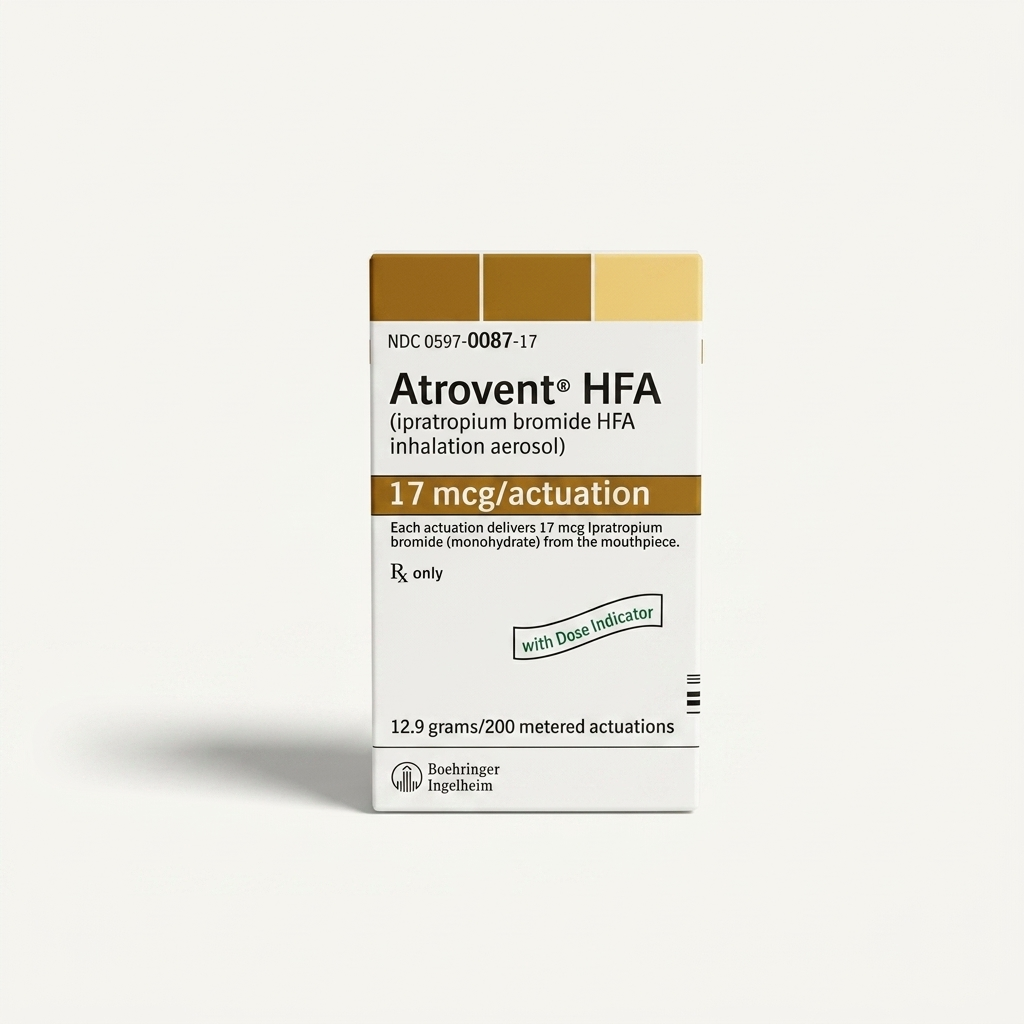
How It Works
Your body uses a chemical messenger called acetylcholine to tell the muscles around your airways to contract. Atrovent HFA helps your lungs by:
- Blocking the signal: When you inhale the medication, it travels into your airways and blocks acetylcholine from attaching to the muscles.
- Relaxing the muscles: By blocking this signal, the medication prevents the muscles from constricting the airways.
- Opening the path: As the muscles relax, the airways widen, making it easier for air to move in and out of your lungs.
By providing this steady, relaxing effect, Atrovent HFA reduces the overall work your body has to do to breathe, helping you feel more comfortable during both rest and activity.
| Quick Facts | |
|---|---|
| Common Brands | Atrovent HFA |
| Drug Class | Anticholinergic bronchodilator (SAMA – short-acting muscarinic antagonist) |
| Generic Status | Generic version available |
| Availability | Prescription only |
Dosing
Atrovent HFA is designed for a consistent daily schedule. Because it is a maintenance medication, missing doses can cause your breathing symptoms to return or worsen.
- Standard daily dose: Providers typically recommend 2 inhalations (puffs) taken 4 times a day.
- Maximum daily limit: Standard guidelines recommend not exceeding 12 inhalations in any 24-hour period.
- Wait between puffs: If you are taking two puffs, wait at least 15 seconds between the first and second inhalation.
- No shaking required: Unlike many other spray inhalers, Atrovent HFA does not need to be shaken before use.
- Hold your breath: After inhaling a puff, providers generally advise holding your breath for up to 10 seconds. This gives the medication enough time to settle deep into the lung tissues.
- Missed doses: If you miss a dose, it is generally accepted to take it as soon as you remember. However, if it is almost time for your next dose, skip the missed one and stay on your regular schedule. Standard guidelines advise against taking double doses.
Note: Dosing information below is educational only. Your prescribing physician will determine your specific dose based on your individual health needs. Always follow your healthcare provider’s instructions for exact dosing.
Uses
FDA-Approved Uses
The FDA approves Atrovent HFA for the long-term treatment of bronchospasm associated with chronic obstructive pulmonary disease (COPD), including chronic bronchitis and emphysema.
Off-Label Uses
You may see Atrovent HFA prescribed for uses that are not FDA-approved. This is a common and legal practice called off-label prescribing, where a doctor uses their clinical judgment to prescribe a drug for a different (but well-researched) purpose.
Atrovent HFA may be prescribed off-label for the following conditions:
- Asthma flare-ups: While not approved for daily asthma maintenance, some specialists use Atrovent HFA alongside albuterol during a moderate-to-severe asthma attack to provide additional bronchodilation.
- Post-viral cough: It is occasionally used to help settle a lingering cough after a severe respiratory infection.
- Common cold symptoms: In some cases, it may be used to reduce excessive mucus production during a cold or viral infection.
Side Effects
Most people tolerate Atrovent HFA well, but because the medication affects nervous system signals in the lungs, some local and systemic effects can occur.
Common Side Effects
- Dry mouth
- Mild cough or throat irritation
- Headache
- Nausea
- Dizziness
- Back pain
Serious Side Effects
Serious side effects are rare, but it’s important to know what to look for if they do occur.
It’s generally accepted that you stop taking the medication and immediately call the doctor if you experience any of the following symptoms:
- Paradoxical bronchospasm: A rare but dangerous reaction in which breathing suddenly worsens immediately after using the inhaler. It is generally advised to seek emergency help if this happens.
- Eye problems: If the spray gets into your eyes, it can cause sudden blurred vision, eye pain, or halos around lights. People with glaucoma are at higher risk.
- Urinary retention: Difficulty passing urine or a painful, full bladder. This is more common in men with an enlarged prostate.
- Severe allergic reactions: Standard guidelines typically advise seeking help for hives, swelling of the face or tongue, or severe difficulty breathing.
Call your doctor immediately if you experience any concerning or prolonged symptoms.
Pharmacist Tips
Priming Is Key
If your inhaler is new or hasn’t been used in more than 3 days, it is generally recommended to prime it by spraying it twice into the air (away from your face) before your first dose.
Keep It Clean
At least once a week, remove the metal canister and rinse the plastic mouthpiece with warm running water for 30 seconds. Let it air dry before putting the canister back in. This helps prevent buildup that can block the medicine from dispensing.
Watch the Counter
Atrovent HFA has a built-in dose counter. When the counter reaches 20 (indicated in red), it is time to get a refill. It is generally advised to throw the inhaler away when the counter reaches 0, even if it still feels like there is liquid inside.
Protect Your Eyes
Providers generally advise being careful not to let the mist get into your eyes. If you use a face mask with a nebulizer form of this drug, standard guidelines typically recommend that it fit tightly.
Room Temperature Storage
It is generally accepted to keep your inhaler in a dry, room-temperature place. It is best not to leave it in a car, as extreme heat can cause the canister to burst.
Don’t Skip Doses
Maintenance medications only work if they stay at a steady level in your system. Even if you feel like you are breathing fine, continue to use the inhaler as prescribed.
Drug Interactions
Atrovent HFA has relatively few interactions with pills you swallow, but it can interact with other inhaled or specialized medications.
Let your doctor know if you take:
- Other anticholinergics: Taking other medications in the same class (like Spiriva or certain over-the-counter allergy medicines) can increase the risk of dry mouth, constipation, and blurred vision.
- Beta-blockers. Some blood pressure medications can constrict the airways, potentially counteracting the effects of Atrovent HFA.
- Glaucoma medications: If you are being treated for narrow-angle glaucoma, Atrovent HFA may interact with your eye drops or worsen your eye pressure.
Always give your doctor and pharmacist a complete list of all your medications, vitamins, and supplements to check for potential interactions.
FAQs
How many times a day should Atrovent HFA be administered for COPD maintenance?
The standard maintenance schedule is 2 puffs taken 4 times a day. This ensures the airway-relaxing effect is present around the clock.
Can Atrovent HFA be used as a rescue inhaler during sudden shortness of breath?
No. Atrovent HFA takes about 15 to 30 minutes to start working and up to 2 hours to reach its full effect. In a breathing emergency, use a fast-acting rescue inhaler, such as albuterol.
Does Atrovent HFA contain an inhaled steroid?
No. It is only a bronchodilator (muscle relaxer). It does not contain an inhaled corticosteroid.
Is shaking required before administering a dose of Atrovent HFA?
No. Unlike many other inhalers, Atrovent HFA does not need to be shaken. Standard guidelines generally recommend simply removing the cap, and it is ready to use.
How does Atrovent HFA affect patients diagnosed with narrow-angle glaucoma?
If the medication accidentally gets into the eyes, it can increase eye pressure and potentially trigger an acute glaucoma attack. It is generally accepted that you should always point the inhaler directly into your mouth.
How should the Atrovent HFA mouthpiece be cleaned to prevent medication buildup?
Remove the canister and rinse the plastic mouthpiece under warm running water for 30 seconds once a week. Shake off excess water and let it air-dry to prevent the clogging.
Is Atrovent HFA approved by the FDA for the maintenance and treatment of asthma?
No, it is only FDA-approved for COPD. However, doctors may prescribe it off-label for asthma, especially for patients who do not tolerate other types of bronchodilators well.
Can a patient attach a spacer chamber to the Atrovent HFA inhaler?
Yes. If you find it difficult to coordinate pressing the canister while breathing in, a spacer device can help hold the mist so you can inhale it more easily.
How long does Atrovent HFA take to open the airways compared to albuterol?
Albuterol is much faster, often working within 5 minutes. Atrovent HFA begins working more slowly, taking about 15 minutes, but its effects often last longer than those of albuterol.
Does Atrovent HFA cause heart palpitations?
It is much less likely to cause a racing heart than albuterol. Because it acts on a different chemical pathway, it typically does not cause the jittery or racing-heart side effects associated with many other bronchodilators.
Comparable Medications
Albuterol, Spiriva, Combivent, or Flovent?
Here are the potential alternatives to Atrovent HFA:
Albuterol HFA (Generic Ventolin)
From $59.99
Albuterol is a rescue medicine that works fast but wears off quickly. Atrovent HFA is a maintenance medicine that starts slower but provides steady airway relaxation. Many patients use both.
Spiriva
Spiriva is an anticholinergic bronchodilator. However, Spiriva is long-acting and requires only one dose every 24 hours. Atrovent HFA is short-acting and requires dosing 4 times a day.
Combivent Respimat
From $699.99
Combivent contains the active ingredient of Atrovent plus albuterol in one device. It is often the next step for patients who need more help than Atrovent HFA alone can provide.
Flovent HFA
Flovent is an inhaled steroid that reduces inflammation. Atrovent HFA works by relaxing airway smooth muscle. They treat two different physical problems and are frequently used together for comprehensive COPD care.
We Have Atrovent HFA in Stock. Get Yours Today!
Important: Information on this page is for educational purposes only. Prescribing decisions are made by independent, licensed providers. TelyRx operates technology-enabled pharmacies and a telehealth platform that connects patients with licensed providers. Prescriptions, when provider-approved and issued, are filled and shipped by TelyRx-affiliated pharmacies. We do not employ physicians or make prescribing decisions. Learn more about our editorial standards here.